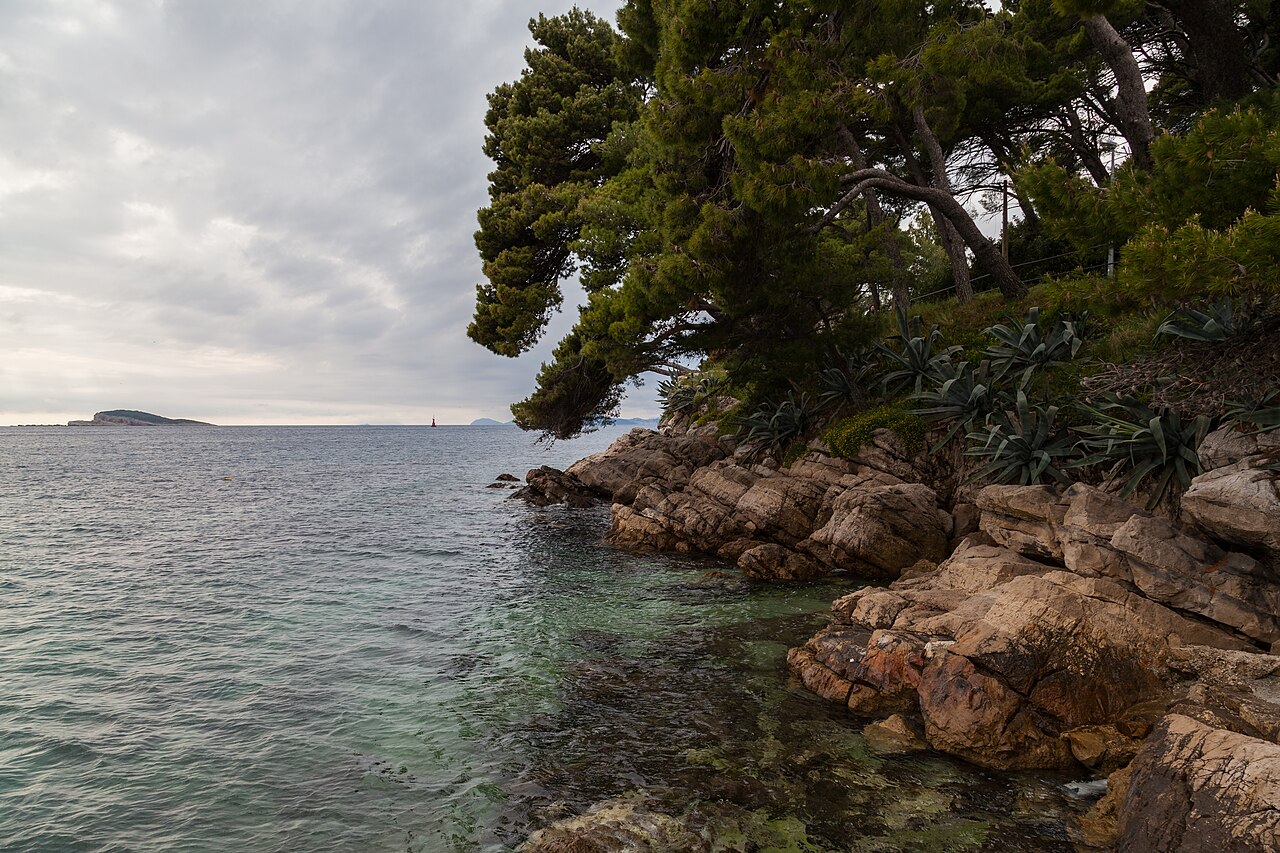
Cavtat is where Dubrovnik began, and it is the best easy half-day out of the city. Ancient Epidaurum, a Greek and then Roman town, stood here, and when it was destroyed in the early Middle Ages its refugees are said to have founded the settlement that became Dubrovnik. Today Cavtat is a small, prosperous harbour town set on two pine-covered peninsulas, with a palm-lined waterfront, stone houses climbing the slope and a ring of walking paths around the headlands that pass coves where you can swim off the rocks. The sights are modest but genuinely good. The Bukovac House is the birthplace of Vlaho Bukovac, one of the founders of modern Croatian painting; it reopened in 2004 after reconstruction, and shows about thirty of his paintings, wall paintings he made as a young man before leaving for Paris, and his furniture and personal belongings, and it is open all year. On the hilltop above the town, the cemetery of St Rocco holds the Račić family mausoleum, built in 1921 of white Brač stone with a cupola and bronze details, with a bell designed by Ivan Meštrović; the views from there over both bays are lovely. The Rector's Palace on the waterfront houses the Baltazar Bogišić Collection, run by the Croatian Academy of Sciences and Arts, with graphics, coins, manuscripts and books, though only part of it is currently on display. The Franciscan monastery of Our Lady of the Snow, founded in 1484, holds paintings including a work by Bukovac.
Getting there is part of the fun. In the warmer months, small boats run along the coast from the old harbour in Dubrovnik to Cavtat, which is the most scenic way to arrive. Year-round, the local bus from the main bus station and the stop above the Old Town takes around half an hour. Cavtat is also close to Dubrovnik Airport, so it works as a first or last afternoon, or as a quieter base for the whole trip. Once there, walk the waterfront, climb to the cemetery and mausoleum, swim from one of the rocky coves around the peninsulas, and finish with seafood on the harbour.
Plan around the season. In summer the waterfront fills with day-trippers and the boats run frequently; in winter the town is very quiet, some restaurants close, and the boats may not run, but the walks are lovely and the Bukovac House is open all year. Opening hours for the smaller museums vary, so check before you build your day around them. The Konavle valley inland, with its vineyards, watermills on the Ljuta river and traditional embroidery, is an easy extension if you have a car.
Who should go: couples who want a relaxed day with a swim and a long lunch, art lovers for the Bukovac House, families who want a calm waterfront and easy walks, and travellers looking for a quieter base near the airport. It is not a must for a two-day visit, but on a longer stay it is the best antidote to the summer crowds of the Old Town.
What to expect
The experience
A free wander around a small harbour town with a waterfront promenade, coastal paths, swimming coves and a few small museums and galleries.
Best time
Late spring and early autumn. In summer go early or late; in winter the town is quiet and some places close.
How long
A half day, or a full day with a swim and long lunch.
Tips
Take the coastal boat from the old harbour in season, or the local bus year-round. Climb to the Račić mausoleum for the view. Check museum hours before you go.
Quick picks
- Best for
- A relaxed half-day with a swim, a walk and seafood by the harbour.
- Families
- Calm waterfront, easy paths and gentle swims make it simple with children.
- Couples
- Arrive by boat, walk the headland at sunset and eat on the harbour.
- Pair with
- The Konavle valley inland, or a last afternoon before a flight from the nearby airport.
- Time needed
- A half day.
Good questions
How do I get from Dubrovnik to Cavtat?+
By coastal boat from the old harbour in the warmer months, or by local bus all year. The bus takes around half an hour.
Is Cavtat worth visiting?+
Yes, especially on a stay of three days or more. It is calm, pretty and good for swimming, with a few small but rewarding sights.
What is there to see in Cavtat?+
The waterfront and coastal paths, the Bukovac House, the Račić mausoleum on the hilltop cemetery, the Bogišić Collection and the Franciscan monastery.
Is Cavtat a good base instead of Dubrovnik?+
For a quieter stay close to the airport, yes. You trade Old Town atmosphere for a calmer waterfront and easy beaches.
Is Cavtat open in winter?+
The town is lived in all year and the Bukovac House stays open, but some restaurants close and the boats may not run.