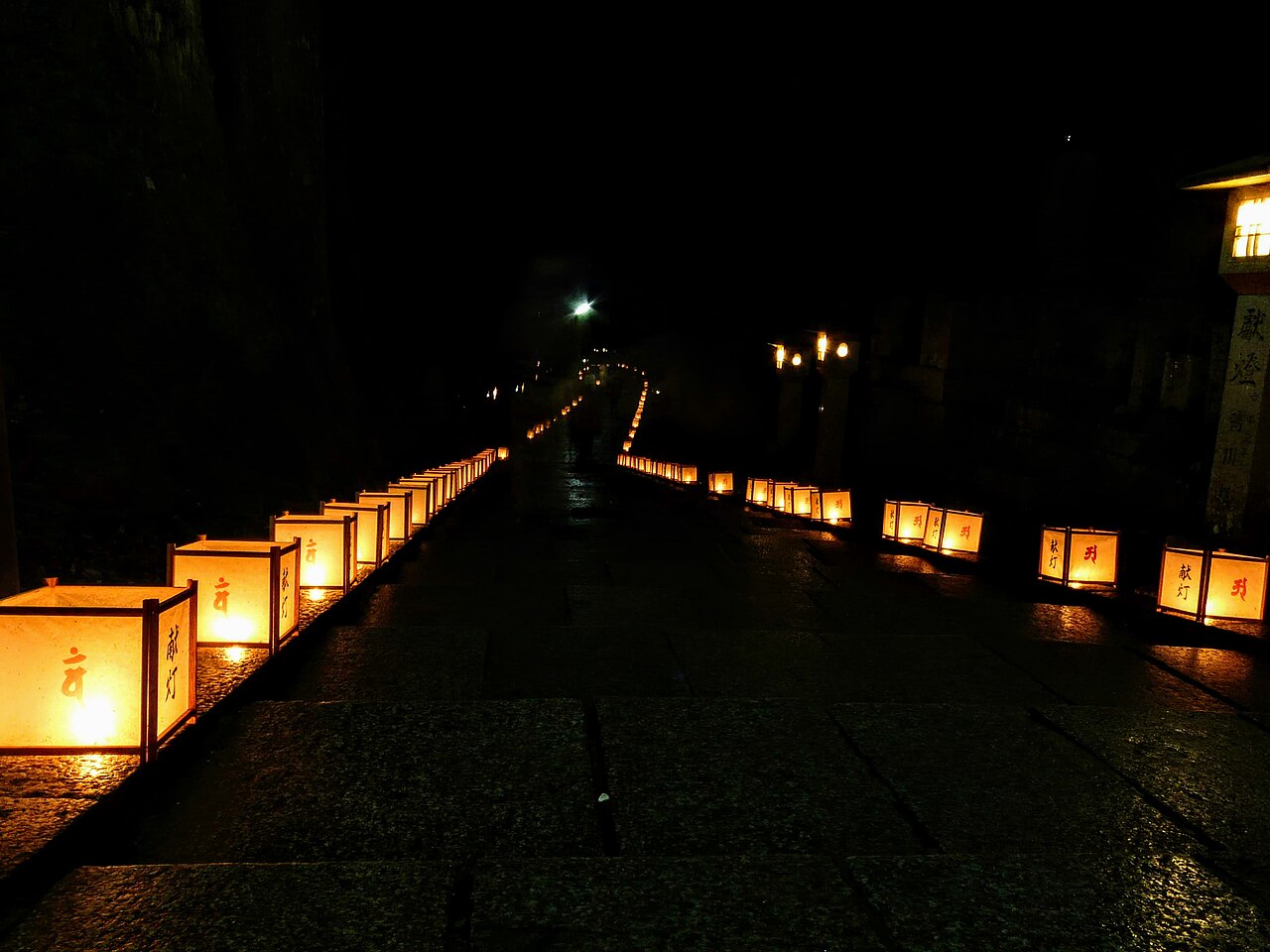
Koyasan is the one trip from Osaka that feels like leaving the modern world entirely. In 816 the monk Kobo Daishi, also known as Kukai, chose a high basin ringed by eight peaks in the mountains of northern Wakayama as the center of Shingon esoteric Buddhism, and the town that grew around his monastery is still, twelve centuries later, a working religious community: monks in robes walk to morning services, the air is cool and smells of cedar and incense, and the main street is lined with temples rather than shops. Together with the pilgrimage routes of the Kii Peninsula it is part of a UNESCO World Heritage Site. Three places define a first visit. Okunoin is the great cemetery that leads to Kobo Daishi's mausoleum, a path of roughly two kilometers through ancient cedars lined with moss-covered gravestones, memorials and stone lanterns, from feudal lords to modern companies; at the end, the Torodo lantern hall glows with thousands of lamps, and beyond it lies the mausoleum where believers hold that the master remains in eternal meditation. The Danjo Garan is the sacred central complex, dominated by the vermilion Konpon Daito, the Great Pagoda, whose interior is a three-dimensional mandala of painted pillars and golden Buddhas. Kongobuji, the head temple of the Shingon sect, is a designated National Treasure with painted sliding doors and the Banryutei rock garden, one of the largest in Japan. A combination ticket covers the main paid halls, and the tourist information center rents English audio guides. The town is small and walkable, with local buses linking the cable car station to the center and Okunoin.
Getting there is part of the experience. Nankai trains leave from Namba, climbing out of the suburbs and up a narrow, winding valley to Gokurakubashi, where a steep cable car lifts you onto the plateau; from Koyasan Station, local buses run into town. The Limited Express Koya, with reserved seats, is the comfortable choice, and the Nankai discount tickets for Koyasan, which bundle rail, cable car and bus travel and sometimes discounts at temples, usually beat buying fares separately. Allow around two hours each way from Namba, and leave early: a day trip gives you about five or six hours on the mountain, enough for Okunoin, the Garan and Kongobuji at a steady pace. The cable car occasionally stops for maintenance, when replacement buses run from Hashimoto, so check Nankai notices before you travel.
Stay overnight if you possibly can. Around fifty temples operate as shukubo, temple lodgings, where you sleep on futons in tatami rooms, eat shojin ryori, the vegetarian Buddhist cuisine of tofu, sesame, mountain vegetables and seasonal dishes, and are invited to the dawn service of chanting, and often a fire ritual, before breakfast. Many temples now take online bookings and are used to foreign guests; rooms range from simple to rather grand, and some have private baths, though shared bathing is common. Okunoin after dark is unforgettable, and several groups run evening walks in English. Temple stays are not cheap, but they include dinner and breakfast and are the most memorable night many visitors spend in Japan.
Practical notes. Koyasan sits around eight hundred meters up and is noticeably colder than Osaka: bring a warm layer even in summer evenings, and expect snow and ice in winter. Autumn leaves, usually in late October and early November, and the fresh green of late spring are the most beautiful seasons, and weekends in autumn are busy. Shoes come off inside temple halls, photography is restricted in many interiors, and Okunoin's inner sanctuary near the mausoleum is a no-photo, quiet zone. Shops close early, so do not count on a late lunch. This is a contemplative place rather than a sightseeing checklist, and it rewards slowing down.
What to expect
The experience
A day or overnight trip by Nankai train and cable car to a mountaintop temple town, with walks through the Okunoin cemetery, the Danjo Garan complex and Kongobuji head temple.
Best time
Late October to early November for autumn color, or late spring for fresh green. Leave Namba early for a day trip.
How long
Around two hours each way, plus five or six hours on the mountain. An overnight temple stay is far better.
Tips
Buy a Nankai Koyasan discount ticket. Bring a warm layer. Use the combination ticket for the paid halls, and walk Okunoin both by day and, if you stay, after dark.
Quick picks
- Best for
- Travelers who want the spiritual heart of Japanese Buddhism, and a night in a temple.
- Families
- Older children enjoy the cable car, the giant cedars and the temple stay; the walking suits ages eight and up.
- Couples
- A temple stay with vegetarian dinner and dawn chanting is a once-in-a-lifetime night.
- Pair with
- Shitennoji and Sumiyoshi Taisha in Osaka for more of Japan's early religious history.
- Time needed
- A long day, or better, one night.
Good questions
Can you visit Mount Koya as a day trip from Osaka?+
Yes. Nankai trains from Namba plus the cable car take around two hours each way, leaving five or six hours for Okunoin, the Danjo Garan and Kongobuji. An overnight temple stay is more relaxed and more memorable.
What is a shukubo?+
A temple lodging. Around fifty temples on Koyasan take guests, with tatami rooms, a vegetarian shojin ryori dinner and breakfast, and an invitation to the morning service.
Which ticket should I buy?+
Nankai sells discount tickets for Koyasan that bundle the round-trip train, cable car and local buses. They usually cost less than separate fares. Check current options at Namba Station.
Is the Japan Rail Pass valid to Koyasan?+
No. The route uses the private Nankai Railway and its cable car, so JR passes do not apply.
What should I wear?+
Comfortable shoes you can slip off at temples, and warm layers. Koyasan is around eight hundred meters up and much colder than Osaka, especially in the mornings and evenings.