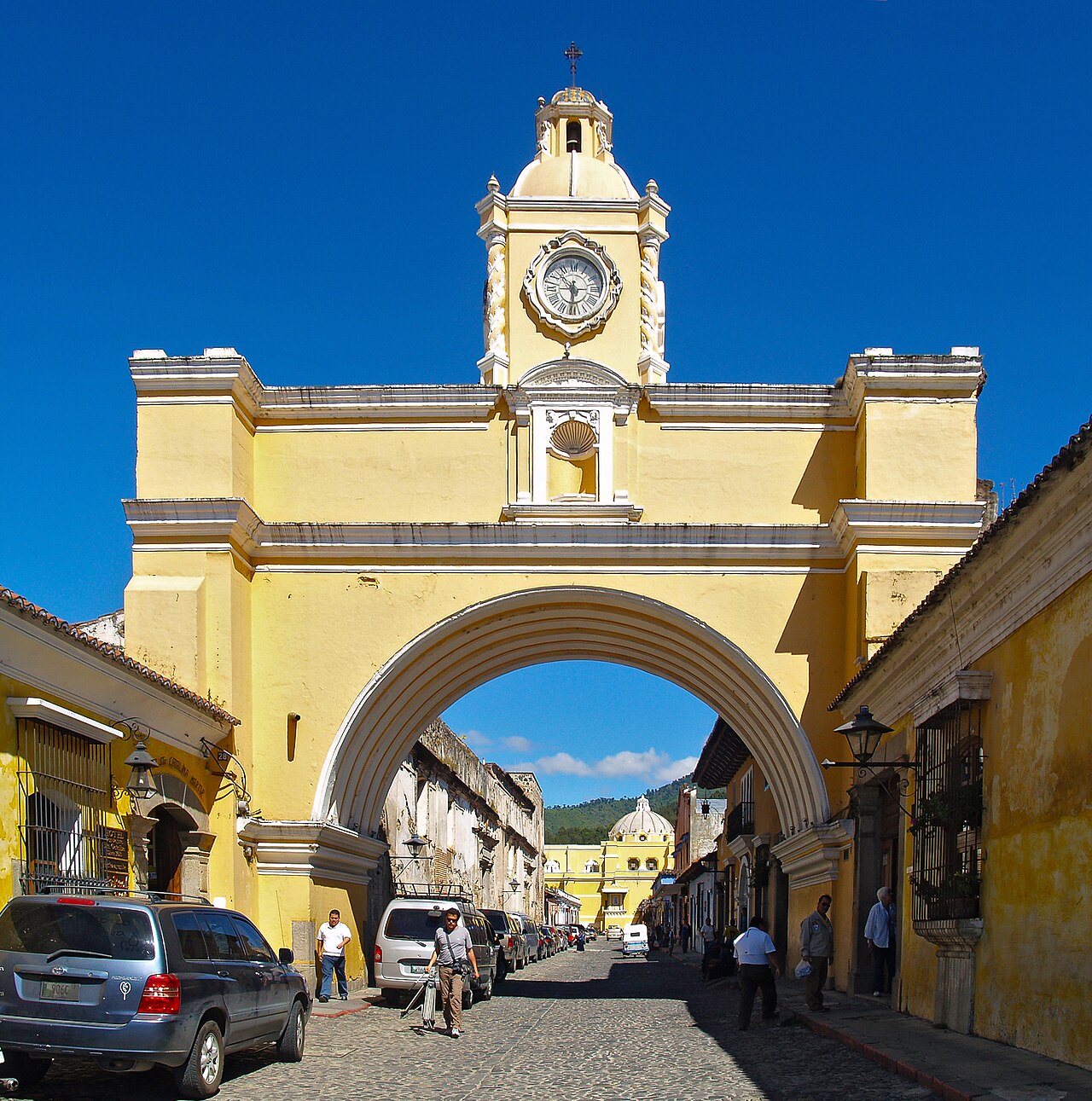
The Arco de Santa Catalina is the image most visitors carry home from Antigua: a bright yellow arch spanning 5th Avenue North, topped with a small clock tower, with the cone of Volcán de Agua rising behind it on clear days. It dates to the 17th century, with a commonly cited date of 1693, and it was built so that the cloistered nuns of the Santa Catalina convent could cross the street to the school on the other side without going outside. A clock was added in the 1830s, and the arch was restored in 2017. It is part of the Antigua Guatemala UNESCO World Heritage Site, designated in 1979. You can walk through it, photograph it, and stand on the cobbles for the classic view, and it costs nothing. Shops and cafes line the street, so it works as a natural meeting point and a break between sights. Because it is among the most photographed places in Guatemala, crowds gather at the best angles, so timing matters.
The best time to go: early morning, around sunrise or soon after, when the light is soft, the street is nearly empty and the volcano is usually visible. Later in the day the street fills with photographers, vendors and groups, and cloud often hides the volcano by afternoon. Stand a few blocks back along 5th Avenue North for a longer lens view, and move closer for details of the clock and the yellow paint.
Around the arch: the street is lined with cafes, chocolate shops and restaurants, and a short walk leads to the Iglesia de la Merced, the Capuchinas convent and the Central Park. Most walking tours pass it, including the small-group tour linked in this guide. It is an easy stop to build into a morning that starts with coffee and ends at the museums of Casa Santo Domingo.
Practical notes: the arch is on a public street and free to see, so no ticket is needed. The cobbles are uneven, so mind your footing, and traffic is light but present. Keep an eye on bags in crowds. For a different view of the city and the arch, climb to Cerro de la Cruz in daylight, or look for rooftop terraces that frame the volcano. If you are visiting during Holy Week or major festivals, expect the area to be extremely busy and some streets closed for processions. In short, it is a quick but unmissable stop that rewards a little planning around the light.
What to expect
The experience
A free, self-guided stop on 5th Avenue North: walk through the arch, photograph it with Volcán de Agua behind it and browse the cafes nearby.
Best time
Early morning for soft light, empty streets and the clearest chance of seeing the volcano.
How long
Fifteen to thirty minutes, longer if you stop for coffee.
Tips
Arrive early, step back along the avenue for a longer view and watch your footing on the cobbles.
Quick picks
- Best for
- Every first-time visitor; it is the symbol of the city and costs nothing.
- Families
- Easy and short; children enjoy the clock and the colour, but hold hands near the street.
- Couples
- A sunrise photo and a coffee at a nearby cafe is a simple highlight.
- Pair with
- The Merced church, the Capuchinas convent and the walking tour.
- Time needed
- Under half an hour.
Good questions
Why was the arch built?+
It linked the Santa Catalina convent to a school across the street, so cloistered nuns could cross without going out into the street. It dates to the 17th century.
Does it cost anything to visit?+
No, the arch spans a public street and is free to see at any time. There are cafes and shops nearby if you want to linger.
When is the best time to photograph it?+
Early in the morning, when the street is quiet and the volcano is most likely visible. Afternoon cloud and crowds make it harder.
Can you see the volcano from it?+
On clear days Volcán de Agua rises behind the arch to the south. Cloud often builds later in the day.
Is it part of a World Heritage Site?+
Yes, it is within the Antigua Guatemala UNESCO World Heritage Site, designated in 1979. The arch was restored in 2017.
