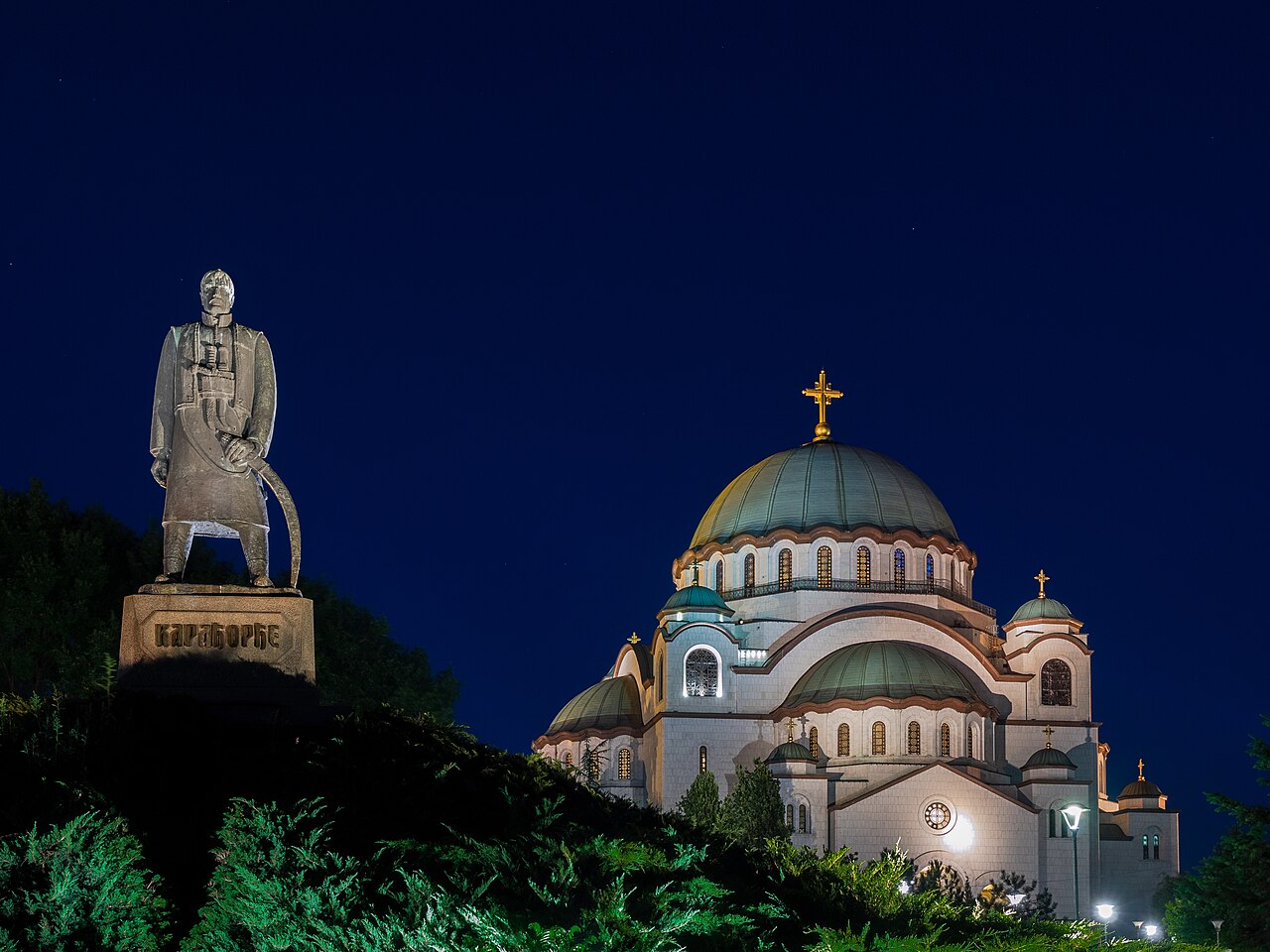
You will see it before you reach it: the white marble bulk and green copper domes of the Temple of Saint Sava dominate the skyline of Belgrade from Vračar hill. It is dedicated to Saint Sava, the founder of the Serbian Orthodox Church and its first archbishop, the most revered of Serbian saints, and it stands on the spot where, according to tradition, the Ottomans burned his remains in the sixteenth century to break the spirit of the Serbs. Construction began in the 1930s and was interrupted for decades by war and the communist years, and the interior was finished only recently. The wait was worth it. Inside, the vast central dome is covered in a gold mosaic of Christ, and the walls and arches glitter with saints and scenes from the Bible; below, the crypt is a jewel box of gold, chandeliers and frescoes. Entry is free, and a visit takes less than an hour.
How to visit: the temple is on Vračar hill at the end of a broad plateau, about fifteen minutes on foot from Slavija square and a short walk from the Nikola Tesla Museum. Entry is free and the church is open daily, though services take precedence; visitors are welcome as long as they are quiet and respectful. Dress modestly, with shoulders and knees covered. The crypt is entered from the side and is well worth finding.
What to see: inside, stand under the main dome and look up at the mosaic of Christ Pantocrator surrounded by angels, then walk the aisles to see the mosaics of saints and Serbian rulers. The scale is astonishing, and the light through the windows changes the gold throughout the day. Downstairs, the crypt is more intimate, with a richly gilded interior and the relics and treasury. Outside, the plateau has a fountain where locals meet, the monument to Karađorđe, who led the First Serbian Uprising, and the National Library of Serbia, which holds the largest book collection in the Balkans.
Making the most of it: visit in the late afternoon, when the sun warms the marble, and stay for the evening when the temple is lit. Combine it with the Tesla Museum and a coffee in one of Vračar’s cafes, a residential district with plenty of local life.
What to expect
The experience
A free, self-guided visit to a working Orthodox church with a gold-mosaic dome and a gilded crypt.
Best time
Late afternoon for warm light on the marble, and evening for the illuminated exterior.
How long
About 45 minutes to an hour, including the crypt.
Tips
Cover shoulders and knees, keep quiet during services, and do not miss the crypt entrance at the side.
Quick picks
- Best for
- Everyone; it is the most impressive interior in Belgrade and free to see.
- Families
- Children are wowed by the size and the gold; keep voices low inside.
- Couples
- An evening visit to see the temple lit up, followed by dinner in Vračar.
- Pair with
- The Nikola Tesla Museum, about fifteen minutes away on foot.
- Time needed
- Under an hour.
Good questions
Is the Temple of Saint Sava free to visit?+
Yes, entry to the church and the crypt is free. Donations and candle purchases are welcome.
What should I wear to the Temple of Saint Sava?+
Cover your shoulders and knees, as in any Orthodox church. Women may cover their hair but are rarely asked to.
Is the crypt worth visiting?+
Yes, the crypt is richly gilded and decorated and feels very different from the vast church above. The entrance is at the side of the building.
Why is the Temple of Saint Sava important?+
It honours Saint Sava, founder of the Serbian Orthodox Church, and stands where tradition says his remains were burned under Ottoman rule. It is one of the largest Orthodox churches in the world.
How do I get to the Temple of Saint Sava?+
It is about fifteen minutes on foot from Slavija square, or a short taxi ride from the old town. The Tesla Museum is nearby.