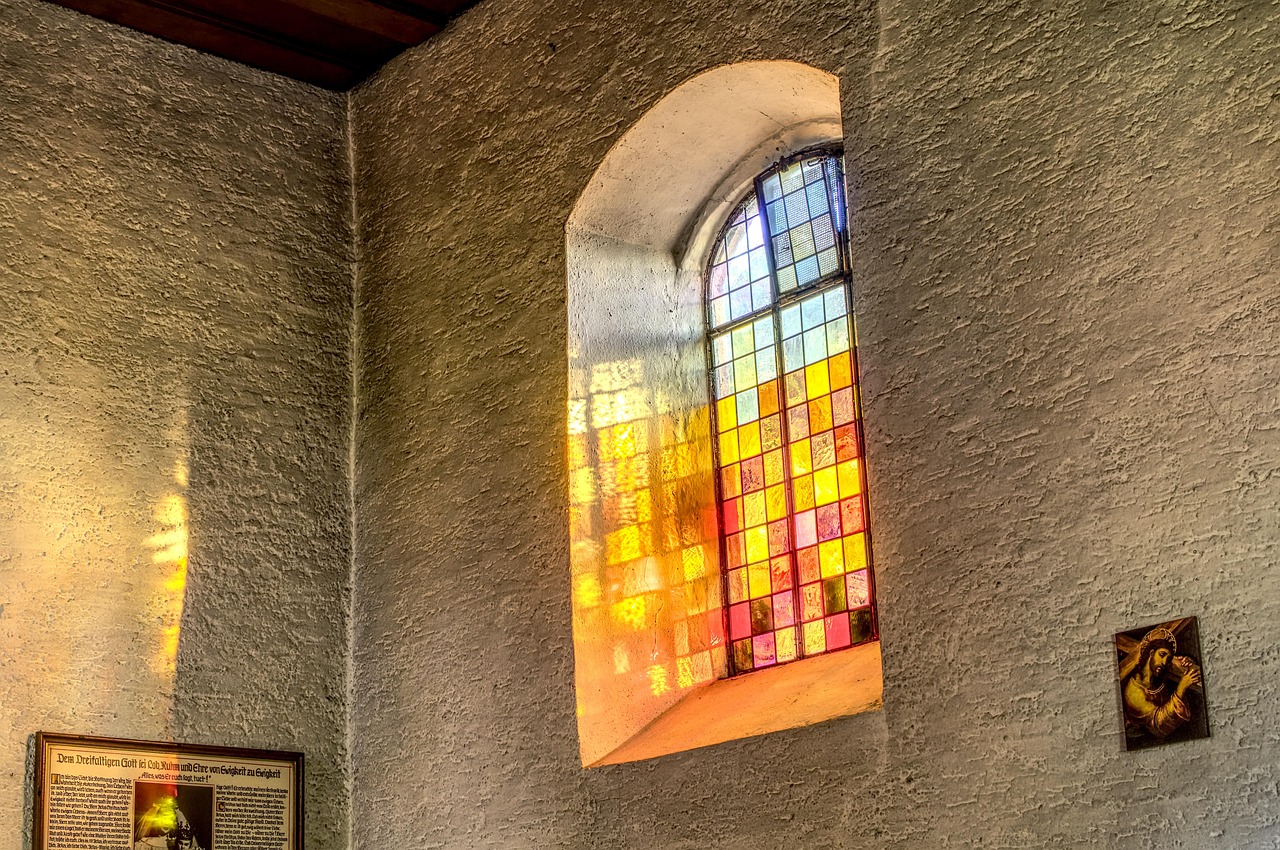
The Mapparium is Boston's most delightful oddity and a genuine one-of-one: a three-story inside-out globe of stained glass — 608 hand-painted panels mapping the world as it stood in 1935 — crossed at the equator by a 30-foot glass bridge, so that you stand at the literal center of the Earth with every country equidistant around you: the only place anywhere to see the planet's surface without distortion, since every map flattens and every normal globe curves away from you. The experience comes in two registers at once. Geographically, it is a time capsule deliberately never updated: Siam, Persia, French Indochina, the Soviet Union at full sprawl, colonial Africa's crazy-quilt — a 15-minute guided presentation (lights-and-narration formats rotate) that turns the frozen borders into a lesson on everything since. Acoustically, it is a famous accident: the glass sphere reflects sound perfectly, producing a whispering-gallery effect where a murmur at one end of the bridge lands crisply in an ear thirty feet away, and a word spoken at dead center returns to its speaker in surround — the staff's demonstrations are the giggling heart of every visit. It lives inside the Mary Baker Eddy Library on the Christian Science Plaza (the broader complex — Reflecting Pool, the Mother Church's basilica scale — is Back Bay's great architectural surprise, worth the stroll regardless), tickets are modest with tours running frequently, and the whole stop fits in under an hour: the perfect oddball slotted between the Prudential's views and Symphony Hall, and the single best fifteen minutes in Boston that most visitors have never heard of.
The artifact's history is period-perfect
Commissioned by the Christian Science Monitor's architect Chester Lindsay Churchill for the publishing house's 1935 headquarters — the Monitor was then a global newsgathering force, and the globe advertised worldliness — the sphere was built by Rand McNally cartography fired onto glass by the Czechoslovak-American stained-glass house of Charles Connick's era, lit originally by hundreds of bulbs behind the panels (now LED, enabling the modern shows). The never-update decision came after debate: panels were designed for replacement as borders moved, but by the 1960s the 1935 world was itself the exhibit — a cartographic Pompeii — and the library leaned in: the current presentations use the frozen map to narrate decolonization, the Soviet arc, and the century's redrawings against the glowing original.
The acoustics deserve their lore
The sphere's rigid glass reflects sound without absorption, creating effects the builders never intended — the bridge-end whisper trick, the center-point surround voice, and the reason groups are small and giggly. The library around it adds the quick extras (the Monitor's history, the Hall of Ideas' fountain of quotations), and the plaza outside is the architectural dessert: I.M. Pei's 1970s composition — the 670-foot Reflecting Pool, the colonnade, the Romanesque-Byzantine Mother Church extension's dome — Back Bay's most unexpected monumental space, free to wander and photogenic in all light.
Practicals and fit
Massachusetts Avenue at the Christian Science Plaza (Symphony or Prudential stations; the Pru's View Boston is ten minutes' walk), timed tours every 20-ish minutes, modest tickets, under an hour all-in, no interior photography of the globe (enforced; buy the postcard and keep the memory). Fit: everyone — kids for the whispering, map-and-history people for the 1935 borders, architecture fans for the plaza, couples for the oddball-date slot — and especially itineraries needing a one-hour wonder between bigger bookings: nothing else in Boston delivers this much delight per minute.
What to expect
The experience
A guided fifteen minutes inside a three-story stained-glass globe — the 1935 world glowing around the glass bridge, with whispering-gallery acoustics demonstrated — inside the Mary Baker Eddy Library.
Best time
Any gap between bigger bookings — tours run every twenty-ish minutes; the Pei plaza outside rewards the golden-hour walk.
How long
Under an hour, delight-dense.
Tips
Whisper from the bridge ends — thirty feet of planet carries it. Find Siam, Persia, and the Soviet sprawl. No photos inside the globe; the plaza's Reflecting Pool consoles your camera.
Quick picks
- Best for
- The one-hour wonder most visitors never hear about — maximum delight per minute in Boston.
- Families
- The whisper trick owns every kid; the frozen map quietly teaches the century.
- Couples
- The oddball-date slot — the globe, then the Reflecting Pool at dusk.
- Pair with
- View Boston at the Prudential ten minutes away; Symphony Hall across the avenue.
- Time needed
- One timed tour and a plaza stroll.
Good questions
Why is the map from 1935?+
Built that year for the Christian Science Monitor's headquarters and deliberately never updated — the frozen borders (Siam, Persia, colonial Africa, the full USSR) became the exhibit, and the presentations narrate everything since against them.
What is the whispering effect?+
The rigid glass sphere reflects sound perfectly — a whisper at one bridge end lands crisply thirty feet away, and a voice at dead center returns in surround. An accident the builders never intended, demonstrated on every tour.
Is it really undistorted?+
Uniquely — standing at the center puts every point of the surface equidistant, the only way to see Earth's geography without a map's flattening or a globe's curve away.
Can we take photos?+
Not inside the globe — enforced — but I.M. Pei's plaza outside, with the 670-foot Reflecting Pool and the Mother Church dome, is Back Bay's most photogenic surprise.
How long does the visit take?+
The guided globe presentation runs about fifteen minutes; with the library's quick exhibits and the plaza stroll, budget an hour.