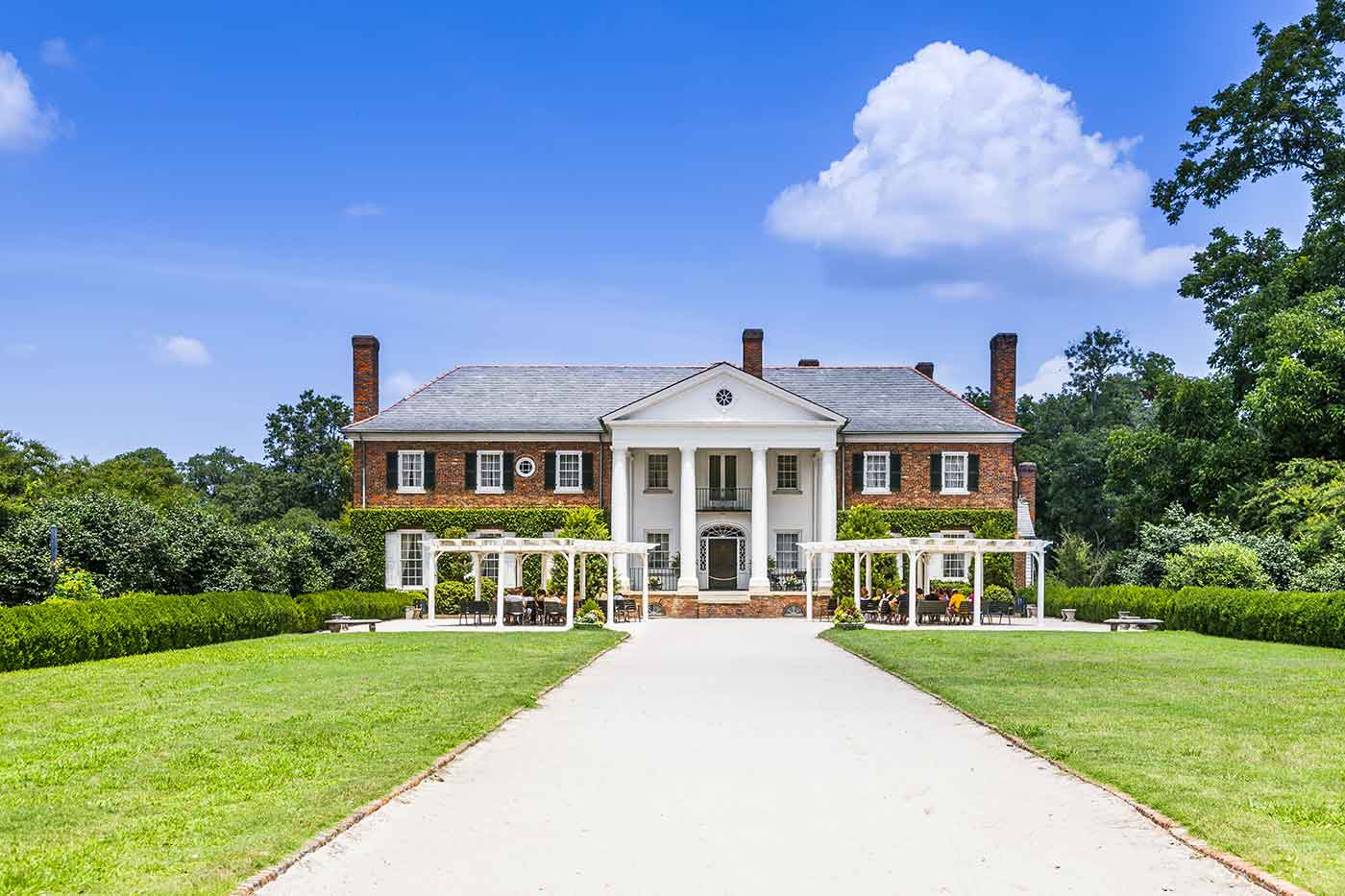
The Nathaniel Russell House is Charleston's interior masterpiece: the 1808 townhouse merchant-prince Nathaniel Russell built at 51 Meeting Street — a neoclassical showpiece whose restoration (by the Historic Charleston Foundation, to paint-archaeology exactitude) presents the Federal era's apex as its builders saw it: the free-flying staircase, three stories of cantilevered ellipse rising without visible support (the single most famous architectural object in the city, photographed up its own spiral by every visitor), geometric room suites — rectangular, oval, square per floor — whose proportions and plasterwork run the period's mathematics, joinery and faux-finishes recovered to original schemes (the vivid verditer blues and oranges correcting every muted-pastel assumption), and furnishings curated to the Russells' documented world. The interpretation earns equal billing: the house names and narrates the enslaved household — eighteen people whose labor ran the mansion, their work spaces (kitchen house, the back stairs' parallel circulation) read alongside the drawing rooms, the Foundation's research making 51 Meeting a model of whole-household museum practice. Tours run guided on the hour-ish (45-60 minutes; the Aiken-Rhett pairing ticket is the connoisseur's double: this house preserved-restored, that one preserved-as-found), the Meeting Street address sits on the Battery approach every itinerary walks, and the fit is anyone who has ever gawked at a Charleston facade and wondered — this is the one interior that out-promises its exterior.
Russell's biography frames the splendor
The Rhode Island-born merchant (Charleston's "king of the Yankees") built his fortune in the port's trade — including, the house states plainly, the slave trade — and raised 51 Meeting at age 70 as the retirement statement of the city's commercial peak, its £80,000 cost legendary in its day. The architecture delivers the legend: the staircase's engineering (each cantilevered step locking the next, the ellipse free of the wall), the piano nobile's oval drawing room with its curved doors and windows, the geometric suite logic, and the ornament program — Adamesque plasterwork, gilt and faux-bois, the recovered paint schemes whose saturation (verditer blue, coral, stone-color illusions) revolutionized how American museums present the Federal interior.
The restoration's scholarship is the differentiator: the Foundation's decades of paint archaeology, moulding casts, and documentary digging produced a house presented at circa-1808 accuracy rather than romantic assemblage — and the same rigor drives the enslaved-household interpretation: eighteen named individuals, the kitchen-house and work-yard framing, back-stair circulation read against the formal rooms' choreography, and tour narration that holds the mansion's beauty and its labor system in one frame without flinching. The garden (formal parterres behind the iron fence) and the museum-shop wing complete the compound.
Practicals and fit
Guided tours on posted times (book or arrive ahead in azalea season), 45-60 minutes; the Aiken-Rhett combination ticket is the city's best house-museum strategy — Russell's restored perfection against Aiken-Rhett's untouched decay, the pairing that teaches preservation's whole argument in one afternoon. The Meeting Street position folds into any Battery walk; photography policies favor the staircase (no flash, no tripods, endless awe). Fit: architecture pilgrims, history-first couples, and every visitor who wants one interior at full depth rather than five at porch distance — this is Charleston's single finest room-set, and the staircase alone repays the city's whole trip.
What to expect
The experience
A guided hour through the 1808 masterpiece — the free-flying staircase, geometric room suites, recovered paint schemes — with the enslaved household's documented interpretation throughout.
Best time
Posted tour times; azalea season books ahead. The Aiken-Rhett combo ticket makes the definitive house-museum afternoon.
How long
Forty-five to sixty minutes plus garden.
Tips
The staircase photographs up its own spiral — no flash. Take the combo with Aiken-Rhett: restored-versus-as-found is the whole preservation argument in two tickets. The paint colors are the originals; recalibrate accordingly.
Quick picks
- Best for
- Architecture pilgrims and anyone choosing one interior at full depth over five at porch distance.
- Families
- A guided hour suits older kids; the staircase's physics question keeps them engaged.
- Couples
- The oval drawing room and garden parterres make the elegant hour of the Battery walk.
- Pair with
- Aiken-Rhett House by combo ticket; Rainbow Row and the Battery two blocks on.
- Time needed
- One tour slot, booked ahead in bloom season.
Good questions
Is the staircase really unsupported?+
Each cantilevered step locks into the wall and the next — the ellipse flies free of visible support for three stories. It is the most famous architectural object in Charleston, and photographs accordingly.
Are the colors accurate?+
Paint-archaeology originals — saturated verditer blues, corals, faux finishes — correcting the muted-pastel myth. The restoration's scholarship reset how American museums show the Federal era.
How does it handle slavery?+
By name and space — eighteen enslaved residents documented, kitchen-house and back-stair work read alongside the drawing rooms — a model of whole-household interpretation.
What is the Aiken-Rhett pairing?+
The combo ticket's argument: Russell restored to 1808 perfection, Aiken-Rhett preserved untouched in its decay — the two philosophies of preservation in one afternoon.
Do we need reservations?+
Tours run on posted times with modest caps — book ahead for azalea season and fall weekends; shoulder seasons walk up comfortably.