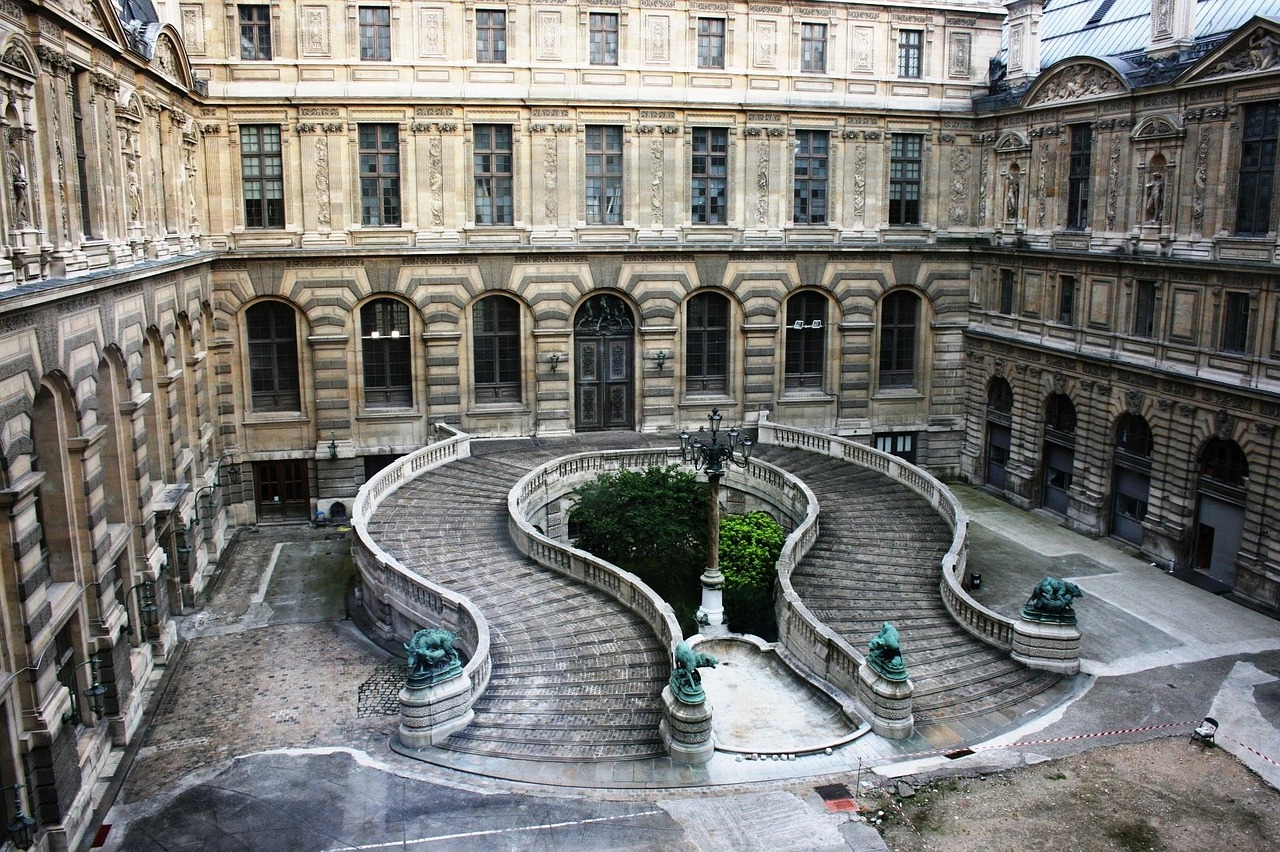
The Rookery is the Loop's architectural matryoshka and its most photographed interior: the 1888 masterwork of Burnham & Root — the heaviest hitters of the Chicago School, whose red-granite-and-brick exterior bridges Romanesque mass and the coming steel frame (the building is half load-bearing wall, half skeleton: the transition to the skyscraper caught mid-stride) — wrapped around the famous light court: the glass-roofed central atrium that John Root engineered as the formula's heart (light and air to inner offices in the gaslight era) and that Frank Lloyd Wright remodeled in 1905 into the room every Chicago architecture tour builds toward — white Carrara marble incised with gilded arabesques sheathing Root's ironwork, the double-helix oriel staircase climbing the court's north wall, and the suspended stair's lamp-posts and planters composing the Loop's single most beautiful interior. The visit scales by appetite: the light court itself welcomes visitors during business hours (the building works for a living — tenants stream past the photographers), while the guided tours (the on-site tour program runs the full story: Root's engineering, the Burnham legend — his offices upstairs planned the 1893 World's Fair and the Plan of Chicago — Wright's redo, and the 1992 restoration that recovered it all) earn the ticket for anyone whose trip carries the architecture chip. Twenty minutes to an hour, LaSalle Street's canyon two blocks from the Board of Trade's deco crown, and the natural pairing is everything: the river cruise's history made touchable, the Loop walking day's anchor, and the lobby that out-argues every observation deck about why this city matters to buildings.
The layers the tour unpacks
Root's 1888 engineering (the floating-raft foundation that solved Chicago's mud, the hybrid structure's walls-to-frame transition, the light court's iron lacework and electroliers), the name's double history (the site's temporary city hall drew roosting crows and the "rookery" nickname — plus the crow-ish politicians within; Root carved rooks into the entry arch as the joke made permanent), Burnham's upstairs decades (the office where the White City and the 1909 Plan were drawn — the tour's pilgrimage room when accessible), Wright's 1905 intervention (then a rising Oak Park name, hired by the building's managers to modernize: his marble-and-gold sheathing brightened Root's iron without erasing it — the two geniuses layered in one room), and William Drummond's 1930s elevator-lobby deco plus the 1992 McClier restoration that peeled a century of paint and grime back to all of it.
Visiting craft
The light court's free business-hours access suits the quick pilgrimage (mid-morning and mid-afternoon dodge the tenant rush; the oriel stair photographs best from the second-floor balcony angle), the guided tours (check current schedule — the program has run daily middays) add the upstairs and the stories, and the LaSalle Street context completes the stop: the Board of Trade's Ceres-topped deco cliff closing the canyon two blocks south, the Chicago Fed and Continental's temple fronts flanking, and the river cruise's narration suddenly concrete underfoot. The architecture-chip itinerary writes itself: river cruise for the skyline grammar, the Rookery for the interior masterpiece, the Wright houses for the domestic revolution.
Practicals and fit
209 South LaSalle (every Loop line within three blocks), free court access in business hours with tours ticketed, twenty minutes to an hour, photography welcomed (tripods by permission). Fit: architecture travelers categorically, couples on the Loop-interiors circuit (pair the Cultural Center's Tiffany dome), photographers at the oriel stair, and every first-timer whose river-cruise afterglow needs one buildable address — this is where the cruise's story walks indoors.
What to expect
The experience
The Loop's most beautiful interior — Root's 1888 glass-roofed light court resheathed by Wright in marble and gold — free to enter business hours, with guided tours unpacking the layers.
Best time
Mid-morning or mid-afternoon dodges the tenant rush; the oriel stair photographs from the second-floor balcony; pair straight off the river cruise.
How long
Twenty minutes to a toured hour.
Tips
Look for Root's carved rooks in the entry arch. The court is a working lobby — photograph respectfully. Walk two blocks to the Board of Trade's deco cliff to finish the canyon.
Quick picks
- Best for
- The river cruise's story made touchable — the Loop walking day's essential interior.
- Families
- A twenty-minute wow between bigger stops; the staircase hunt engages the kids.
- Couples
- Marble, gold, and the oriel spiral — the Loop's most romantic free room.
- Pair with
- The architecture river cruise before; the Cultural Center's Tiffany dome across the Loop.
- Time needed
- One pilgrimage stop, camera charged.
Good questions
Can we just walk in?+
The light court welcomes visitors during business hours free — it is a working lobby — while the guided tours add the upstairs stories and the Burnham legend for a modest ticket.
What did Wright actually do here?+
The 1905 remodel — sheathing Root's iron court in white Carrara marble incised with gold, adding the planters and lamps — layering two geniuses in one room without erasing either.
Why is it called the Rookery?+
The site's temporary city hall drew roosting crows (and crow-ish politicians, the papers said) — Root carved rooks into the entry arch to make the joke permanent.
What is the famous staircase?+
The oriel stair — the half-round tower spiraling the court's full height — the Loop's most photographed vertical and the balcony angle's reward.
How does it fit the architecture day?+
As the interior anchor: river cruise for the skyline grammar, the Rookery for the walkable masterpiece, the Wright houses for the domestic revolution.