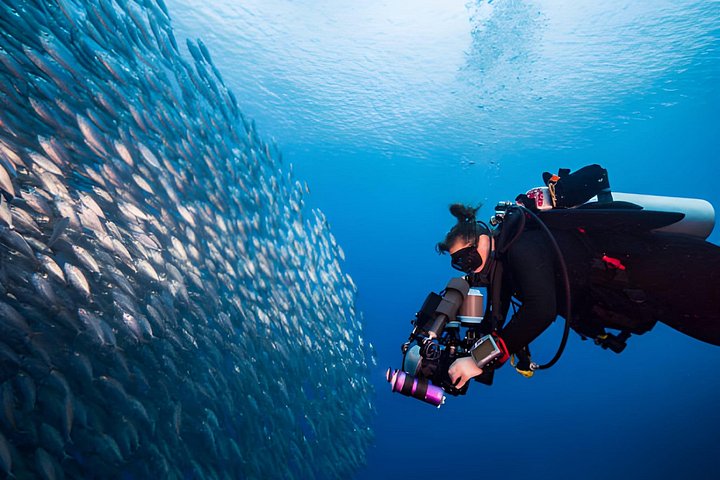
The Red Sea is one of the world's best places to learn to dive, and Hurghada has built a large industry around it. The PADI Open Water Diver course is the entry-level certification that lets you dive with a buddy to a depth of eighteen metres anywhere in the world, and taking it here means your first breaths underwater are on warm, clear reefs rather than in a cold lake. This version includes eLearning access, so you can complete the theory at home or by the pool before you arrive, which frees up more of your holiday for the water. In the pool or shallow water, you practise the core skills with an instructor, then you make your open water dives from a boat or shore, surrounded by coral, reef fish and, if you are lucky, a turtle or a ray.
What the course looks like
The knowledge section is done online at your own pace, with quizzes at the end of each module. Once in Hurghada, you meet the instructor, complete paperwork and a medical questionnaire and start the confined-water sessions, where you learn to clear your mask, control your buoyancy and handle problems.
After that come the open water dives, usually four dives across two days, with skills practised at depth and time to enjoy the reef. A final exam completes the theory. Most schools aim to finish the in-water part in around three to four days.
What to bring
Swimwear, towel, sun protection, a printed or digital copy of your eLearning completion and a passport photo if the school asks for one. Equipment is usually supplied, though some people prefer to bring their own mask for fit. You must be comfortable in the water and able to swim, and the medical questionnaire may need a doctor's sign-off if you answer yes to any question. Remember that you should not fly for at least eighteen to twenty-four hours after your last dive, so schedule your course early in the holiday.
Choosing the right school
Look for a centre with small groups, good safety standards, modern equipment and instructors who speak your language. Ask how many people are in each class, how the dives are run and what is included in the price, such as certification fees, boat trips and equipment. Courses vary in pace, and a longer plan can be more relaxed, especially for nervous learners.
Non-diving partners and children can enjoy the semi-submarine, snorkeling or the Grand Aquarium while you learn. If you only want a taste of diving, the beginner scuba day trip is a shorter alternative, and if you already hold a certification, the certified diver day trips offer more reefs per dive day.
Practical notes
Take the pre-course medical questions seriously, because some conditions need a doctor's approval before you can dive. Work through the eLearning modules in good time, since they can take several hours, and bring proof of completion. Equalise your ears early and often on descent, tell your instructor about any discomfort and never hold your breath underwater. Respect the schedule, because the dives are planned around tides and winds. After you are certified, record your dives in a logbook, which is useful evidence of experience if you later book boat dives or a liveaboard.
What to expect
The experience
A PADI Open Water course with eLearning, pool or shallow-water skills and open water dives with an instructor on Hurghada's reefs.
Best time
Year-round, with the warmest water from late spring to autumn; start early in your stay.
How long
Usually three to four days of in-water training plus the online theory.
Tips
Finish the eLearning before you arrive, complete the medical form honestly and do not fly within a day of your last dive.
Quick picks
- Best for
- Holidaymakers who want to leave with a diving qualification instead of a one-off try dive.
- Families
- Suitable for older children and teenagers who meet the age rules; younger children can try a shorter programme.
- Couples
- A great shared challenge, with a bond over the first dive and plenty of reef to enjoy afterwards.
- Pair with
- A snorkeling cruise or the semi-submarine for non-diving family members.
- Time needed
- Three to four days.
Good questions
Do I need diving experience for the Open Water course?+
No. It is designed for beginners, though you must be able to swim and meet the health requirements.
What does the eLearning include?+
It covers the theory, with videos and quizzes, so you can study at home before you arrive.
How deep will I dive?+
Open Water divers are certified to dive to a depth of eighteen metres.
When can I fly after diving?+
Wait at least eighteen to twenty-four hours after your last dive before flying.
What age can I take the course?+
The minimum age is normally ten for the junior certification. Check the school's rules.