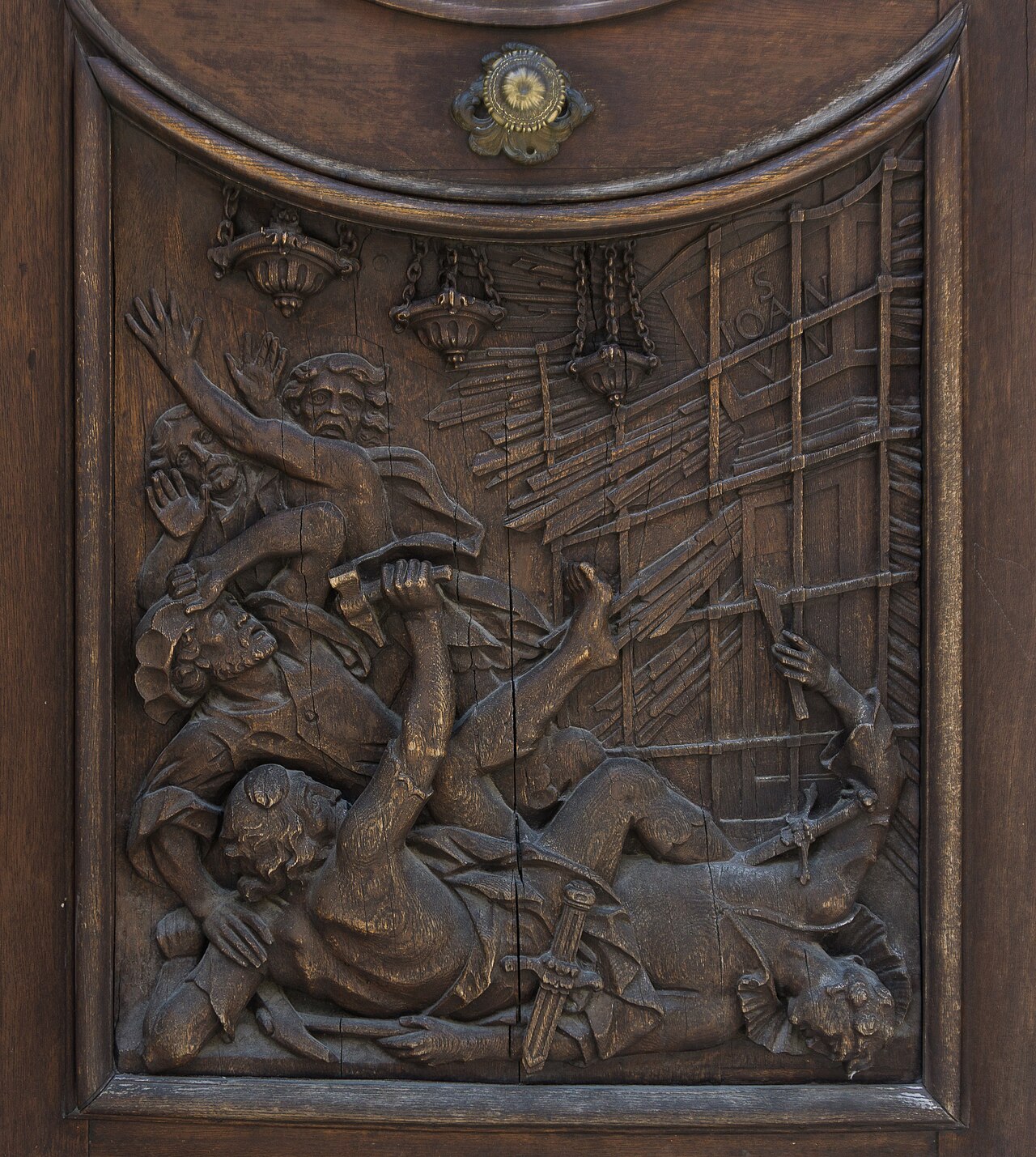
From the street you could walk straight past it: a narrow facade wedged between the houses of the Sendlinger Strasse, its doorway framed by rough-hewn rocks with a figure of St John of Nepomuk. Step inside, and the Asamkirche is one of the most astonishing interiors in Germany. The church of St Johann Nepomuk was built between 1733 and 1746 by the brothers Cosmas Damian Asam, a painter, and Egid Quirin Asam, a sculptor and stuccoist, the leading masters of Bavarian late baroque, who had worked on churches and monasteries across southern Germany. They built it next to Egid Quirin's house, with no patron or client, as their own private church, for the glory of God and for their own salvation; Egid Quirin could look at the high altar from a window in his home. Public pressure later obliged the brothers to open it to the people of Munich. The interior is tiny, only around 22 metres long and 8 metres wide, and the Asams used every centimetre. The walls rise in three zones, from the darker, earthly zone below, with confessionals and pews, through a gallery level to the light-filled heavenly zone of the ceiling fresco, which depicts the life of St John of Nepomuk. Stucco, gilding, marble, sculpture and painting merge into one theatrical whole, and the high altar, with its four twisted columns and a dramatic sculpture of the Trinity, is lit by a hidden window, a favourite baroque trick. Cosmas Damian died seven years before the consecration and Egid Quirin four years after it. The church was damaged in the Second World War, and restoration of the interior continued until 1983. Today it is a working church and free to enter, though donations towards its upkeep are welcome, and it is just a few minutes' walk from Marienplatz and Sendlinger Tor.
How to plan your visit: the Asamkirche is on the Sendlinger Strasse, around five minutes from Sendlinger Tor and ten from Marienplatz, and a visit takes fifteen to thirty minutes. From April to October it opens daily from 9am to 7pm, except on Fridays, when it opens at 1pm; from November to March it closes an hour earlier. Stand at the back first to take in the whole, then walk to the altar and look up, and back again to see how the light changes from the dark lower zone to the bright ceiling. Visit quietly: it is a place of worship, and the space is too small for crowds or loud tour groups.
When to go: mornings on weekdays are quietest; the church can feel crowded when tour groups arrive in the afternoon. Light changes the effect dramatically, so a sunny day shows off the gilding and the hidden window behind the altar. Next door, the Asamhaus, the brothers' home, has a decorated facade worth a look from the street.
How it compares: for sheer concentrated baroque splendour, nothing in Munich beats it, and it is the perfect counterpoint to the plain, rebuilt interior of the Frauenkirche. If it whets your appetite, the Theatinerkirche near Odeonsplatz and the pilgrimage church at Andechs show other faces of Bavarian baroque and rococo, and the Cuvillies Theatre at the Residenz is the court's secular equivalent.
What to expect
The experience
A short, free visit to a tiny, intensely decorated late-baroque church on a shopping street.
Best time
Weekday mornings, on a sunny day for the light. Opens at 1pm on Fridays.
How long
Fifteen to thirty minutes.
Tips
Look from the back first, then up at the ceiling. Keep quiet: it is a working church. Leave a donation.
Quick picks
- Best for
- Lovers of baroque art and anyone who enjoys a hidden gem.
- Families
- A quick, free stop on the way to or from Sendlinger Tor; children enjoy the gold and the rock doorway.
- Couples
- A few quiet minutes in one of Munich's most beautiful interiors.
- Pair with
- The Frauenkirche, St Peter's tower and the Viktualienmarkt.
- Time needed
- Half an hour at most.
Good questions
Is the Asamkirche free?+
Yes. Entry is free, though donations towards the upkeep of the church are welcome.
When is the Asamkirche open?+
From April to October daily from 9am to 7pm, except Fridays, when it opens at 1pm. From November to March it closes an hour earlier.
Who built the Asamkirche?+
The brothers Cosmas Damian and Egid Quirin Asam, between 1733 and 1746, as their private church next to their house.
How big is it?+
Tiny: only around 22 metres long and 8 metres wide, with a facade about eight metres across.
Where is the Asamkirche?+
On the Sendlinger Strasse, about five minutes' walk from Sendlinger Tor and ten from Marienplatz.