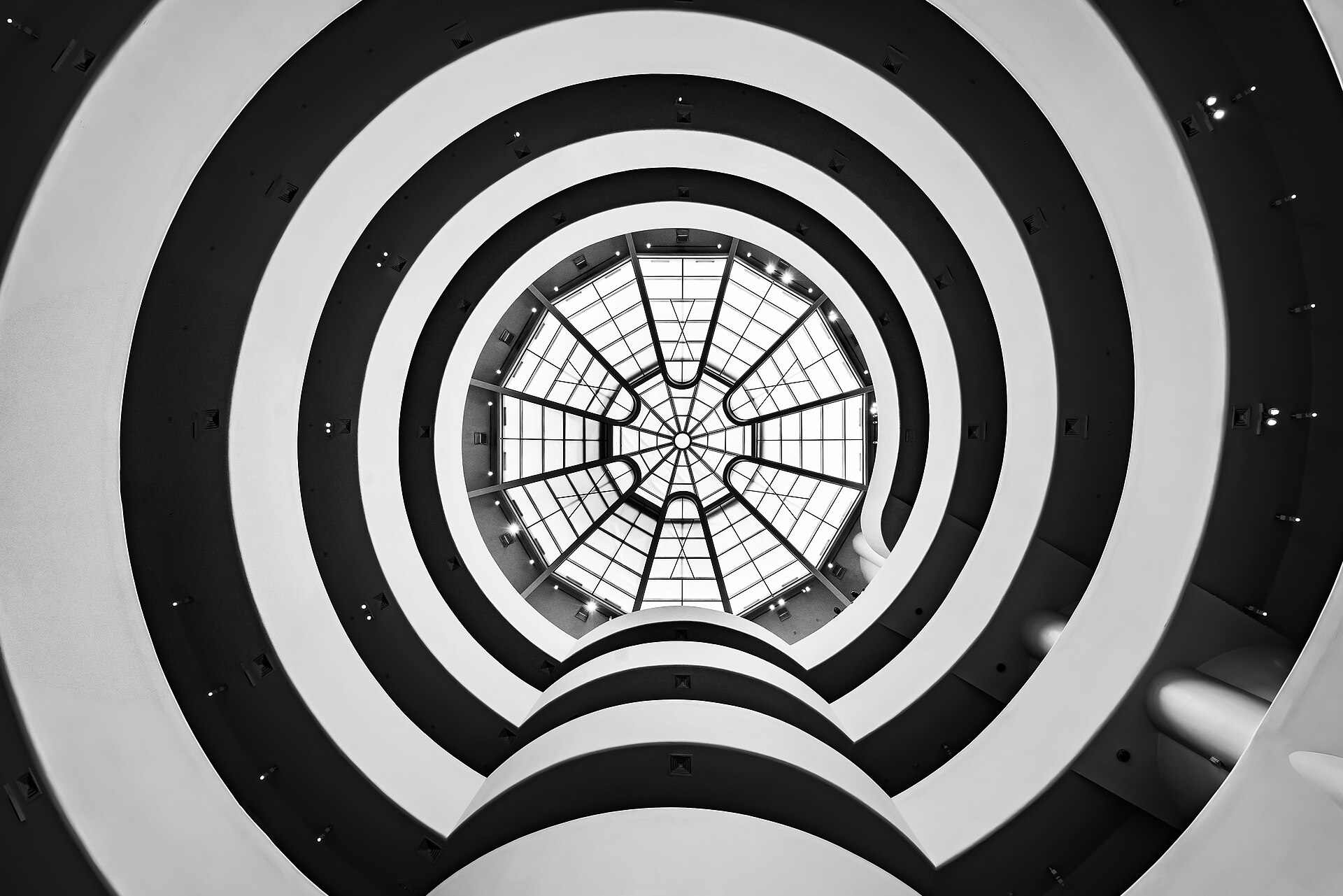
The Solomon R. Guggenheim Museum opened in 1959 in Frank Lloyd Wright's spiral building on Fifth Avenue, six months after Wright's death. The continuous ramp galleries are unlike any other museum in the world — you take the elevator to the top, then walk down the spiral past the exhibitions. The permanent collection focuses on early modernism (Kandinsky, Picasso, Mondrian) and the rotating program emphasizes contemporary art.
The Solomon R. Guggenheim Museum opened in October 1959, six months after Frank Lloyd Wright's death. Wright designed it specifically for Solomon Guggenheim's collection of non-objective art, and the building is among the 20th century's most important architectural statements — a continuous spiral ramp gallery that you experience by taking the elevator to the top and walking gently downward past the exhibitions.
The architecture is the experience as much as the art. Wright designed the spiral so visitors would encounter art chronologically (or thematically) without doubling back through galleries, and so the natural light pouring through the central oculus would light the entire spiral evenly. Critics in 1959 were divided — some called it a masterpiece, others complained that the slanted ramp and curved walls made it nearly impossible to hang traditional paintings. Both readings remain valid.
The permanent collection focuses on early 20th-century non-objective and abstract art — Kandinsky (the largest collection outside Russia), Picasso, Mondrian, Léger, Klee, plus a strong post-war contemporary collection. The rotating exhibition program in the spiral galleries is consistently among NYC's most adventurous.
Saturday Pay-What-You-Wish hours (typically 4-6 PM) make the Guggenheim accessible without paying full price; check the museum's website for current schedule. The museum is on Museum Mile (Fifth Avenue between 79th and 105th streets), making it pair naturally with the Met, Cooper Hewitt, or other nearby museums.
What to expect
The experience
Take the elevator to the top, walk down the spiral ramp past the exhibitions. Self-paced.
Best time
Saturday Pay-What-You-Wish hours (typically 4-6 PM) are crowded but free. Weekday mornings are quietest.
How long
2 hours typical.
Tips
Walking down the spiral is the intended direction — don't fight it. The Tower (the lower-rise addition with traditional galleries) is easy to miss; signage isn't great. Bring a sweater — the building runs cold.
Quick picks
- Best for
- Architecture enthusiasts and visitors interested in early modernism and abstract art.
- Families
- Older kids find the architecture compelling. Younger kids may not engage with the abstract collection.
- Couples
- The spiral itself makes for a good date pace — you can talk while walking.
- Pair with
- Pair with the Met (a 15-min walk south) for a Museum Mile day. Cooper Hewitt is also nearby.
- Time needed
- 2 hours.
Good questions
What's special about the building?+
Frank Lloyd Wright designed it as a continuous spiral ramp — you take the elevator to the top and walk down past the exhibitions. The architecture is the experience as much as the art.
Is Pay-What-You-Wish still available?+
Yes, on Saturdays during specific hours (typically 4-6 PM). Check the museum's website for current schedule.
Is the Tower included with admission?+
Yes — the Tower addition (with traditional galleries) is part of the museum. It's easy to miss; signage isn't always clear.
Is the Guggenheim better visited with another museum?+
It's on Museum Mile (Fifth Avenue between 79th and 105th). Pair with the Met (15-min walk south), Cooper Hewitt, or the Frick (when open in its temporary location).
Should I start at the top or the bottom?+
Most visitors take the elevator to the top and walk down the spiral ramp, which is the way Frank Lloyd Wright intended it to be seen.