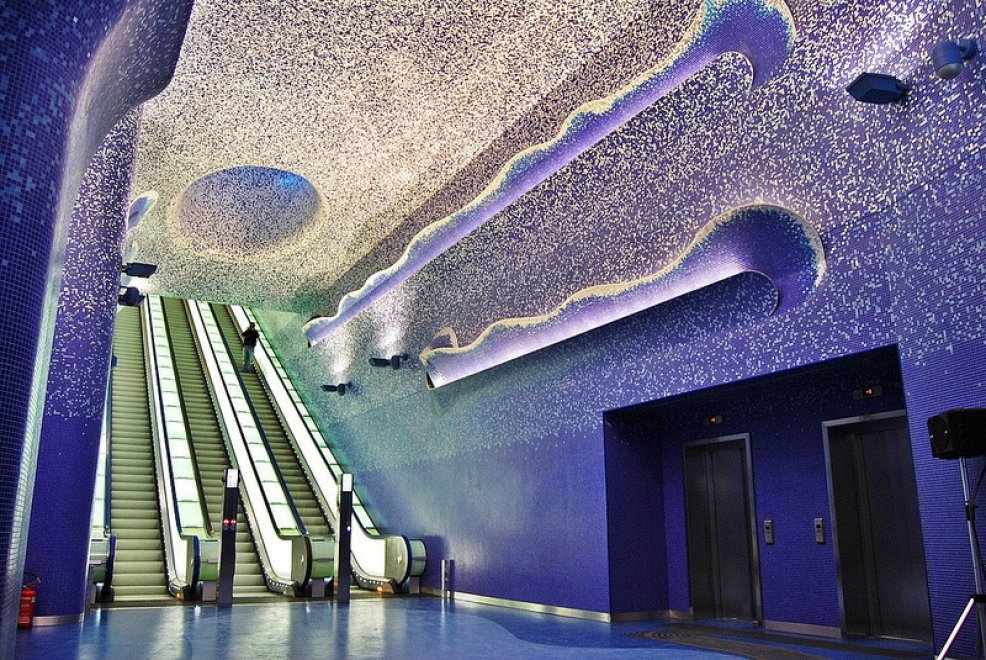
Toledo station is the best value art experience in Naples: for the price of a single metro ticket, you descend into a work of architecture that has been widely called the most beautiful metro station in Europe. It sits on Line 1 under Via Toledo, the city's main shopping street, and was designed by the Catalan architect Oscar Tusquets Blanca, opening in 2012. The concept is a descent from earth into sea. At street level and in the upper hall, the colours are ochre and earthy, a reference to the tuff rock of Naples. As you ride the escalators down, the walls turn blue, and the deepest hall becomes the Galleria del Mare, a sea gallery lined with blue mosaic tiles and soft lights that make you feel as though you are underwater. The centrepiece is the Crater de Luz, a great cone that runs up through every level to the street, letting daylight fall into the station and mixing it with LED lights and the shimmer of the wave-like mosaics on the side walls. Along the way, there are works by contemporary artists, including large mosaics by William Kentridge, and others that honour the workers who built the metro. Toledo is part of a wider project known as the Metro dell'Arte, in which several Line 1 stations were designed by famous architects and filled with contemporary art: Università with Karim Rashid's bright pop forms, Dante and Museo with art and archaeology, and Municipio, where Roman and medieval remains found during construction are on show. Fit: first-timers, families (it is a ten-minute wonder for kids), design fans and anyone sheltering from rain.
Why it matters: building a metro under a city as old as Naples is slow and archaeologically complicated, and the city turned the challenge into a showcase, commissioning major architects and artists so that the stations themselves became destinations. Toledo is the star, but riding Line 1 between a few stations makes a free-form underground gallery tour.
How to do it well: buy a single ticket and validate it, ride the escalators all the way down slowly, and look up from the bottom through the Crater de Luz. Avoid rush hours if you want photos without crowds; mid-morning or early afternoon on a weekday is calmest. Be considerate, as this is a working station, and keep bags close, as in any busy metro. Then ride a few stops to Università, Dante or Municipio to compare styles.
Practicals: Toledo station has exits on Via Toledo and toward the Quartieri Spagnoli, a short walk from Piazza del Plebiscito and the Galleria Umberto I. The only cost is a standard metro fare. Combine with a walk up Via Toledo, the Royal Palace and Galleria Borbonica nearby, or a pizza fritta in the Quartieri Spagnoli above.
What to expect
The experience
A working Line 1 metro station designed as a descent from earth to sea, with a light crater, blue mosaic halls and contemporary art, plus other art stations a few stops away.
Best time
Weekday mid-mornings or early afternoons, outside rush hours.
How long
Thirty minutes for Toledo, an hour with other art stations.
Tips
Buy and validate a single ticket. Ride the escalators slowly and look up through the Crater de Luz. Add Università and Municipio stations.
Quick picks
- Best for
- World-class design for the price of a metro ticket.
- Families
- A quick, magical stop that kids find genuinely exciting.
- Couples
- A blue underwater moment between shopping on Via Toledo and dinner.
- Pair with
- Royal Palace of Naples, Galleria Borbonica and Spaccanapoli.
- Time needed
- Under an hour.
Good questions
Why is Toledo station famous?+
It is widely considered one of the most beautiful metro stations in Europe, designed by Oscar Tusquets Blanca as a descent from earth to sea, with a light crater and blue mosaic halls.
Do I need a ticket to see it?+
Yes, the station's best parts are inside the paid area, so buy and validate a standard metro ticket. That is the only cost.
What are the Naples art stations?+
Several stations on Line 1, known together as the Metro dell'Arte, were designed by noted architects and filled with contemporary art, including Toledo, Università, Dante, Museo and Municipio.
When is the best time to visit?+
Mid-morning or early afternoon on a weekday, outside commuting peaks, for calmer halls and easier photos.
Is it worth it for kids?+
Yes. The long escalators, the blue underwater feel and the light crater make it a short, memorable stop for children.