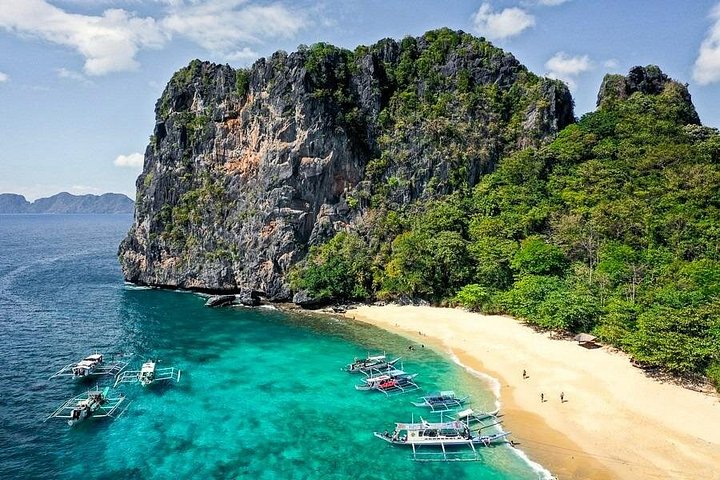
Bacuit Bay is best known for its cliffs and lagoons, but the water beneath the boats is just as interesting, with coral slopes, rock walls and plenty of reef life. A discover scuba programme is designed for complete beginners, and it takes you from a short briefing on land to a supervised dive in shallow water with an instructor beside you. You do not need a certification, only reasonable health and basic swimming comfort. Most programmes include a safety briefing, equipment fitting, a short practice session in very shallow water and one or two guided dives at a calm site chosen by the instructor. The experience is a good test of whether you want to pursue a full Open Water course later on, and it gives you a taste of the bay that surface swimmers miss.
What you see depends on the site and the day, but the typical El Nido reef scene includes hard and soft corals, anemones with clownfish, schools of small reef fish, sea cucumbers and the occasional turtle or ray. Visibility is generally best in the dry season, and calm mornings give the clearest water. Instructors keep the depth shallow, often within about twelve metres, and they stay within arm's reach throughout. Group sizes are small, because beginner dives are run on a low student-to-instructor ratio for safety.
Preparation is straightforward. You will be asked to complete a short medical questionnaire, and anyone with conditions such as asthma, heart problems, ear issues or a recent illness should check with the operator and a doctor before you book. Do not fly within the recommended time after diving, usually eighteen to twenty-four hours depending on the dive profile, so plan this activity early in your trip, not on your last day.
Get tickets for the programme that suits your schedule, and ask what the price covers: equipment, boat transfer, insurance and photos are included by some operators and charged separately by others.
The discover programme works best when paired with the snorkelling you will do on the standard island-hopping tours. Many visitors do Tour A or C on one day and a scuba session on another, so they see the bay from both above and below. Bring a swimsuit, a towel, reef-safe sun cream and a rash vest.
Avoid alcohol the night before. If you decide you love it, ask the instructor about the next steps in certification, which often take a few days in El Nido and can be completed without a long classroom component thanks to online theory modules.
Boat departures can be cancelled in rough seas, and a good operator will offer a different date or a refund in that case. For those who prefer to stay near the surface, snorkelling on the island-hopping routes is still excellent, but a discover dive gives a deeper sense of the reef.
It is worth choosing an operator that is open about its safety record, its equipment maintenance and its instructor qualifications. Ask how many students share each instructor, whether the boat carries oxygen and a first-aid kit, and what happens if you feel uncomfortable at depth. A calm, well-organised briefing is a good sign, and a rushed one is a reason to look elsewhere.
What to expect
The experience
A beginner scuba programme in Bacuit Bay with a briefing, equipment fitting and a supervised shallow dive led by an instructor.
Best time
Go in the dry season from November to May for the calmest seas and clearest water.
How long
About four hours including briefing, boat transfer and dives.
Tips
Complete the medical questionnaire honestly, avoid alcohol the night before and do not plan a flight within a day of diving.
Quick picks
- Best for
- Adventurous first-timers who want to try scuba without committing to a full course.
- Families
- Usually for children aged ten or older, depending on the operator's age rules.
- Couples
- A great shared first for couples who both want to try diving.
- Pair with
- Pair it with an island-hopping day on another date to see the bay from above and below.
- Time needed
- Half a day.
Good questions
Do I need to be certified?+
No. A discover programme is designed for complete beginners and is supervised by an instructor from start to finish.
How deep will I go?+
Typically a shallow depth, often no more than about twelve metres, chosen by the instructor to suit beginners.
Who should not dive?+
People with certain conditions such as asthma, heart problems or recent ear issues should consult a doctor first, and the operator will ask for a medical questionnaire.
Can I fly after diving?+
Wait the recommended time, usually eighteen to twenty-four hours, before flying. Plan your dive early in your trip.
What if I do not like it?+
You can signal the instructor and surface at any time. Many beginners find the first few minutes the hardest and then relax.