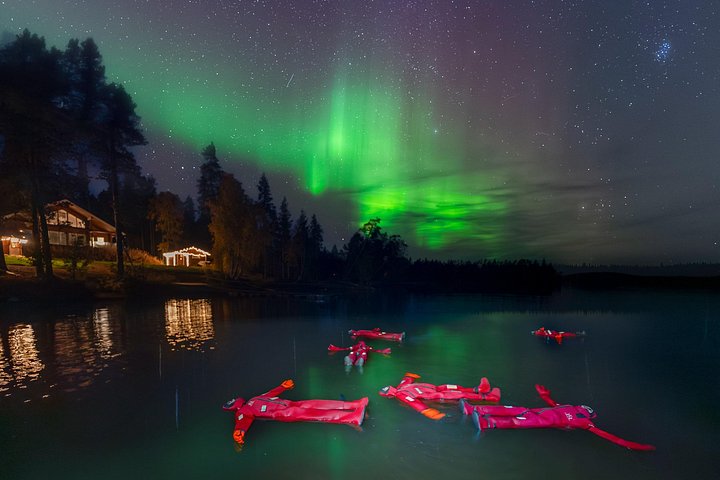
An icebreaker cruise is the kind of experience that sounds improbable until you are standing on the deck watching a ship split a metre of sea ice. The cruise sails from the coast of the Gulf of Bothnia, to the south of Rovaniemi, where the sea freezes over for several winter months. The vessel pushes through the ice, the hull groaning and the plates tilting, and passengers gather on deck to watch, take photographs and learn from the crew how icebreakers keep shipping lanes open. On many departures the highlight comes at the end, when guests put on a buoyant survival suit and step into an open channel in the ice to float in the sea, an odd and surprisingly calm sensation. Because this is a long day, the trip is usually sold as a package that includes the transfer from Rovaniemi, the cruise itself and a warm meal or snack on board.
Think of it as a full-day expedition. The coast is a drive of roughly an hour and a half to two hours from Rovaniemi, and the return trip takes just as long, so you will spend a good part of the day on the road. Depending on the option, a coach or minibus collects guests from town, or you meet the group at the harbour, so check the meeting point and times carefully when you book.
The cruise itself lasts several hours, and the on-board programme often includes a briefing on the ship, hot drinks and a meal. Dress in layers and expect wind on deck: a windproof outer shell, insulated boots, a hat, gloves and a neck warmer make the time outside far more pleasant.
The ice-floating section is optional on some programmes and included on others. You wear a thermal survival suit that covers the whole body except for the face and hands, and you float on your back in water that is only just above freezing. The suit keeps you dry and warm, and the experience is more about the novelty than any sense of cold. Not everyone can take part, since there are usually limits on age, height, health conditions and swimming ability, so read the conditions for your date before relying on it.
The cruising season depends on the sea ice, which usually builds up from midwinter and lasts until early spring, so this is a trip for roughly January to March or April rather than the early part of winter. It is an excellent choice for couples, groups of friends and families with older children who like unusual experiences. It is less suitable for travellers who dislike long road days or who are sensitive to cold. Book early, because departures are limited and the ice conditions can change the schedule.
A few practical tips make the long day easier. Eat a solid breakfast, bring snacks and water for the road, and carry a small bag with a change of socks and a dry base layer, since the thermal suit and the wind on deck can leave you damp. Motion sickness is rarely a problem on an icebreaker moving slowly through ice, but if you are prone to it, take your usual precautions.
Keep valuables, phones and cameras in a zipped inner pocket or a lanyard when you are on deck, and be ready to follow the crew's safety instructions at every stage of the cruise.
What to expect
The experience
A cruise on an icebreaker through frozen sea, with an optional float in a thermal suit, plus the journey between Rovaniemi and the coast.
Best time
Typically from about January to March or April, once the sea ice is thick enough.
How long
Nine to ten hours door to door, with the cruise itself taking several hours.
Tips
Check the meeting point and the age and health limits for floating, and dress in windproof layers for the deck.
Quick picks
- Best for
- Travellers who want one big, memorable winter day out.
- Families
- Works for older children; the long journey and cold deck are hard for toddlers.
- Couples
- An unusual shared experience that most people remember for years.
- Pair with
- A Northern Lights hunt on another evening, since this day ends tired and early.
- Time needed
- A full day.
Good questions
Where does the icebreaker sail from?+
It sails from the coast of the Gulf of Bothnia, roughly an hour and a half to two hours south of Rovaniemi. Check the exact departure point for your option when you book.
When does the icebreaker season run?+
Usually from about midwinter to early spring, depending on the sea ice. Early winter is generally too soon.
Do I have to go into the water?+
Ice floating is optional on some programmes. You can watch from the deck if you prefer.
Is the floating cold?+
The thermal suit keeps the body dry and warm, and only the face and hands are exposed. Most people find it calm rather than cold.
Who cannot take part in the floating?+
There are usually limits on age, height, health conditions and swimming ability. Read the conditions for your date before you book.