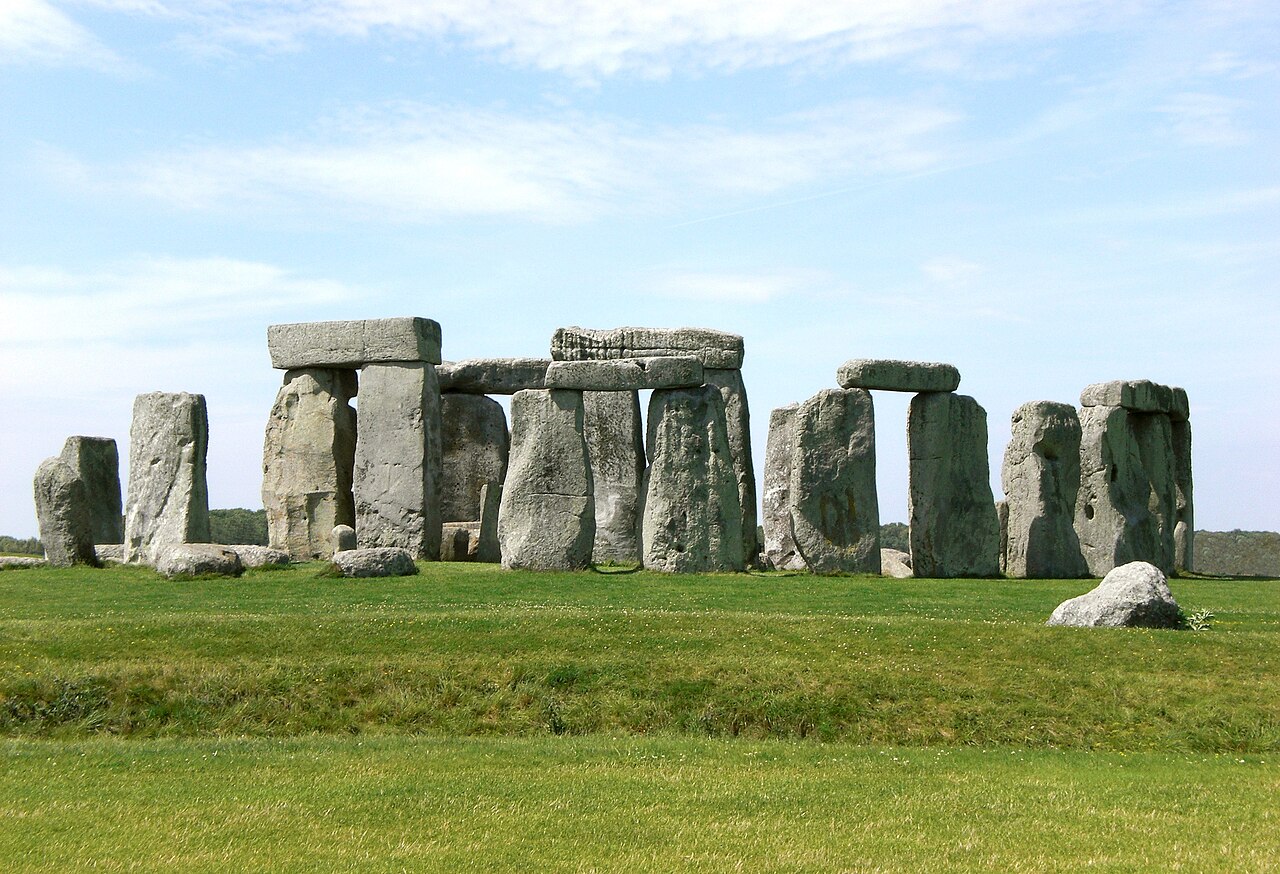
Stonehenge is the one sight in this corner of England that almost everybody has already pictured, and the reality is better than the picture. The monument stands alone on open chalk downland, a circle of enormous upright sarsen stones capped by horizontal lintels, with a smaller inner setting of bluestones, and it was built in stages from around 3000 BC with the great sarsen circle raised roughly five thousand years ago. The bluestones were brought from the Preseli Hills in Wales, a journey of well over a hundred and fifty miles, and the sarsens came from the Wiltshire downs, which is part of what makes the place so astonishing: nobody has ever settled why people invested so much effort here. What we do know is that the monument is aligned on the midsummer sunrise and midwinter sunset, that it sat at the centre of a landscape of burial mounds, avenues and earlier monuments, and that it is now part of a UNESCO World Heritage Site shared with Avebury. A modern visitor centre, about a mile and a half from the stones, holds the exhibition, a reconstructed Neolithic village and the shop and café, and a shuttle carries you out to the monument, though you can also walk the path across the fields. Ordinary admission keeps you on a path around the circle rather than inside it, which gives good views from every side, and an audio guide is included. Tickets are timed, and it pays to pre-book, because the site is very busy at weekends and in school holidays.
Understanding what you are looking at makes the visit richer. The first monument here was a circular ditch and bank, and the stones followed over many centuries, so what you see is the last stage of a long story rather than a single building project. The lintels are held on to the uprights by carpentry joints, mortise and tenon, which is an unusual technique to find in stone, and the tallest sarsens stand about seven metres high with a good part of their length underground. Many stones fell, were broken up or were re-erected in the twentieth century, so the gaps in the ring are part of the real history. Recent research has added further surprises, including the origin of the central Altar Stone far to the north, so the exhibition is worth your time before you walk out.
Working the visit: arrive at the visitor centre a little before your slot, see the exhibition and the Neolithic houses first, and then take the shuttle out to the stones, which saves your energy for the circuit itself. The path takes about half an hour at an unhurried pace, longer if you stop for photographs, and the ground is open, flat and exposed, so a warm layer matters on most days outside midsummer. The shuttle is the easy way across the field for anyone with limited mobility, and the exhibition and shuttle make the visit manageable for most visitors. Parking at the visitor centre is by pre-booked space, and you should not park on the nearby A303 or surrounding roads.
Choosing your approach: if you want the stones to yourself and a chance to stand inside the circle, look at the Stone Circle Experience on this site. If you have no car, the day tours from London are the simplest option, and Salisbury is the better base if you want unhurried time. Go early or late in the day for fewer people, expect weather to change quickly, and keep the rest of the day for Salisbury or Old Sarum. Do not touch or climb on the stones, and respect the rule that prevents you from walking into the circle during standard visits.
What to expect
The experience
A timed visit that starts at the visitor centre with an exhibition and Neolithic houses, then a shuttle or walk to the stones and a circular path with an included audio guide.
Best time
Early morning or late afternoon on a weekday for the thinnest crowds; low winter sun is beautiful but the open plain is cold and exposed.
How long
About two to three hours including the exhibition, the shuttle ride and a leisurely circuit of the stones.
Tips
Pre-book a timed ticket and a parking space, wear a warm layer, and do not park on the A303. Keep time afterwards for Salisbury or Old Sarum.
Quick picks
- Best for
- Every first-timer — it is the reason most people come to this part of England.
- Families
- The Neolithic village and the shuttle ride keep children interested; the circuit itself is short and buggy-friendly.
- Couples
- A late-afternoon slot with golden light on the stones, then dinner back in Salisbury.
- Pair with
- Old Sarum and Salisbury Cathedral, or Avebury for a second, very different stone circle.
- Time needed
- Allow half a day including travel from Salisbury.
Good questions
Do I need to book Stonehenge in advance?+
Yes, pre-booking a timed ticket is strongly recommended, and it is essential at weekends, in school holidays and at midsummer. If you are driving you also need to book a parking space.
Can you walk inside the stone circle?+
Not on a standard visit, which follows a path around the monument. The separate Stone Circle Experience offers guided access inside the circle outside normal hours.
How far is Stonehenge from Salisbury?+
It is about nine miles by road, roughly twenty minutes by car or taxi. A dedicated tour bus also runs from Salisbury, so check its timetable before you rely on it.
How long does a visit take?+
Most people spend two to three hours, including the exhibition, the Neolithic houses and the walk around the stones. Add travel time if you are coming from Salisbury or London.
Is Stonehenge worth it in winter?+
Yes, it is far quieter and the low sun and frost can be spectacular. Dress warmly, because the plain is windswept and there is no shelter at the stones.