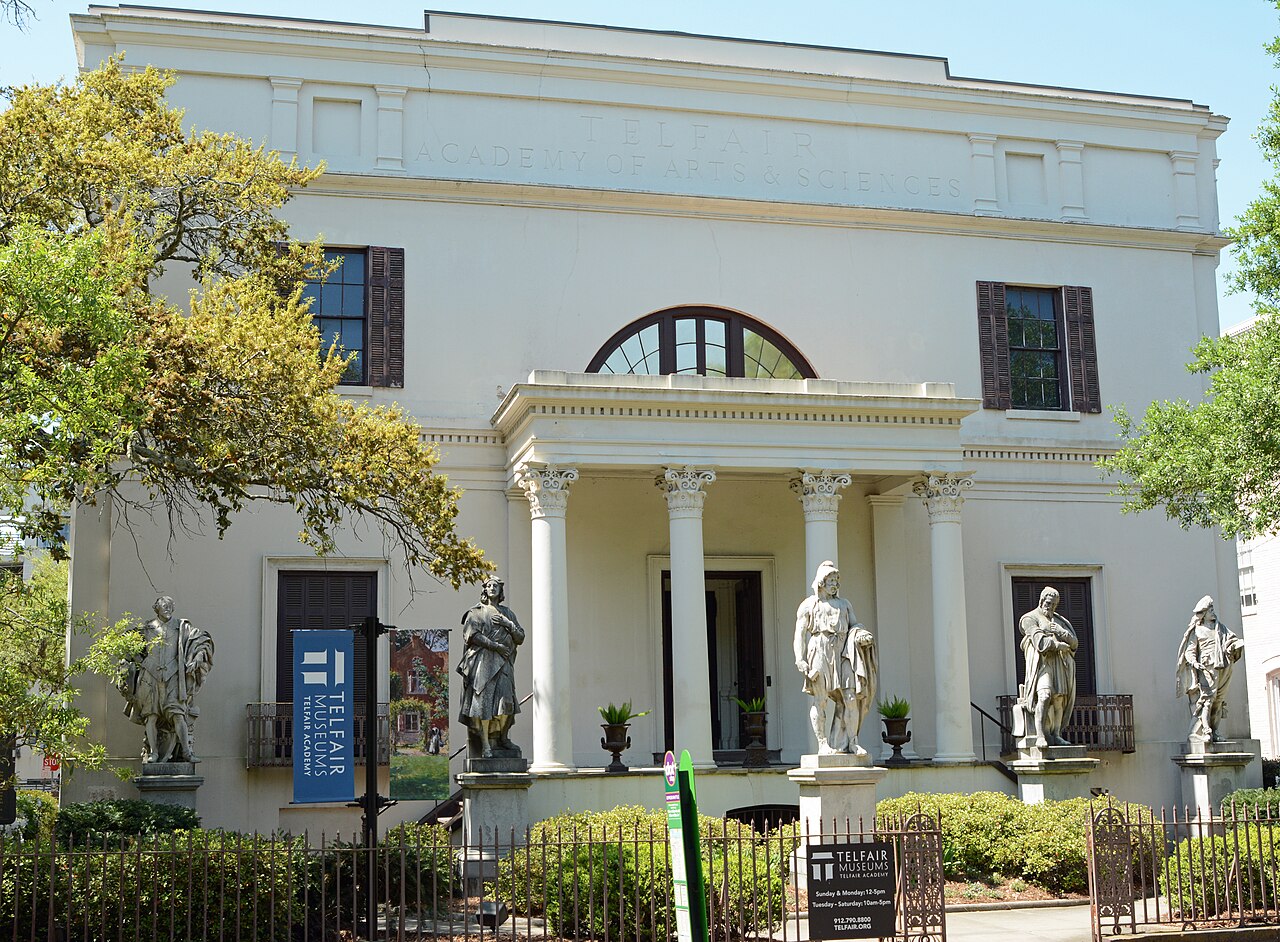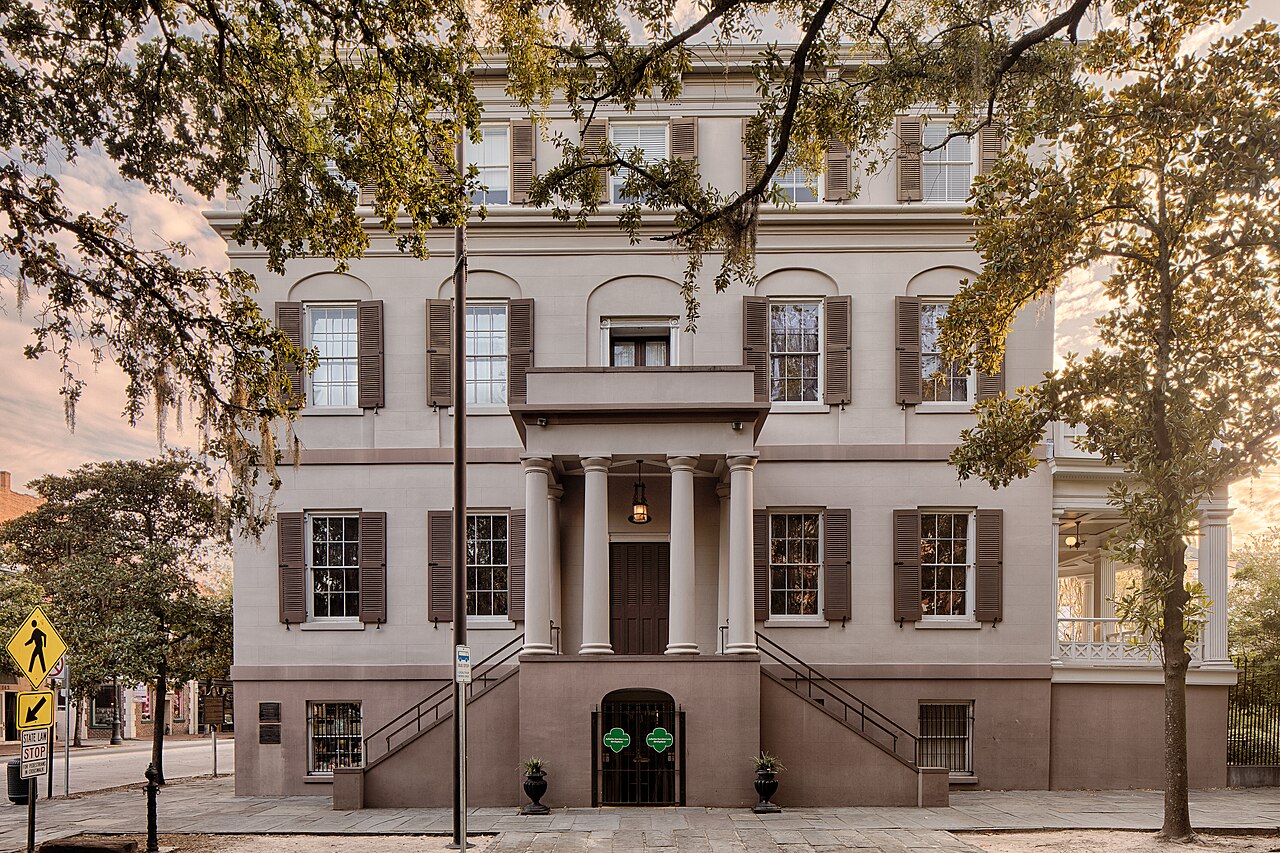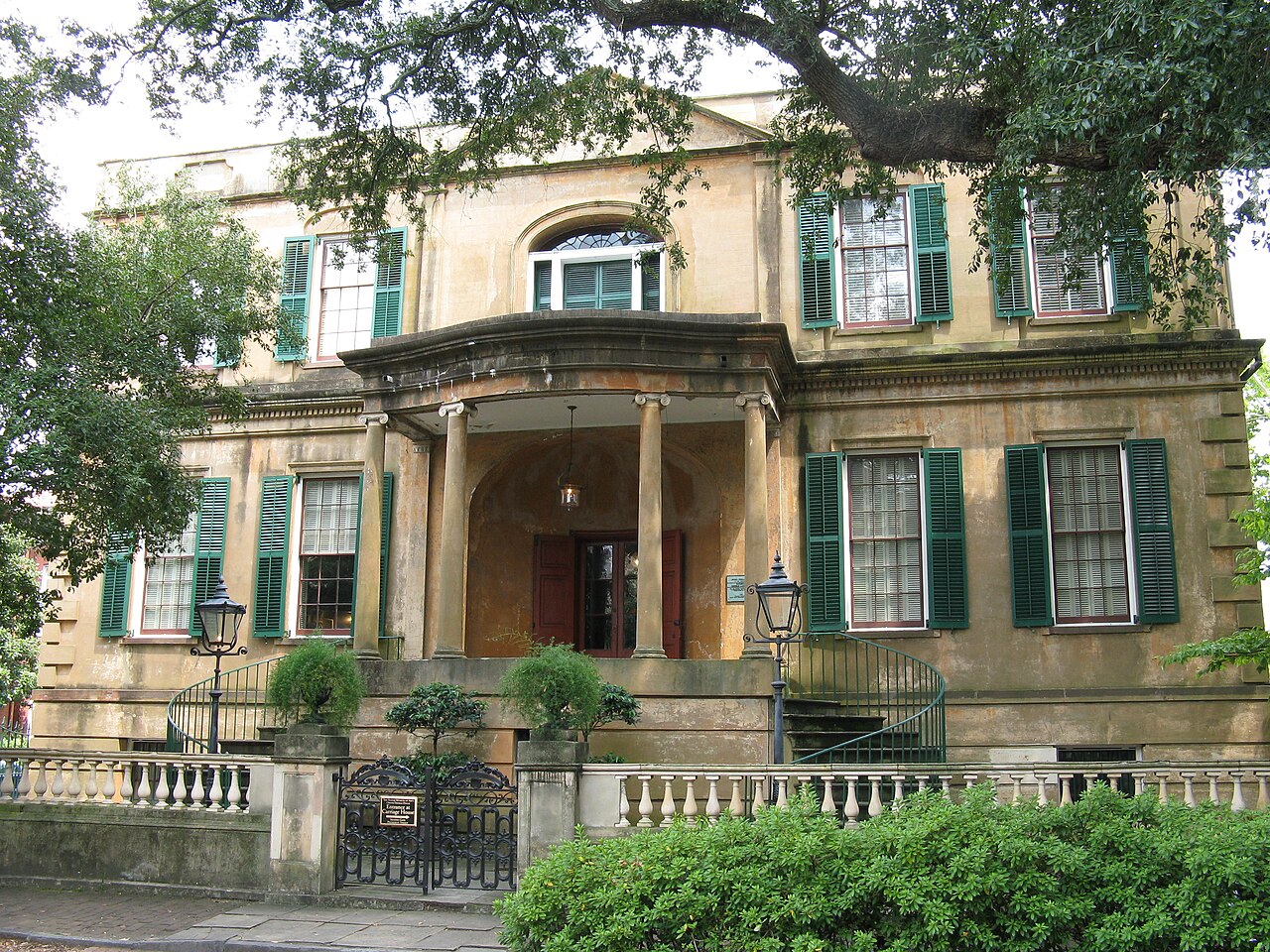
The Owens-Thomas House is the finest building on any Savannah house tour and the most important one, because it refuses to tell only half the story. The English architect William Jay arrived in Savannah in 1817 to supervise its construction, and the house he finished in 1819 for the merchant and banker Richard Richardson is the best-preserved example of his work in the city: a symmetrical Regency villa of tabby and coquina with iron in its joists, columns and shutters, a curving entrance stair, a Coade stone balustrade along the street, and a cast-iron balcony on the south facade shipped from England in pieces — considered the first large-scale structural use of cast iron in American architecture. It was also the first house in Savannah with indoor plumbing, fed by a rainwater cistern in the central hall, with a marble tub and a flushing water closet in the master suite. The Marquis de Lafayette stayed here in 1825 and addressed the crowd from the house, once in English and once in French. Then the tour crosses the garden to the carriage house, whose north half held the quarters of the five to fourteen enslaved people who worked the household at different times — one of the most intact urban slave quarters in the South. Telfair Museums renamed the site to include the quarters and rebuilt the tour around both households, a model other historic homes have followed. Fit: history travelers first, couples who like architecture with substance, and any first trip that wants the city's beauty and its foundations in the same hour.
The household history runs like a novel. The Richardsons lost two children and Frances Richardson died in 1822; Richard lost his fortune and the house, which passed to the Bank of the United States and was rented out as a boarding house — Lafayette's 1825 visit came during that interlude. In 1830 George Welshman Owens bought it: lawyer, mayor, state legislator and congressman, and an enslaver of more than four hundred people across his plantations. He added rooms on the second story around 1833, the only structural change the house ever saw. His granddaughter Margaret Thomas left the property and its contents to the Telfair in 1951, and the first floor opened as a museum in 1954. The decorative arts collection, mostly Owens family furnishings from roughly 1750 to 1830, means the rooms are dressed with what was actually here rather than with lookalikes.
The tour's power comes from the walk between the two buildings. The parterre garden, laid out in 1956 by the Savannah landscape architect Clermont Lee, occupies what was once a hard-working service yard enclosed by a tabby wall; the basement kitchen and service rooms under the mansion were where the enslaved household cooked and labored; and the quarters above the carriage house, with their small heating fireplaces, are where they lived. Guides connect specific people to specific rooms, and the interpretation is direct without being performative — visitors leave understanding how a Savannah townhouse functioned as a system of people, not just a display of furniture. If you tour the Davenport House as well (this guide's museum entry), do this one second: Davenport is the preservation story, Owens-Thomas the fuller picture of who made the city's elegance possible.
Practicals: the house is seen only by guided tour, with small groups of about a dozen leaving at frequent intervals through the day and the last tour starting late afternoon; tours run forty-five minutes to an hour. Even with a ticket bought in advance you check in on site for a tour time, so arrive a little early in spring and October. The same seven-day Telfair ticket covers the Telfair Academy and Jepson Center, and the museums close on Mondays. There is no elevator, and the tour includes stairs in the house and the carriage house. The address is 124 Abercorn Street on Oglethorpe Square, a short walk from Colonial Park Cemetery and the Davenport House.
What to expect
The experience
Small-group guided tours of the Regency mansion, basement service rooms, parterre garden, carriage house and the intact urban slave quarters.
Best time
Mornings for the smallest groups and the garden in good light; tours fill on spring and October weekends.
How long
Forty-five minutes to an hour on the tour, plus time in the garden.
Tips
Check in on site for a tour time even with an advance ticket. Look up at the cast-iron balcony from the garden side. Pair with Davenport House the same morning — two great houses, two very different stories.
Quick picks
- Best for
- Architecture lovers and history travelers who want the whole story of a Savannah townhouse.
- Families
- Best for older children and teens; the stairs and the subject matter suit them more than toddlers.
- Couples
- The district's most beautiful interior, then a walk through Oglethorpe and Columbia squares.
- Pair with
- Davenport House two squares away; the Telfair Academy on the same seven-day ticket.
- Time needed
- About an hour, booked into a morning of house museums.
Good questions
Is the Owens-Thomas House included in the Telfair ticket?+
Yes. One Telfair Museums ticket covers the Owens-Thomas House & Slave Quarters, the Telfair Academy and the Jepson Center, with unlimited visits for seven days. Check in at Owens-Thomas for a guided tour time.
Why are the slave quarters important?+
They are among the most intact urban slave quarters in the South, and the tour uses them to tell the story of the enslaved people who built, ran and lived in the household — not as an add-on but as half of the house's history.
Who designed the house?+
William Jay, the young English architect who also designed the Telfair mansion and other landmarks in the city. He came to Savannah in 1817 to oversee construction, and the house was completed in 1819.
Is it accessible?+
Not fully. There is no elevator, and the tour involves stairs in the main house and the carriage house. Contact the museum ahead if mobility is a concern.
Owens-Thomas or Davenport House?+
Both if you can. Davenport is the preservation rescue and Federal-style elegance; Owens-Thomas is the finer architecture and the deeper interpretation of slavery. With time for only one, choose Owens-Thomas.