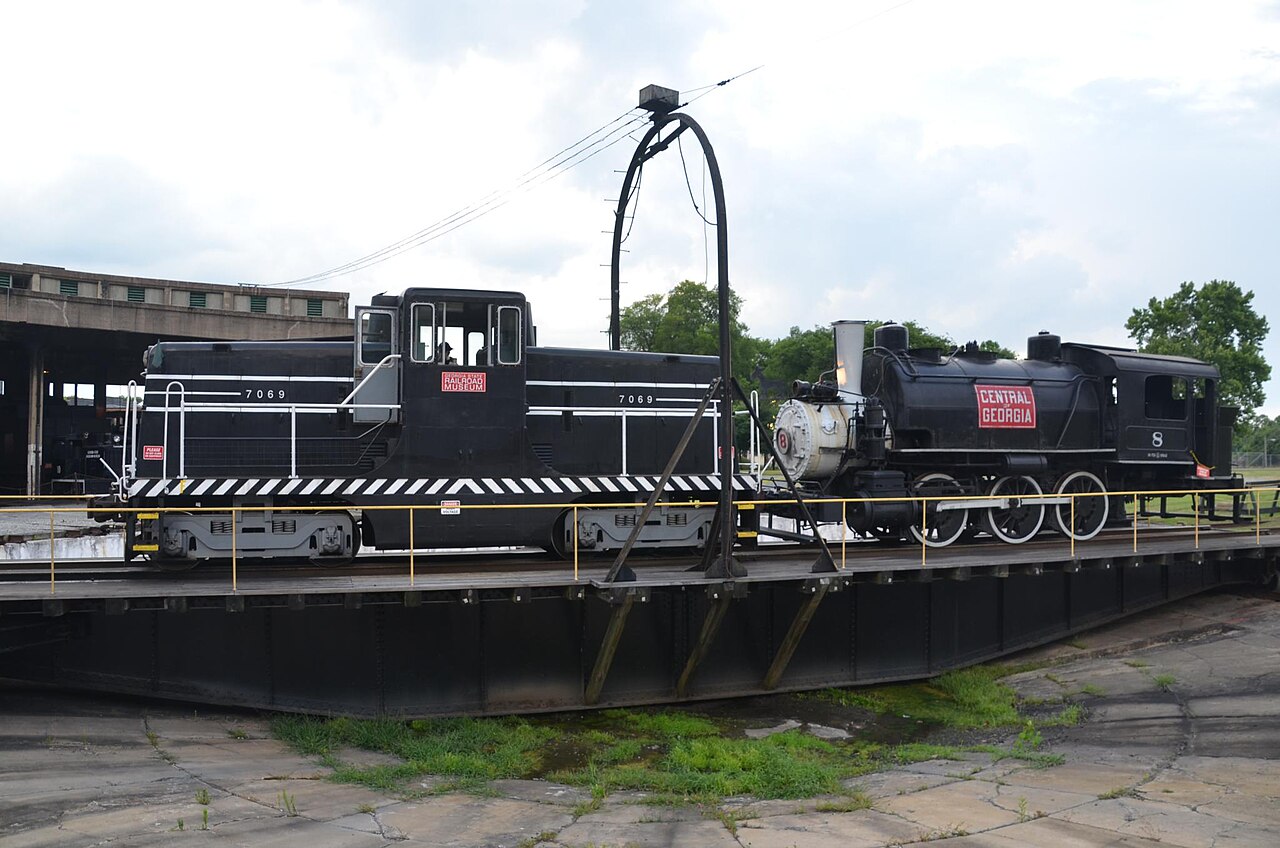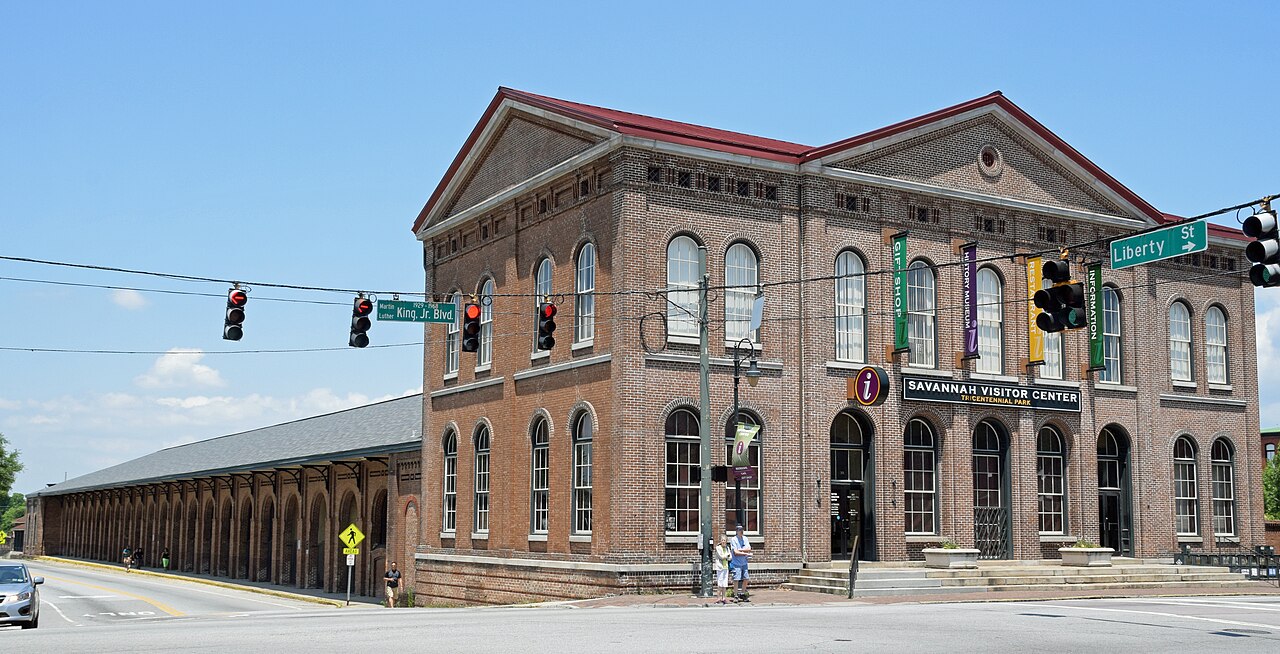
The Savannah History Museum is the stop that makes every other stop in this guide make more sense, and it is ideally placed to do so: it fills the old Central of Georgia Railway passenger station and train shed beside the city's Visitor Information Center on Martin Luther King Jr. Boulevard, where many visitors park, start the trolley, or arrive by tour bus. The station handled passengers until 1972, and the Coastal Heritage Society has run the museum inside it since 1990. The exhibits move through the city's story in an hour: the Yamacraw people and their leader Tomochichi, whose alliance with James Oglethorpe made the 1733 colony possible; the town plan that produced the squares; the Revolutionary War and the October 1779 Battle of Savannah; the cotton economy and the enslaved labor that built it; the Civil War and Sherman's arrival; and the twentieth-century city of preservation fights, port growth and film fame. Objects carry it — a Central of Georgia steam locomotive parked in the train shed, a carriage that belonged to Juliette Gordon Low, a collection of evening gowns spanning the 1800s to the 1960s — and the crowd-pleaser is the Forrest Gump bench, displayed here while Chippewa Square, where the film's bench scenes were shot, has none. Next door, Battlefield Memorial Park marks the redoubts of the 1779 battle. Fit: first trips that want context early, families who need a short indoor stop with a famous prop, and history buffs who want the overview before the specialist house museums.
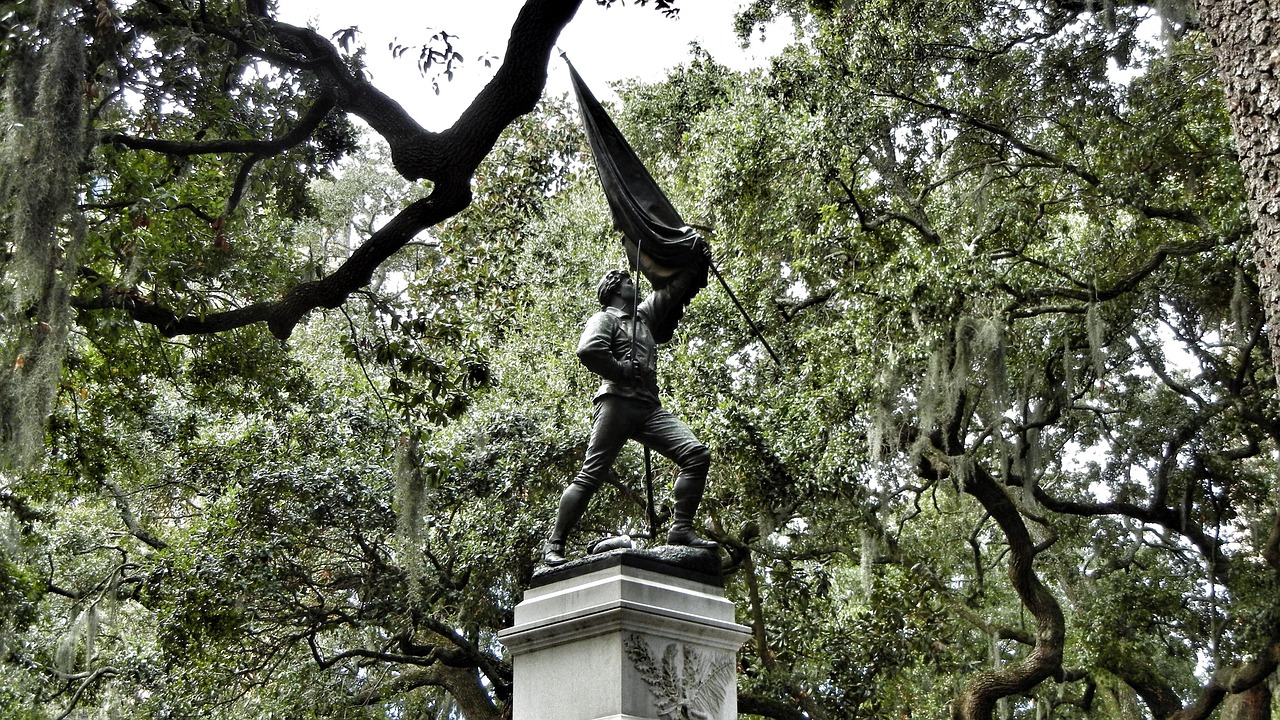
The Revolutionary chapter is the one most visitors know least, and the museum and the adjacent park make it vivid. On October 9, 1779, a combined French and American force, with Haitian volunteers among the French troops, assaulted the British lines around Savannah; the attack failed with heavy losses, and it is counted as one of the bloodiest single engagements of the war, with about 800 killed or wounded among the attackers. The Polish cavalry officer Casimir Pulaski was mortally wounded in the fighting — his monument stands in Monterey Square — and the Spring Hill redoubt reconstructed in Battlefield Memorial Park, steps from the museum doors, marks where much of the fighting happened. Reading the battle in the museum and then walking the park takes half an hour and changes how the squares' monuments read for the rest of the trip.
The station building is part of the exhibit. Its train shed, with the locomotive and heavy timber roof, is one of the more atmospheric museum spaces in Savannah, and the Coastal Heritage Society's other sites — the Georgia State Railroad Museum and the Savannah Children's Museum — are steps away in Tricentennial Park, so families can build a morning without moving the car. The galleries are compact and largely self-guided, which keeps the visit to about an hour; history buffs will want longer with the colonial and Revolutionary sections, while children gravitate to the locomotive and the bench.
Practicals: open daily through the day, closed on a few major holidays; admission is modest, with reduced prices for children, and the Coastal Heritage Society's multi-site options include the railroad museum and its other sites. Parking is available at the visitor center garage and lots, and the Old Town Trolley's main stop is right outside, which makes the museum a smart first hour before boarding. The bench is a photo stop, so expect a short queue at busy times. Visitors who want to see where the bench scenes were actually filmed can walk ten minutes east to Chippewa Square, on the Bull Street spine, where the film crew set up along the north side of the square; standing there after seeing the prop is a small, satisfying piece of movie geography. History buffs should save time for the colonial galleries, which introduce Tomochichi and the Yamacraw alliance properly — context that makes the boulder honoring him in Wright Square far more meaningful later in the trip.
What to expect
The experience
Self-guided galleries in the 19th-century Central of Georgia passenger station and train shed, from Tomochichi and Oglethorpe through the Civil War and the film era, with Battlefield Memorial Park next door.
Best time
Early in the trip, ideally the first morning, before boarding the trolley outside.
How long
About an hour, plus half an hour for the battlefield park.
Tips
Do it first — it frames the squares, forts and house museums. Walk to the 1779 redoubt in Battlefield Memorial Park afterward. The Railroad Museum is steps away for a two-museum morning.
Quick picks
- Best for
- First-time visitors who want the whole story in an hour before exploring.
- Families
- Short, indoor and fun — a real locomotive, a famous bench and a battlefield to run around.
- Couples
- A smart, efficient start to a history-focused trip before the trolley loop.
- Pair with
- Georgia State Railroad Museum across the park; the Old Town Trolley from the stop outside.
- Time needed
- An hour, ninety minutes with the battlefield.
Good questions
Is the Forrest Gump bench really there?+
Yes, the bench from Forrest Gump is displayed in the museum. The film's bench scenes were shot in Chippewa Square, which never had a permanent bench of its own.
What was the Battle of Savannah?+
A failed French and American assault on British-held Savannah on October 9, 1779 — one of the bloodiest engagements of the Revolutionary War. Battlefield Memorial Park, beside the museum, marks the site.
How long do I need?+
About an hour in the galleries, plus thirty minutes if you walk the battlefield park next door.
Is it a good first stop?+
Yes — it is the best orientation in the city and sits beside the visitor center and the trolley's main stop, so it fits naturally at the start of a trip.
Where do I park?+
At the visitor center lots and garage on Martin Luther King Jr. Boulevard. From there the historic district is a short walk or a trolley ride.