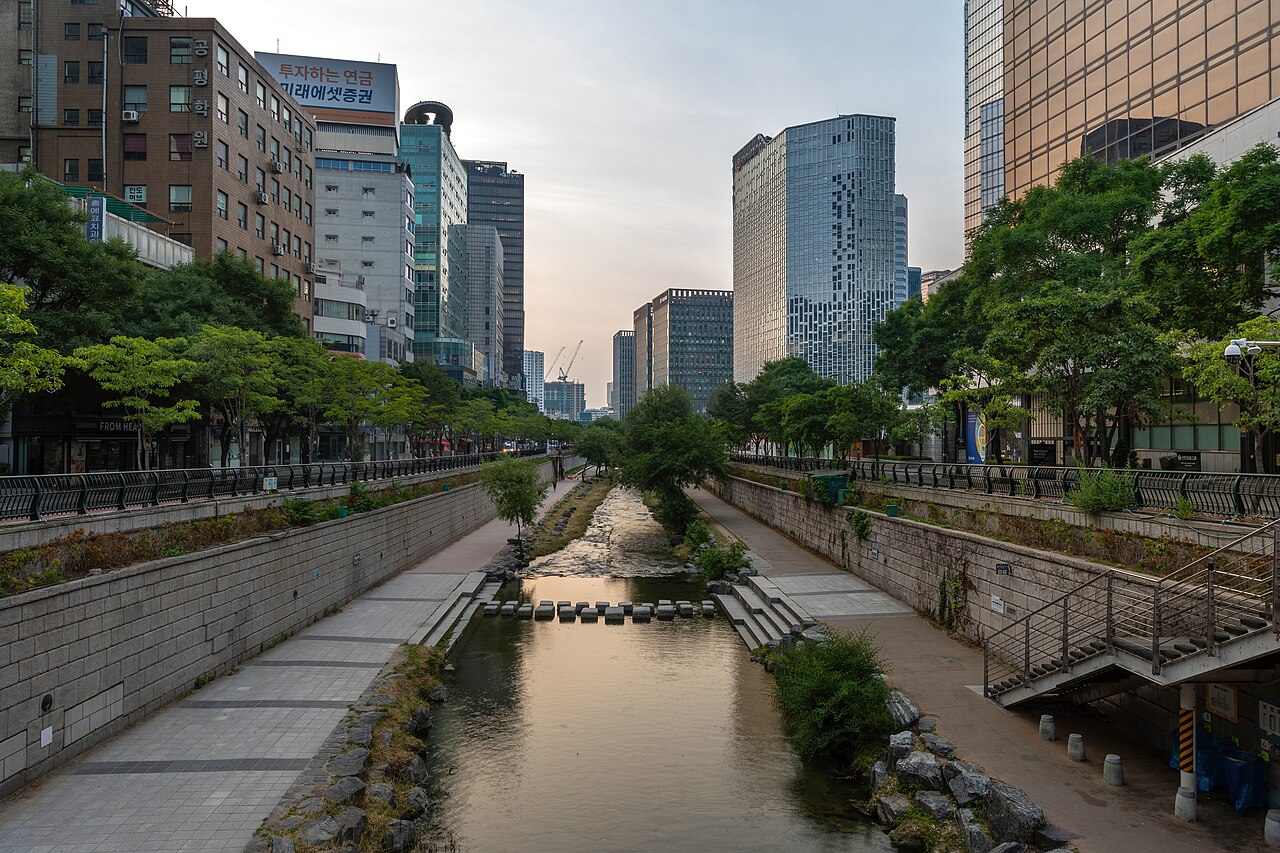
Cheonggyecheon is the best urban walk in Seoul and one of the most famous city regeneration projects in the world. The stream has run through the middle of the old capital since the Joseon dynasty, when it served as the city's drain and its laundry and the dividing line between the aristocratic north and the commoners' south. In the decades after the Korean War it was paved over and buried beneath a road and then an elevated highway, the symbol of breakneck industrialization. In 2003 the city tore the highway down and restored the stream, reopening it in 2005 as a sunken park that now runs for kilometers eastward from Cheonggye Plaza near Gwanghwamun, a few meters below street level. The effect is remarkable: step down the stairs from the traffic and you are suddenly beside running water, willows and reeds, with the noise of the city fading above you. The walkways follow both banks beneath twenty-two bridges, some of them restored historic crossings, with stepping stones to hop across, waterfalls and fountains, murals and public art, and seating where office workers dip their feet in summer. At its head, Cheonggye Plaza is marked by a towering spiral sculpture and a cascading fountain, and it hosts events through the year. The stream is especially magical at night, when the paths are softly lit, and at the end of each year it becomes the stage for the Seoul Lantern Festival, when giant illuminated sculptures float on the water. Further east, the Cheonggyecheon Museum tells the story of the stream's burial and resurrection. For visitors it is both a lovely stroll and a useful shortcut, linking Gwanghwamun, Jonggak, Euljiro, Dongdaemun and the markets on foot.
The stream is open twenty-four hours a day and free, though access to the lower walkway can be closed during heavy rain, when the water rises quickly. The most attractive stretch is the first two or three kilometers from Cheonggye Plaza to around Gwangjang Market, which takes under an hour at a stroll. From there you can climb up to Gwangjang for a market lunch, continue to Dongdaemun and the DDP, or keep going for a longer, quieter walk eastward toward the Cheonggyecheon Museum.
Look out for the Seoul Outdoor Library events, when the plaza fills with beanbags and books, summer evenings when locals cool their feet in the water, and the Seoul Lantern Festival at the end of the year, when the stream is busiest and most spectacular. In spring the willows and forsythia make the banks bright green and yellow. Bring comfortable shoes; the stepping stones are fun but uneven, and some stairs down to the stream are steep, though there are elevators and ramps at points along the route.
Eleven subway stations sit near the stream. Gwanghwamun Station on Line 5 and City Hall Station on Lines 1 and 2 are closest to Cheonggye Plaza, and Jonggak, Euljiro, Jongno 3-ga and Dongdaemun stations all lie within a few minutes of the banks further east. Because it links so many sights, Cheonggyecheon is the ideal connecting walk on a downtown day: Gyeongbokgung or Deoksugung in the morning, the stream in the afternoon, and Gwangjang Market or Ikseon-dong for dinner.
What to expect
The experience
A sunken, landscaped stream walkway through downtown Seoul with stepping stones, bridges, fountains, public art and seasonal festivals.
Best time
Evenings, when the banks are lit; late in the year for the Seoul Lantern Festival; spring for willows and blossoms.
How long
An hour for the main downtown stretch, longer if you continue east.
Tips
Start at Cheonggye Plaza and walk east to Gwangjang Market for lunch. The lower path can close in heavy rain. Stepping stones are uneven.
Quick picks
- Best for
- A free, relaxing walk that connects the downtown sights.
- Families
- Children love the stepping stones and fountains; keep an eye on them near the water.
- Couples
- An evening stroll under the lit bridges is one of Seoul's simplest pleasures.
- Pair with
- Deoksugung, Gwangjang Market or DDP Dongdaemun.
- Time needed
- One to two hours.
Good questions
Is Cheonggyecheon free?+
Yes. The stream walkway is free and open twenty-four hours a day, although the lower path can be closed for safety during heavy rain.
Where does the walk start?+
At Cheonggye Plaza near Gwanghwamun and City Hall, marked by a large spiral sculpture and fountain. From there the stream runs east.
How long is the walk?+
The most attractive stretch, from Cheonggye Plaza to around Gwangjang Market, takes under an hour at a stroll. The full stream continues much further east.
When is the lantern festival?+
The Seoul Lantern Festival is held on the stream at the end of each year, with illuminated sculptures on the water. Check Visit Seoul for exact dates.
Why is the stream famous?+
It was buried under a road and elevated highway for decades. The highway was demolished in 2003 and the stream restored as a park, a landmark of urban regeneration.