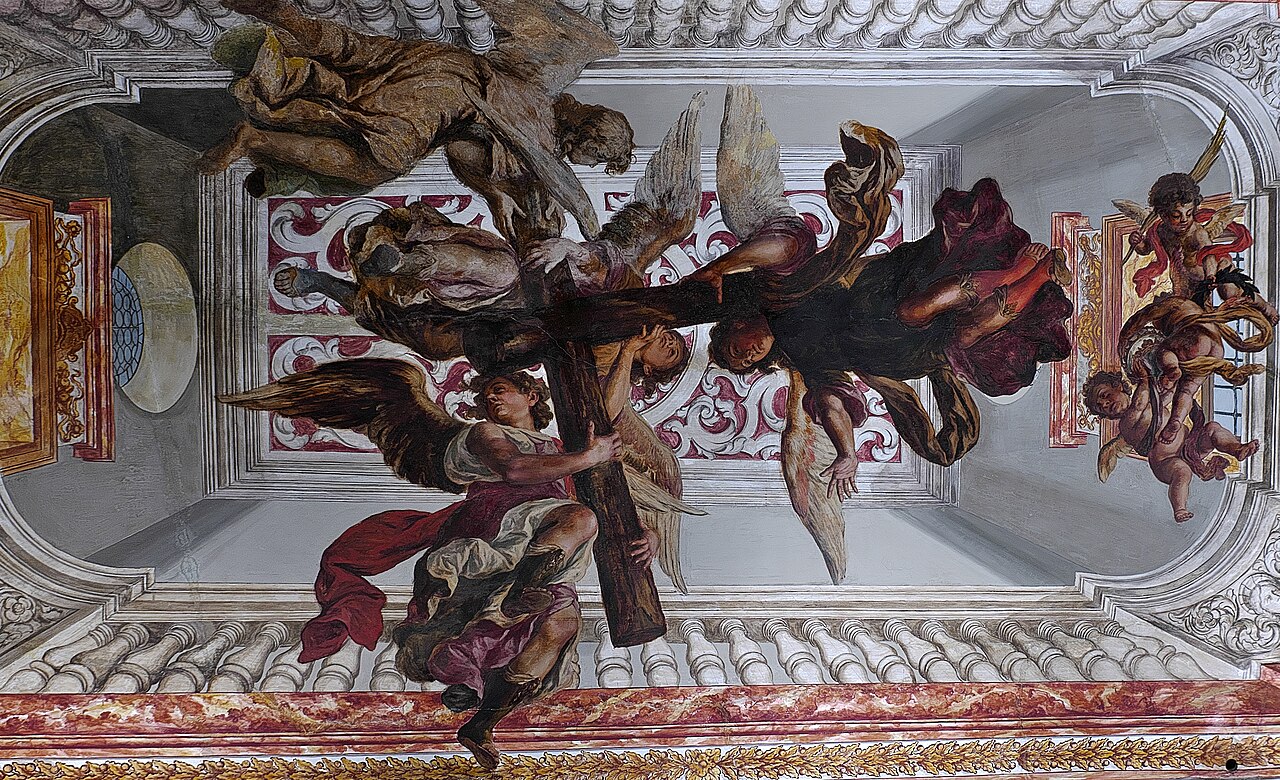
In the middle of the Barrio de Santa Cruz, on a small square of the same name, stands one of the finest Baroque buildings in Seville, and one that most visitors walk straight past. The Hospital de los Venerables was founded in 1675 by Justino de Neve, a canon of the Cathedral and a friend and patron of Murillo, as a residence for elderly and retired priests, the venerables of its name. It was designed by Leonardo de Figueroa, the leading architect of the Sevillian Baroque, and built around a beautiful two-storey courtyard with arcaded galleries and a central fountain set in a sunken basin reached by circular steps lined with tiles, one of the most photographed patios in the city. A grand staircase under an elliptical vault leads to the upper floor. The jewel of the building is the church, a single nave covered from floor to vault in painting. The frescoes of the presbytery, showing the Invention of the Holy Cross, are by Juan de Valdés Leal, Murillo's great contemporary and rival, while the nave was painted by his son, Lucas Valdés, with scenes of the triumph of the Church painted to look like hanging tapestries. The main altarpiece holds Lucas Valdés's Apotheosis of Saint Ferdinand, and the church also has sculptures by Juan Martínez Montañés and Pedro Roldán. Murillo painted one of his most famous Immaculate Conceptions for the hospital; it is now in the Prado, but the connection with the Golden Age painters runs through the whole building. Today the hospital is the headquarters of the FOCUS Foundation, which restored it and created the Diego Velázquez Research Centre here after acquiring his painting of Santa Rufina in 2007, so that Seville once again has an important work by its greatest native artist.
Visiting: the building is open for tourist visits on most days, with an inexpensive entry fee and an audio guide, and it hosts temporary exhibitions, lectures and concerts, including organ recitals in the church. Check the hospital's own website or ask at the tourist office for current hours and any free-entry times. Allow forty-five minutes to an hour. The courtyard and church are the essentials; the Velázquez Centre's gallery adds a focused look at the painter and the art of his time in Seville.
Why it is worth it: Seville has many Baroque churches, but few are as complete, as harmonious and as uncrowded as the Venerables. It is the perfect place to discover Valdés Leal, a painter of dramatic, sometimes macabre intensity, and to see Velázquez in the city where he was born and trained before he left for Madrid and the court. The courtyard, with its sunken fountain and the quiet sound of water, is a calm refuge from the crowded lanes of Santa Cruz, and the building rarely feels busy. Art lovers who have seen the Museo de Bellas Artes will find it a natural complement.
Getting there and around: the hospital is on the Plaza de los Venerables, in the centre of Santa Cruz, a five-minute walk from the Cathedral and the Real Alcázar. Combine it with a wander through the lanes of the old Jewish quarter, the Callejón del Agua along the Alcázar wall and the Jardines de Murillo, or schedule it right after the Alcázar, whose exit is close by. The squares around it, including the Plaza de Doña Elvira and the Plaza de Santa Cruz, are among the prettiest in the city, and there are tapas bars on every corner, although the best value lies a few streets away from the main tourist routes. The Interpretation Centre of the Jewish Quarter nearby adds context to the history of Santa Cruz.
What to expect
The experience
A self-guided visit with audio guide to a Baroque hospital: the sunken tiled courtyard, the painted church and the Velázquez Research Centre gallery.
Best time
Any time; it is rarely busy. Combine with the Alcázar, whose exit is close by.
How long
Forty-five minutes to an hour.
Tips
Look up in the church: the nave is painted to imitate tapestries. Check for organ concerts. Combine with the lanes of Santa Cruz.
Quick picks
- Best for
- Art lovers and anyone who wants a calm Baroque interior in the middle of Santa Cruz.
- Families
- A short visit; the courtyard and its fountain are the highlights for children.
- Couples
- One of the most beautiful and quiet courtyards in Seville, perfect after the Alcázar.
- Pair with
- The Real Alcázar, the Barrio de Santa Cruz and the Museo de Bellas Artes.
- Time needed
- About an hour.
Good questions
What was the Hospital de los Venerables?+
A residence for elderly and retired priests founded in 1675 by Justino de Neve, a canon of the Cathedral and patron of Murillo.
Is there a Velázquez painting?+
Yes. The FOCUS Foundation acquired Velázquez's Santa Rufina in 2007 and created the Diego Velázquez Research Centre in the building.
Who painted the church?+
Juan de Valdés Leal painted the presbytery frescoes and his son Lucas Valdés the nave, with scenes painted to look like tapestries.
How much does it cost?+
The entry fee is modest, with an audio guide. Check the current hours and any free-entry times before you go.
Where is it?+
On the Plaza de los Venerables in the Barrio de Santa Cruz, five minutes on foot from the Cathedral and the Alcázar.