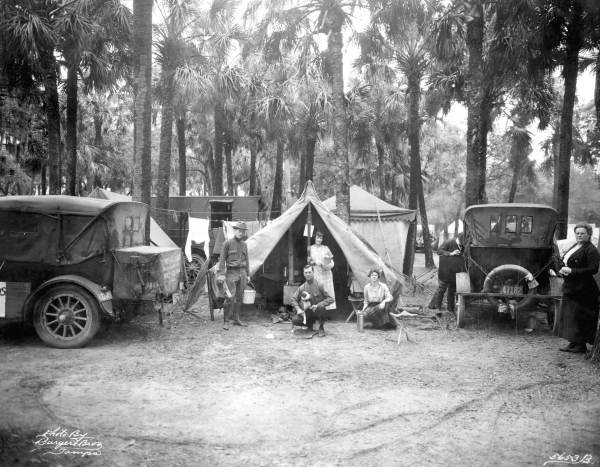
Once the boat drops you, the island's attractions charge nothing — and together they're one of Florida's strangest historic sites. The Egmont Key Lighthouse has burned since 1858 (rebuilt stout after hurricanes wrecked the original), survived the Civil War's light-dousing games, and still works: an active aid to navigation at the bay's front door, its white tower the island's landmark from every angle. Around and south of it sprawls Fort Dade — not a single fort but a vanished town: built for the Spanish-American War, peaking at 300 residents with brick streets, electricity, a hospital, tennis courts, and a movie theater, abandoned by 1923 and surrendered to palms and tortoises since. The brick main street still runs the island's spine; Batteries McIntosh, Guy Howard, and their siblings stand in varying states of noble collapse (some fenced, some walkable, the western ones literally in the Gulf feeding the snorkel tours); and interpretive markers tell the layered story, the Seminole internment chapter included, with refuge-grade honesty. Bring water, sun cover, and curiosity — the island provides the rest.
Egmont's strategic logic never changed
Whoever holds the key holds Tampa Bay's front door. The Tocobaga fished it; the Seminole Wars put a grim internment camp on it (the refuge now marks that history plainly — hold a moment at the memorial); the 1858 light went up to thread shipping through the channel and was dark only briefly when Confederate keepers fled with the lens; and the Spanish-American War panic of 1898 built Fort Dade in earnest — concrete batteries with disappearing guns, a garrison town to serve them, and a sister installation across the channel at Fort De Soto.
The guns never fired at an enemy. The town thrived anyway for two decades (the tennis court is still findable in the palms), then emptied when the war logic moved on, leaving the Gulf Coast's best-preserved military ghost town to the tortoises and the light keepers — and, since 1974, to the wildlife refuge that now owns the island's rules.
Walking it is self-guided and better for it. From the landing, the lighthouse cluster sits north — the 1858 tower (exterior viewing; the working light is automated now), keepers' village foundations, and the northern batteries with their swallowed stairwells. The brick road runs south under cabbage palms: magazine mounds, the hospital site, Battery Guy Howard's long gallery, and the island's resident gopher tortoise aristocracy grazing the verges (federal protection, total right-of-way, no touching — the rangers mean it).
The western shoreline shows the Gulf's patient demolition — batteries tilted into the swash, rebar gardens the snorkel boats anchor over — while the southern third is posted bird sanctuary, closed to entry, its tern and skimmer colonies the refuge's actual priority. Shade is scarce, facilities are minimal, and the hurricane years have rearranged dunes and paths more than once: the island you walk is a working ruin in every sense.
Visit craft
The site needs two-to-four unhurried hours, which the ferry schedule happily provides; mornings beat afternoons for heat and light alike; and the photographer's hours are the first and last ashore — brick road shadows, battery geometry, the tower against Gulf haze. There's no admission beyond your boat ticket, no gift shop, and no vending machine for a thousand yards of history — pack in, pack out, and leave the artifacts where a century put them (collecting is a federal offense and the rangers patrol). Pair this entry with whichever boat suits (ferry for time ashore, snorkel cruise for the drowned half of the same fort), and read the island-hopping guide for the Shell Key and De Soto pairings that make it a weekend theme.
What to expect
The experience
A self-guided walk through a military ghost town — the working 1858 lighthouse, Fort Dade's brick main street and batteries, tortoises with right-of-way, and a posted bird sanctuary holding the southern third. Free once your boat lands you.
Best time
Morning hours ashore — cooler bricks, softer light, livelier tortoises. First-boat arrivals get the ruins before anyone else's footprints.
How long
Two to four hours covers tower, town, and batteries at a wander.
Tips
Water and sun cover are non-negotiable; shade is scarce. Give tortoises the path — federal rules, cheerfully enforced. Artifacts stay where the century left them. Respect the posted sanctuary; the birds were here first.
Quick picks
- Best for
- History walkers — a free-roam ruins site with a working lighthouse, un-themed and unstaffed in the best way.
- Families
- A fort to explore, tortoises to count, and a beach at every turn — self-guided means kid-paced.
- Couples
- The brick road at golden hour before the last boat — the Gulf's most photogenic ghost town to yourselves.
- Pair with
- Whichever boat brought you — and Fort De Soto's sister batteries across the channel for the full 1898 story.
- Time needed
- Two to four hours ashore.
Good questions
Does the lighthouse still work?+
Yes — automated now, but an active aid to navigation since 1858 minus a brief Civil War blackout. The tower is viewed from outside; the village foundations around it tell the keepers' story.
What was Fort Dade?+
A Spanish-American War fortress town — 300 residents, brick streets, electricity, a movie theater — abandoned by 1923. The batteries and main street remain; the western guns are now the snorkel site.
Is there an entrance fee?+
Nothing beyond your boat ticket — the island is a state park within a national wildlife refuge, self-guided, with no concessions of any kind. Pack accordingly.
What are the rules?+
Refuge rules: tortoises and nesting birds outrank visitors, the southern sanctuary is closed, artifacts stay put, and pack-in-pack-out applies. The island stays wild because they're enforced.
How has hurricane damage changed it?+
The 2024 storms rearranged dunes and vegetation and closed the island for recovery months; it's open and walkable again, with the landscape visibly healing — part of the place's working-ruin character now.