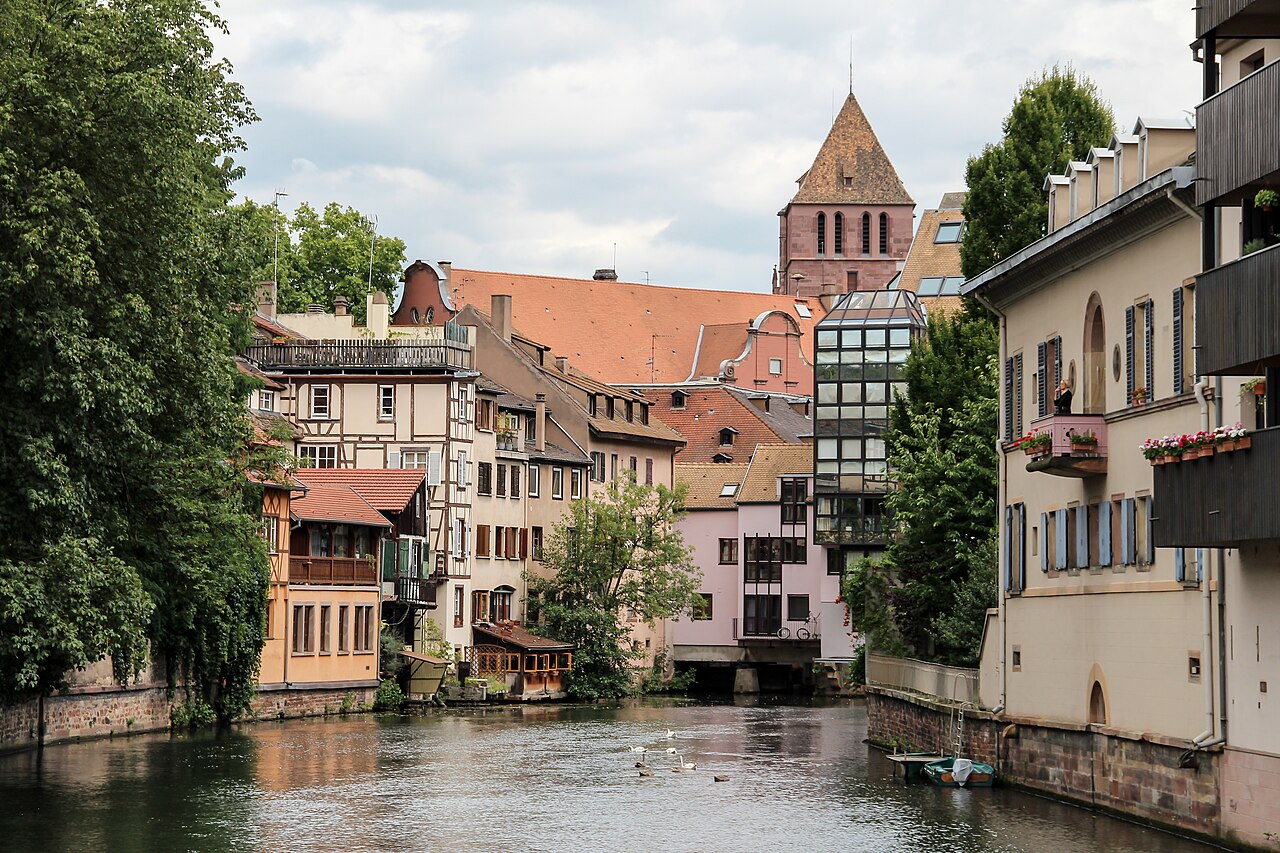
Petite France is the picture most people have of Strasbourg before they arrive, and it lives up to it. At the western end of the Grande Île, the island formed by the branches of the Ill, the river splits into canals lined with half-timbered houses from the 16th and 17th centuries, many of them once the homes and workshops of tanners, millers and fishermen, with steep roofs and open lofts where hides were dried. Flowers spill from window boxes in summer, and in December lights and decorations cover the facades. Just west, the Covered Bridges with their medieval towers guard the old entrance to the city, and beyond them the Vauban Dam, a 17th-century defensive weir, offers a classic view back over the rooftops to the cathedral spire. From Petite France, the lanes lead east across the island past squares and landmarks such as the richly carved Kammerzell House beside the cathedral. The whole Grande Île, together with the Neustadt built by the German Empire after 1870, is listed by UNESCO. This page links to the tourist office’s three-day guide, which covers the walk.
How to visit: Petite France is free and open at all hours, a ten-minute walk from Strasbourg station and from the cathedral. A natural loop starts at the cathedral, follows the Rue Mercière and the Rue des Dentelles to the canals, crosses the Covered Bridges and ends at the Vauban Dam for the view, then returns along the quays. Trams stop at Alt Winmärik and Faubourg National on the edge of the quarter. The cobbles are uneven, so wear comfortable shoes, and expect a swing bridge and locks that pause boat traffic on the canals.
What to expect: in daytime the lanes fill with walkers and tour groups, especially on weekends and through the Christmas market, when Square Louise Weiss in Petite France hosts the Advent Village. Early morning and evening are far calmer and better for photographs. Restaurants in the old houses serve Alsatian classics such as tarte flambée and choucroute; book for weekend dinners.
Making the most of it: see the quarter twice, once on foot and once from the water on a Batorama boat tour, which passes through the canals here. In the Neustadt, east of the island, the grand imperial avenues show a completely different side of the city.
What to expect
The experience
A self-guided walk through canalside lanes of half-timbered houses, across the Covered Bridges and up to the Vauban Dam viewpoint.
Best time
Early morning or after dark for the quietest lanes; December evenings for the Christmas lights and the Advent Village.
How long
One to three hours, depending on stops for coffee and photographs.
Tips
Walk out to the Vauban Dam for the classic view back over Petite France to the cathedral spire.
Quick picks
- Best for
- First-timers, photographers and couples who want the postcard Strasbourg.
- Families
- Children enjoy watching the swing bridge and the boats in the locks, and the walk is short and flat.
- Couples
- An evening stroll along the lit canals, followed by dinner in a half-timbered winstub.
- Pair with
- A Batorama boat tour from the cathedral landing stage, or the cathedral itself at the other end of the island.
- Time needed
- One to three hours.
Good questions
Is Petite France free to visit?+
Yes, it is a public quarter of streets, canals and bridges, open at all hours. You only pay for cafés, restaurants or a boat tour.
How far is Petite France from Strasbourg station?+
It is about a ten-minute walk from the station. The cathedral is a similar distance in the other direction.
What is the best viewpoint in Petite France?+
The Vauban Dam, just beyond the Covered Bridges, looks back over the canals and rooftops to the cathedral spire. It is a favourite at sunset.
Is Petite France part of the Christmas market?+
Yes, Square Louise Weiss in Petite France hosts the Advent Village during the market. In 2026 the market runs from 27 November to 24 December.
Is the Grande Île a UNESCO site?+
Yes, the Grande Île and the Neustadt are listed together as UNESCO World Heritage. The Neustadt was built by the German Empire after 1870.