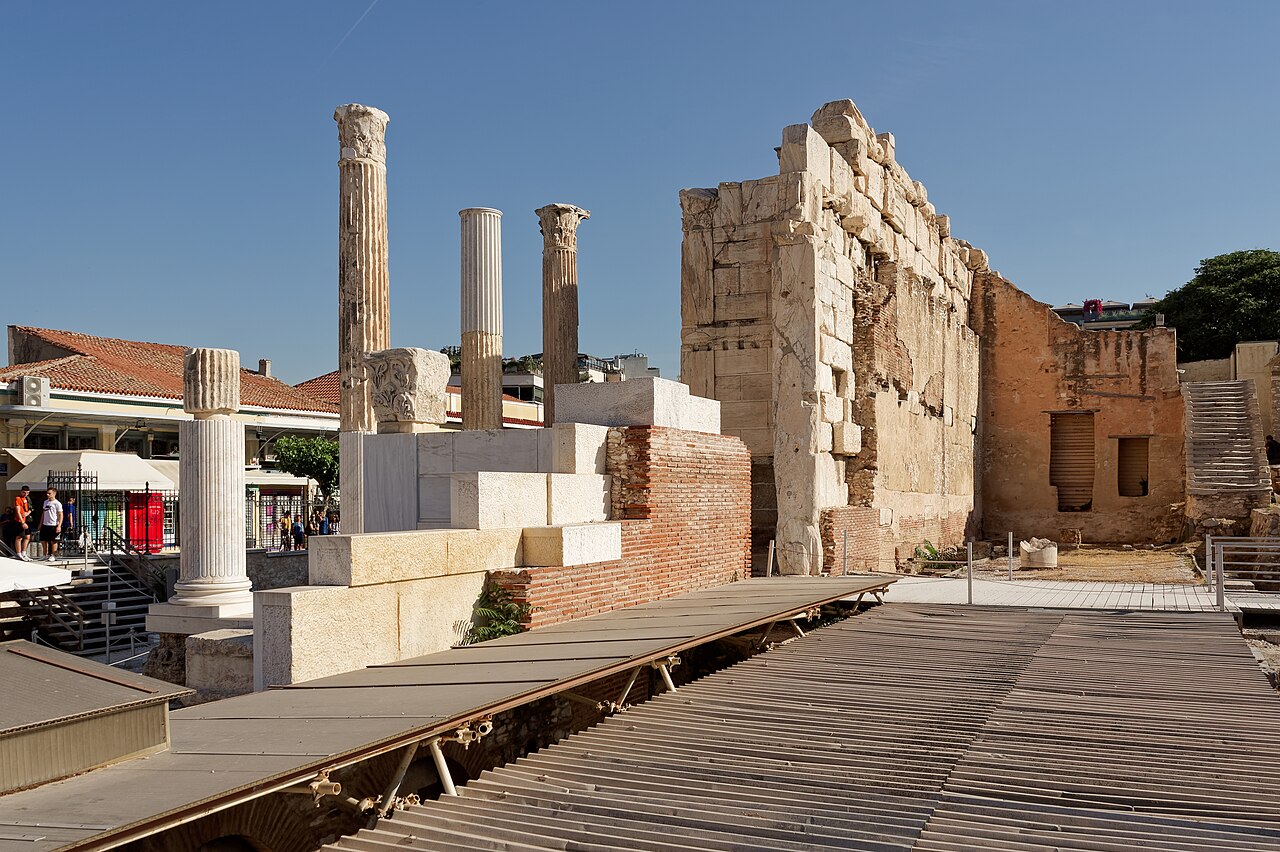
Hadrian's Library is the ruin most people see before they realise it is a ruin. Its tall row of Corinthian columns lines Areos Street just off Monastiraki Square, where crowds pour out of the metro, and many visitors photograph it without ever going in. That is a shame, because behind the facade lies one of the most interesting sites in central Athens. The Roman emperor Hadrian, who loved Athens and lavished buildings on it, created this complex in AD 132 as part of his plan to make the city the cultural capital of his empire. It was not a library in the modern sense but a great rectangular enclosure, with a garden and a long pool in the centre surrounded by a colonnade of about a hundred columns, and on the eastern side halls that held book rolls, reading rooms and lecture spaces. It was, in effect, a philosophy school, a public archive and a place of learning rolled into one. The library was damaged during the Herulian raid of AD 267 and later incorporated into the city's late Roman wall. Then the site kept being reused. In the fifth century a large four-apsed church, the Tetraconch, was built in the courtyard; later came a Byzantine basilica and then a smaller church, and the area remained a busy part of the town through the Ottoman period. Walking around today, you can trace these layers in the foundations, column bases and mosaic fragments, with the Acropolis looming over the southern side. The visit is short and rewarding. Walk along the inside of the western wall to appreciate the scale of the facade, look for the foundations of the Tetraconch in the middle of the courtyard, and find the eastern rooms where the book rolls were kept. Information panels explain the phases clearly. Because the site is right next to Monastiraki, it is easy to slot in between the flea market, the Roman Agora and the Ancient Agora.
Why it is worth paying to go inside: the facade alone is impressive, but inside you understand the ambition of Hadrian's Athens. The enclosure once matched the size of a large city square, and it was decorated with fine marble from across the empire. The library helps explain how Athens survived as a centre of learning long after it had lost its political power: under Roman rule it was still the place where wealthy young Romans came to study rhetoric and philosophy. The later churches built inside show how the city adapted its monuments rather than abandoning them, and the site is one of the clearest places in Athens to see that continuity.
Tickets and hours: Hadrian's Library has its own ticket, ten euros for adults with a reduced rate for eligible visitors, sold at the gate and on the official Hellenic Heritage platform. The old combined ticket covering several sites has been discontinued, so each site is paid separately. From April to August the site is open from early morning into the evening; hours shorten through September and October, and from November to March it closes in the mid-afternoon. Entry is free on certain dates, including the first and third Sundays of the month from November to March. The accessible entrance is on Dexippou Street, about a hundred metres from the main entrance, with a dirt path along the eastern side and adapted toilets on site.
Making the most of it: give yourself forty-five minutes. Pair it with the Roman Agora immediately to the south and the Ancient Agora a short walk west; together they make a superb morning of Roman and classical Athens before the Acropolis in the afternoon. Next to the library, the former Tzistarakis Mosque on Monastiraki Square holds a small collection of Greek folk ceramics. And when you come out, the flea market streets, the souvlaki grills of Mitropoleos Street and the rooftop bars around Monastiraki Square are all within a few steps.
What to expect
The experience
A self-guided walk around the walled enclosure of Hadrian's AD 132 library complex: the Corinthian facade, the courtyard where a garden and pool once lay, the eastern book rooms and the foundations of later churches.
Best time
Early in the day in summer, when Monastiraki is still calm. In winter the site closes in the mid-afternoon, so go in the morning.
How long
About forty-five minutes.
Tips
Read the panels near the entrance to understand the building phases. Use the Dexippou Street entrance for step-free access. Combine it with the Roman Agora next door and the Ancient Agora nearby.
Quick picks
- Best for
- Travellers who want to understand how Athens evolved from classical city to Roman university town to Byzantine and Ottoman neighbourhood.
- Families
- Short and flat, with space to wander, though younger children will enjoy the busy flea market outside more.
- Couples
- A calm morning stop before the bustle of Monastiraki, followed by a drink on a nearby rooftop with Acropolis views.
- Pair with
- The Roman Agora and the Ancient Agora, then the flea market and Psirri for lunch.
- Time needed
- Under an hour.
Good questions
Was Hadrian's Library a real library?+
Partly. Built in AD 132, it was a large cultural complex with rooms for book rolls, reading and lectures arranged around a colonnaded garden courtyard with a pool. It worked as a library, archive and school all at once.
How much does it cost to enter Hadrian's Library?+
The full ticket is ten euros, with a reduced ticket for eligible visitors. Entry is free on some dates, including the first and third Sundays of each month from November to March.
What are the opening hours?+
The site opens early every day. From April to August it stays open into the evening, closing times step earlier through September and October, and from November to March it closes in the mid-afternoon. Last entry is about twenty minutes before closing.
Is Hadrian's Library accessible?+
Partly. There is an accessible entrance on Dexippou Street with a dirt path along the eastern side and adapted toilets, but no accessible route along the western facade. A companion is recommended.
Is it included in a combined ticket?+
Not any more. The old multi-site combined ticket has been discontinued, so Hadrian's Library is sold separately. Some resellers offer bundles of other sites, but check what each one includes.