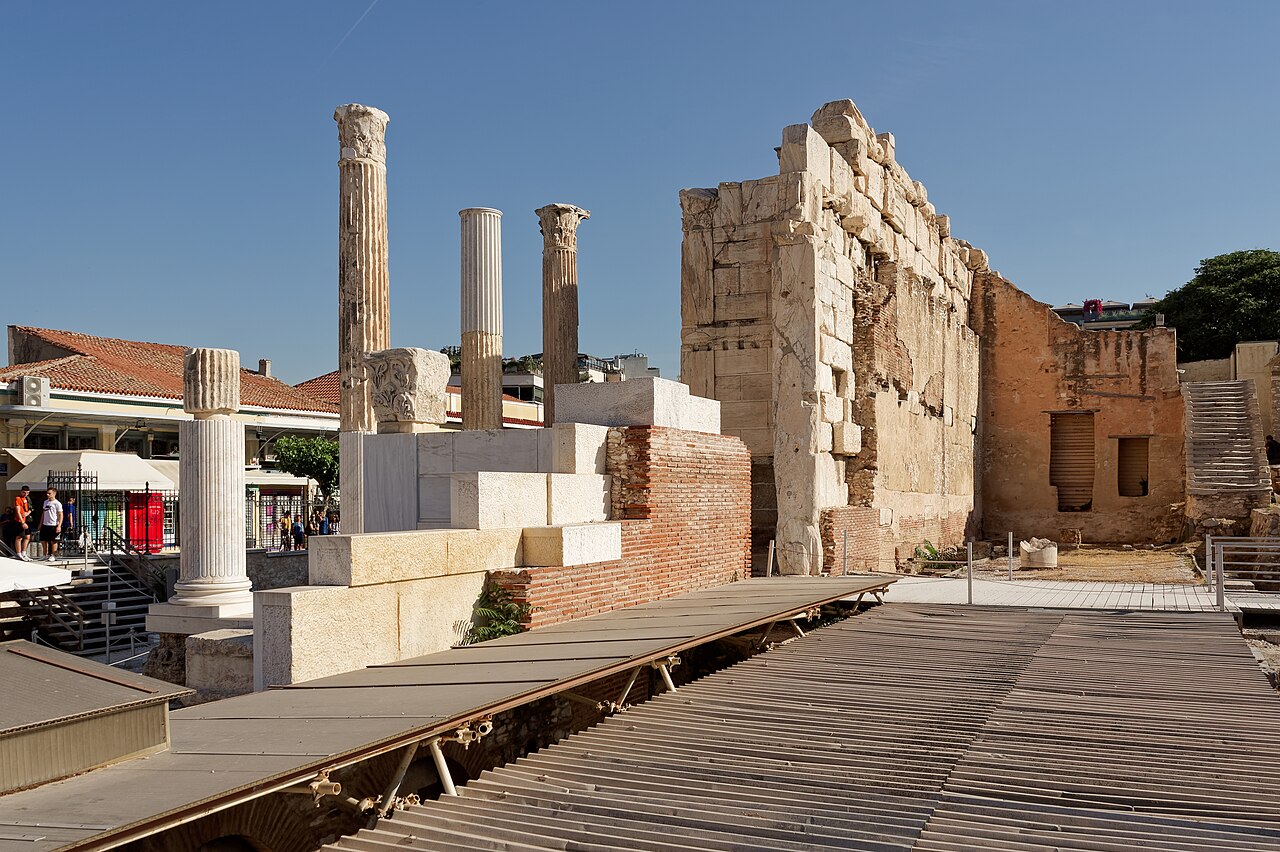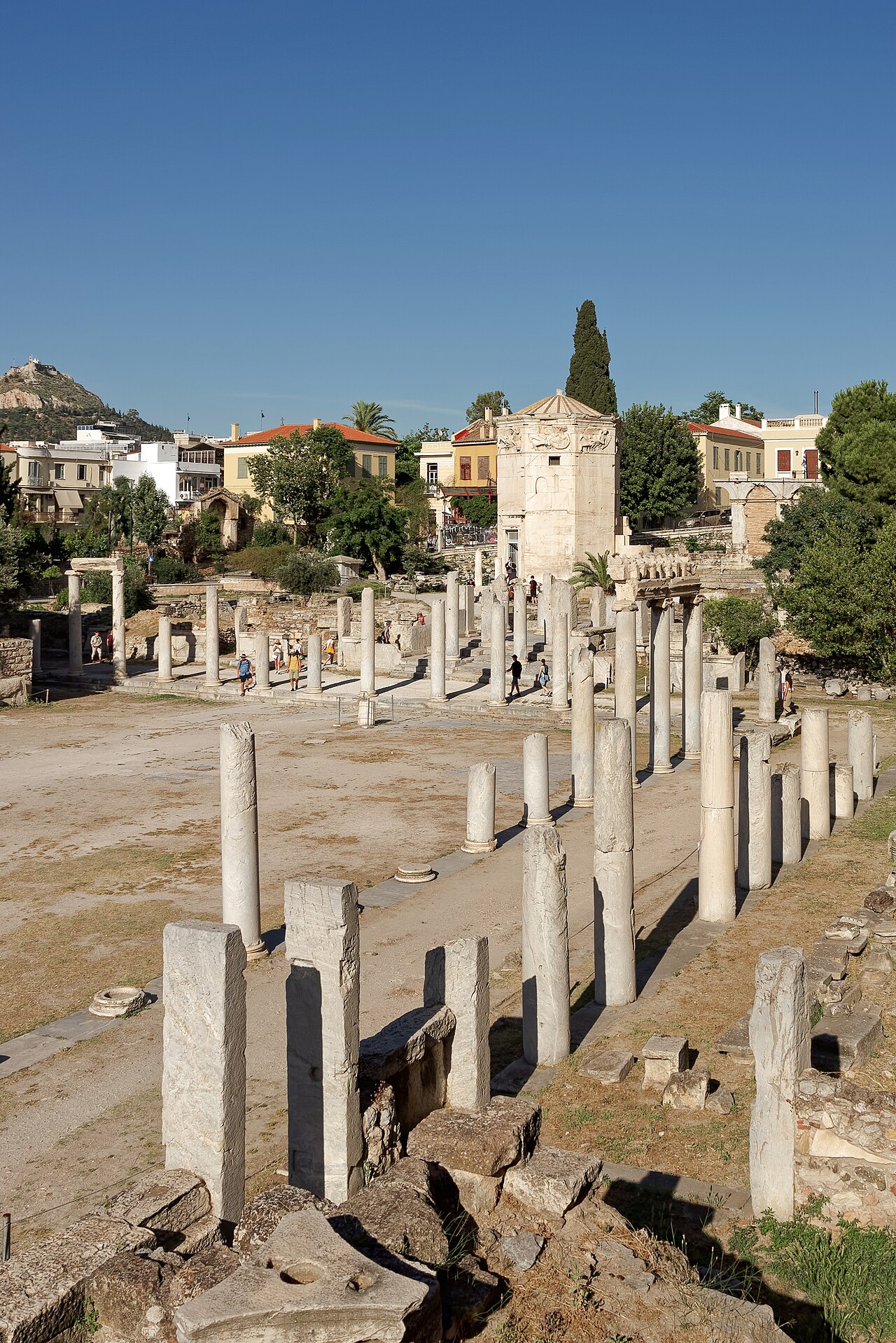
The Roman Agora is the quietest of the big-name ruins in central Athens, and that is exactly its charm. When the old Greek agora below the Acropolis became too cluttered with monuments, Athens built a new, more orderly marketplace a short walk to the east, paid for with gifts from Julius Caesar and Augustus and completed in the last years of the first century BC. It was a large rectangular courtyard surrounded by colonnades and shops, and it served as the commercial heart of the city under Roman rule. You enter beside the Gate of Athena Archegetis, a handsome Doric gateway with four columns that still stands to its full height on the western side. Inside, the courtyard is scattered with column stumps, paving and fragments, and the eye is drawn at once to the Tower of the Winds at the far end. Built by the astronomer Andronikos of Kyrrhos around the first century BC, this octagonal marble tower is one of the best-preserved ancient buildings in Athens. Each of its eight sides faces a compass point and carries a relief of the corresponding wind god, from cold, bearded Boreas in the north to gentle Zephyros in the west. Below the reliefs are the lines of sundials, and inside the tower there was a water clock fed from the slopes of the Acropolis, so the building told time in sunshine and in shade. After a careful restoration the interior can be seen again, and it is worth peering in to appreciate how solid and well engineered the tower is. Around the site you will also find the Fethiye Mosque, one of the few Ottoman mosques left in Athens, the remains of a public latrine and the foundations of an office of the market inspectors. The whole site is small enough to see in under an hour, and it sits right on the busy pedestrian streets between Monastiraki and Plaka, so it fits easily into any day in the old town.
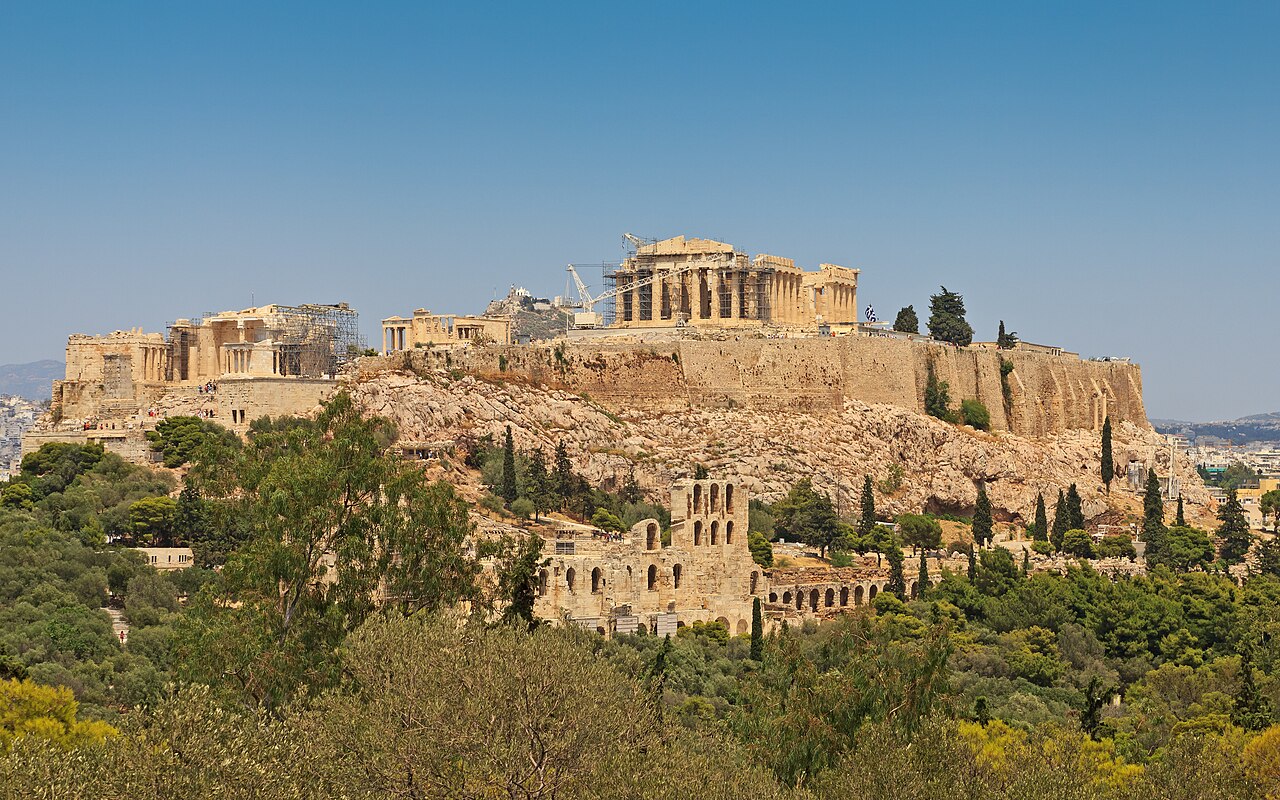
Why it deserves your time: most visitors walk past the railings, glance at the Tower of the Winds and move on. Go inside and the place makes much more sense. You can stand in the courtyard where Athenians bought oil, cloth and spices under Roman rule, see the line of the colonnades and imagine the noise of a working market, then look up at the Acropolis rising behind the tower. It is a reminder that Athens did not stop at the age of Pericles; it remained a prestigious university city and a favourite of Roman emperors for centuries. The Tower of the Winds is also one of the most influential small buildings ever made: it inspired weather vanes, observatories and garden follies across Europe, including the Radcliffe Observatory in Oxford.
How to visit: the Roman Agora has its own ticket, sold at the gate and through the official Hellenic Heritage platform, and it is far cheaper than the Acropolis. The old multi-site combined ticket has been discontinued, so plan on buying separate tickets for each site you want to see. Opening hours follow the usual pattern for Athens archaeological sites, long in summer and closing in the mid-afternoon from November to March, with last entry shortly before closing. On some winter Sundays and national days entry to state sites is free. There is little shade inside, so in summer go early, when the marble is cool and you may have the courtyard almost to yourself.
Combining it: the Roman Agora sits between Hadrian's Library to the north, the Ancient Agora to the west and the lanes of Plaka and Anafiotika to the south and east, all within a few minutes' walk. A good half-day route starts at the Ancient Agora when it opens, continues to Hadrian's Library and the Roman Agora, then climbs through Anafiotika toward the Acropolis for an afternoon slot. Monastiraki Square, with its metro station and food stalls, is around the corner, and the cafes on the street along the northern railings look straight onto the Tower of the Winds, a lovely place for a coffee after your visit.
What to expect
The experience
A small, self-guided archaeological site: the Gate of Athena Archegetis, the colonnaded courtyard of the Roman market, the octagonal Tower of the Winds with its wind-god reliefs and sundials, the Fethiye Mosque and a Roman latrine.
Best time
Right at opening in summer, before the heat, or any time in the cooler months. Winter hours end in the mid-afternoon.
How long
Forty-five minutes to an hour.
Tips
Look for each wind god on the tower and match it to the compass direction. Combine the visit with Hadrian's Library and the Ancient Agora, each a few minutes away, and buy separate tickets, since the combined ticket is gone.
Quick picks
- Best for
- History lovers who want Roman Athens without the crowds of the Acropolis.
- Families
- Small enough for short attention spans; children enjoy spotting the eight wind gods and finding the ancient latrine.
- Couples
- A quiet morning wander, then coffee at a cafe facing the Tower of the Winds on the edge of Plaka.
- Pair with
- Hadrian's Library next door, the Ancient Agora a short walk west, and lunch around Monastiraki.
- Time needed
- Under an hour, or half a day with the neighbouring sites.
Good questions
What is the Tower of the Winds?+
An octagonal marble tower built by the astronomer Andronikos of Kyrrhos around the first century BC. Each face shows a carved wind god, sundials are cut below, and inside there was a water clock, making it an ancient weather station and public clock in one.
Is the Roman Agora worth visiting?+
Yes, if you enjoy ancient sites. It is small and uncrowded, and the Tower of the Winds is one of the best-preserved ancient buildings in Athens. It also shows a side of the city, its Roman era, that the classical sites do not.
Do I need a separate ticket for the Roman Agora?+
Yes. The old multi-site combined ticket has been discontinued, so the Roman Agora sells its own ticket at the gate and through the official Hellenic Heritage platform. It is much cheaper than the Acropolis ticket.
Can you see the Tower of the Winds without a ticket?+
You can see the outside of the tower clearly from the surrounding streets, but to walk through the market courtyard, see the gate up close and look inside the tower you need a ticket.
How do I get there?+
It is a five-minute walk from Monastiraki metro station, on the pedestrian streets between Monastiraki and Plaka, with Hadrian's Library immediately to the north.