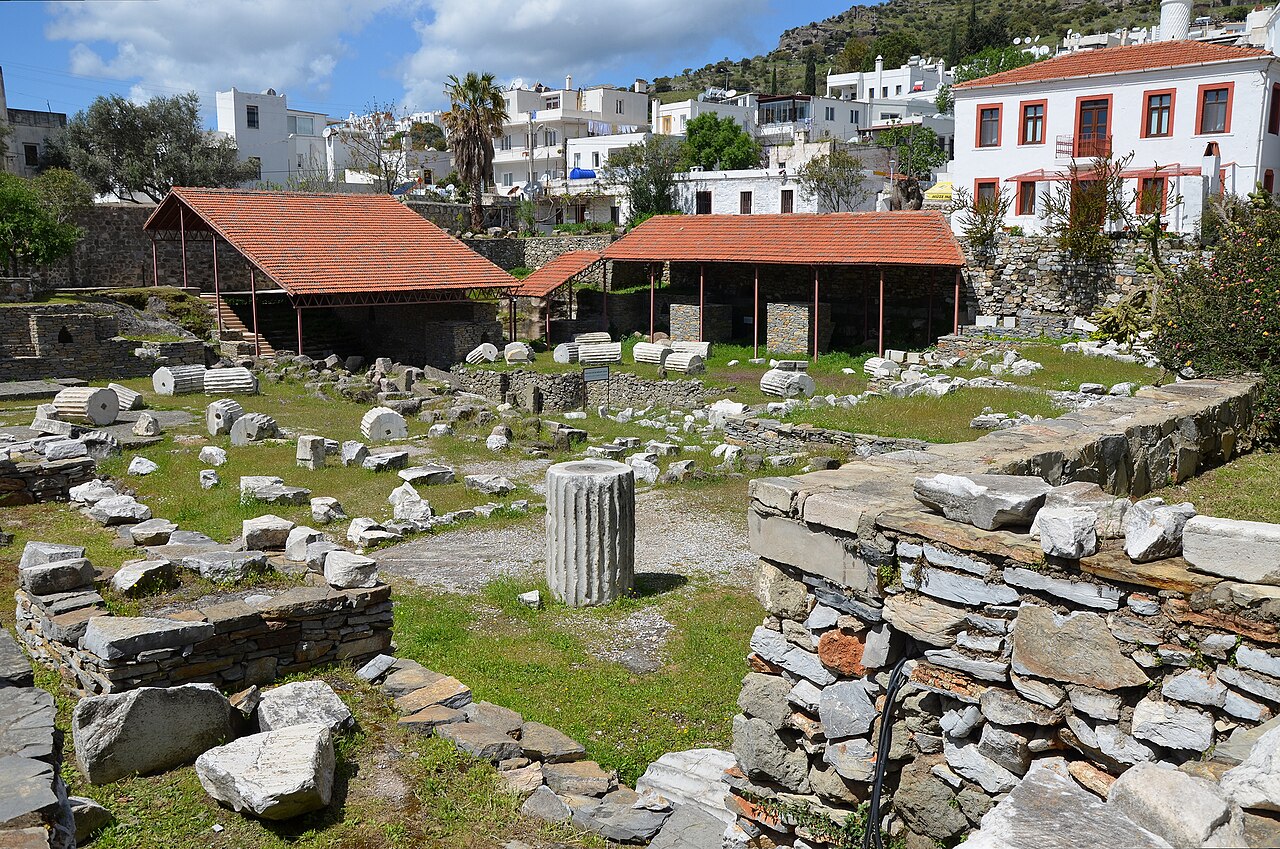
The Mausoleum at Halicarnassus was the monumental tomb of Mausolus, a king and satrap of Caria under Persian rule. Construction began in his lifetime and continued after his death under his wife and sister, Queen Artemisia II, and the structure rose roughly 42 metres, with a high podium, a colonnaded gallery, a stepped pyramid roof and a marble chariot group on top. Ancient writers credit the architect Pytheos, and the sculptors Bryaxis, Timotheos, Leochares and Skopas are said to have decorated it. It became one of the Seven Wonders of the Ancient World and gave every grand tomb since its name. An earthquake on 8 August 1304 badly damaged the monument, and the knights who built Bodrum Castle later quarried its stones. In 1857 British archaeologists removed the surviving reliefs and statues to the British Museum, where they are still displayed. What you see today is an open-air archaeological site: a platform and foundation trenches, with display panels and a model that explain what once stood here.
Manage your expectations and the visit becomes rewarding. This is not a standing ruin like Ephesus; it is a quiet, excavated plot in the middle of town where imagination does most of the work. The most useful way to see it is to arrive with the picture in your head: a tall white-marble block with a ring of columns, a stepped roof and a four-horse chariot at the summit, visible from the harbour to sailors approaching Halicarnassus.
The site's information panels and model help, and a short read of the story beforehand makes the foundation trenches much more vivid.
Where it fits
The site is a ten to fifteen minute walk from the castle, so the natural order is the Mausoleum first, then the castle, where you can spot ancient blocks reused in the walls and the museum's Carian finds. The municipality describes the site as an open-air museum, so there is no long queue or timed entry to plan around.
Opening arrangements and any entry fee can change, so check with the Bodrum Municipality or the gate when you arrive, and allow about half an hour. If you have time for only one ancient site, choose the castle; if you like a story, add this.
Practical notes
Wear a hat in summer, as shade is limited, and keep a bottle of water. The site is flat and easy to walk, which makes it good for older visitors, and the surrounding streets have cafes where you can sit with the guidebook. For another layer of the same history, continue to the ancient theatre on the hillside and the Myndos Gate on the western edge of town, both part of the walls and monuments Mausolus commissioned when he moved his capital to Halicarnassus.
What to expect
The experience
A short self-guided stop at the excavated site, with information panels and a model explaining the vanished tomb.
Best time
Morning or late afternoon, when it is cooler and the light is good for photographs.
How long
Half an hour is enough; add time if you read every panel.
Tips
Read about the monument before you go, bring water in summer, and pair it with the castle, which contains stones from the tomb.
Quick picks
- Best for
- History lovers and anyone who wants the full story of ancient Halicarnassus.
- Families
- Short and flat, so easy with children, though the story matters more than the ruins.
- Couples
- A quiet stop on a walking day through the old town, followed by coffee nearby.
- Pair with
- Bodrum Castle, the ancient theatre and the Myndos Gate.
- Time needed
- Thirty to forty-five minutes.
Good questions
What is left of the Mausoleum at Halicarnassus?+
The foundations, a platform and excavation trenches remain, with panels and a model that explain the lost monument. The sculptures were removed to the British Museum in 1857.
How tall was the Mausoleum?+
The structure is described as about 42 metres high, with a podium, a colonnade, a pyramid roof and a chariot group on top.
Why is it called a mausoleum?+
The tomb of King Mausolus was so famous that his name became the word for any grand tomb.
Can I see the original sculptures?+
The surviving reliefs and statues are in the British Museum in London. Finds from Bodrum itself are displayed at the Museum of Underwater Archaeology in the castle.
How long should I spend here?+
About half an hour is enough. It works best as one stop on a walking day with the castle and the theatre.