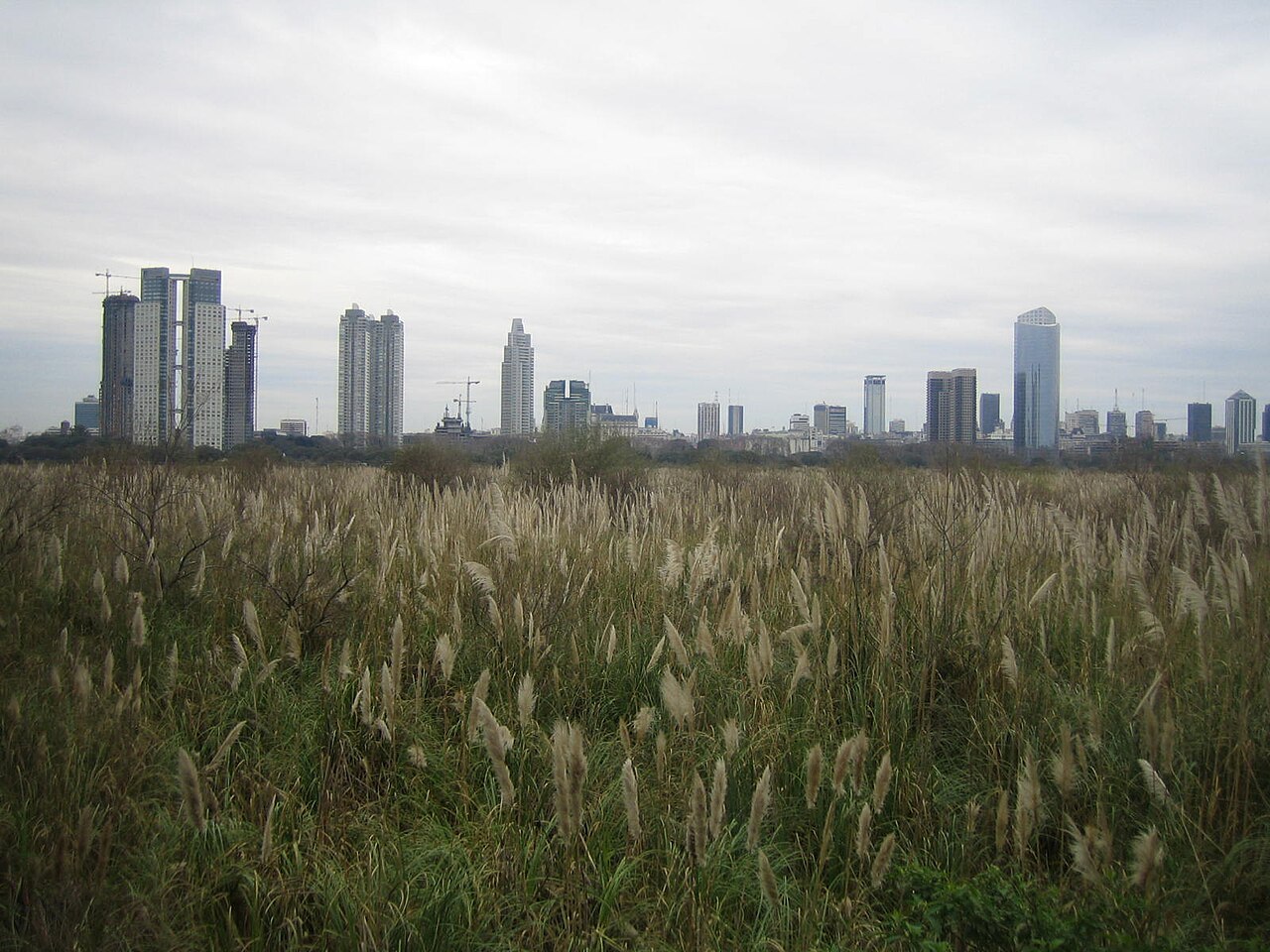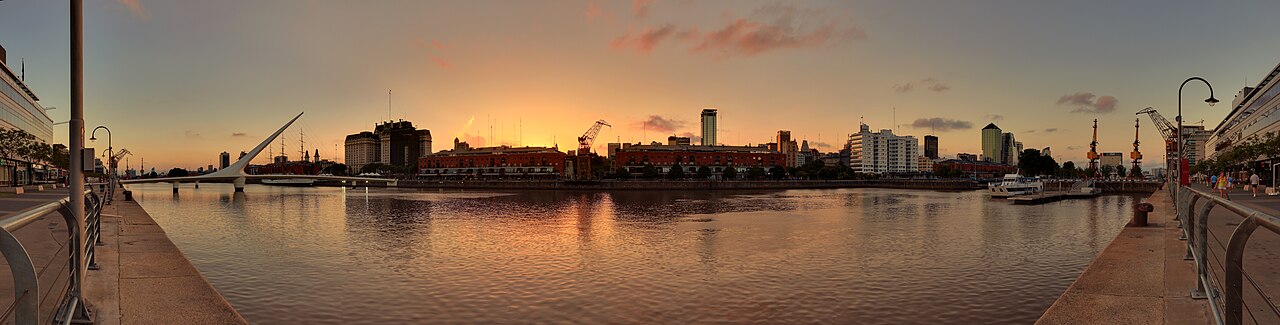
Puerto Madero is the newest and most polished neighbourhood in Buenos Aires, and its story is one of the city's great turnarounds. The port was built in the 1880s and 1890s to a plan by the merchant Eduardo Madero, with four long rectangular docks lined by handsome red-brick warehouses, but it was badly designed for the growing ships of the age and was overtaken within a couple of decades by the new port to the north. For most of the twentieth century it lay largely abandoned. In the 1990s the city launched a major redevelopment, and the warehouses on the western side of the docks were restored and converted into offices, lofts, restaurants and university buildings, while the eastern side filled with luxury apartment towers, office blocks and hotels. The result is a long, walkable waterfront promenade a few blocks from the Casa Rosada, with the old cranes left standing as reminders of the past. Its streets are named after notable Argentine women, and its centrepiece is the Puente de la Mujer, the Woman's Bridge, designed by the Spanish architect Santiago Calatrava and opened in 2001. The white pedestrian bridge, with a single angled mast and cables, is said to evoke a couple dancing tango, and its central section swings on a pivot to let boats pass. Nearby, the Fragata Presidente Sarmiento, a nineteenth-century navy training ship, is moored as a museum, and the Colección de Arte Amalia Lacroze de Fortabat, a private art museum in a striking glass-and-steel building, holds Argentine and international art. Behind the towers lies the Costanera Sur Ecological Reserve, a wild green expanse on the river.
When to go: Puerto Madero is at its most beautiful in the late afternoon and at sunset, when the light catches the brick warehouses and the towers reflect in the docks, and after dark, when the bridge is lit. Walk the length of the docks on the western side, cross the Puente de la Mujer for photographs, and continue along the eastern side. It is one of the safest and best-maintained areas in the city, with a strong security presence, and it is flat, so it suits families with strollers and anyone who wants an easy walk.
Eating and drinking: the converted warehouses are lined with restaurants, many of them large steakhouses with terraces on the water. They are reliable and the setting is lovely, but prices are higher than in Palermo or San Telmo, and locals tend to see the area as a place for business lunches and special occasions rather than everyday dining. For the best value, have a drink or a coffee on a dockside terrace at sunset, then go elsewhere for dinner, or choose a restaurant on a set lunch menu.
How to combine it: Puerto Madero is a short walk from the Plaza de Mayo and the Casa Rosada, so it fits neatly after a morning in the historic centre. Continue east to the Costanera Sur Ecological Reserve for birdlife and river views, or visit the Fragata Sarmiento and the Fortabat collection. On weekends, the food stalls along the Costanera serve choripán, the classic sausage sandwich, a cheap and cheerful alternative to the dockside restaurants.
What to expect
The experience
A free waterfront walk along restored docks and warehouses, crossing Calatrava's Puente de la Mujer, with optional museum ship and art collection visits.
Best time
Late afternoon into sunset, and after dark when the bridge is lit.
How long
One to two hours; half a day with the reserve.
Tips
Have a sunset drink on a dock terrace but eat dinner elsewhere for better value. Flat and stroller friendly. Combine with Costanera Sur.
Quick picks
- Best for
- Couples, families and anyone wanting an easy, safe sunset walk.
- Families
- Flat promenades, the museum ship and open space make it easy with children.
- Couples
- Sunset on the docks and the lit bridge after dark.
- Pair with
- Plaza de Mayo, the Costanera Sur Ecological Reserve and the Fortabat collection.
- Time needed
- One to two hours.
Good questions
What is the Puente de la Mujer?+
A white pedestrian swing bridge designed by Santiago Calatrava and opened in 2001. Its angled mast is said to evoke a couple dancing tango, and the central span rotates to let boats through.
Is Puerto Madero safe?+
It is one of the safest and best-maintained areas of the city, with a strong security presence, and pleasant to walk by day and in the evening.
Are the restaurants worth it?+
The setting is lovely, but prices are higher than in Palermo or San Telmo. A sunset drink on a terrace is the best value.
How far is it from the Plaza de Mayo?+
A short walk east, so it combines easily with a morning in the historic centre.
What else is there to see?+
The Fragata Sarmiento museum ship, the Fortabat art collection and, just beyond, the Costanera Sur Ecological Reserve.