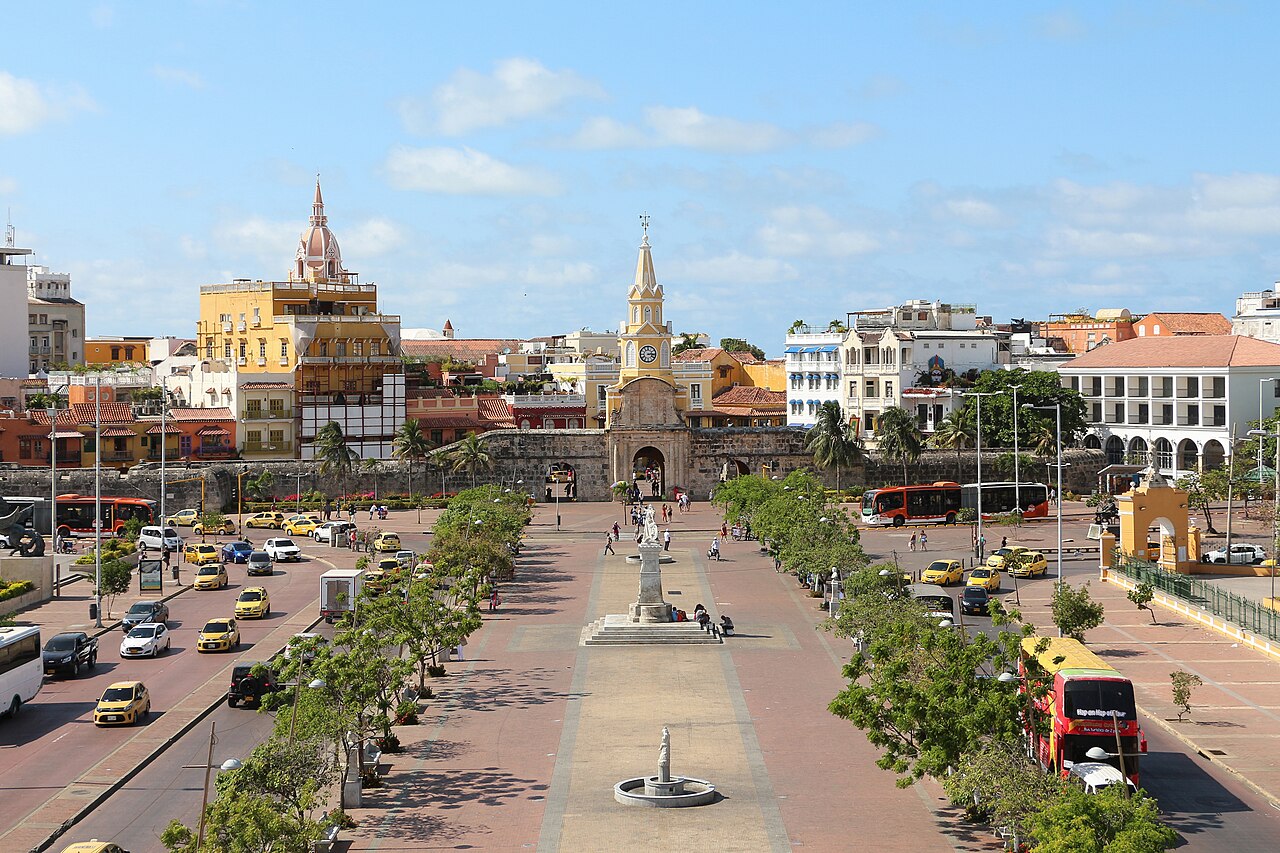
If Cartagena has a front door, it is the Puerta del Reloj, the gate beneath the Clock Tower. It stands at the main entrance of the walled city, and for generations it has been the point where visitors step from the modern city into the colonial one. The tower rises above three open archways, and although it looks like one single monument, the arrangement has a story. Of the three openings, only the central one was the original gate. The other two were once used as a gunroom and a chapel, and were later opened up to let people pass. A clock was brought from the United States in 1874, and the current clock, imported from Switzerland, replaced it 63 years later, in about 1937. It is free to see, always open to the street, and one of the most photographed places in Colombia, particularly at dusk when the tower is lit and the plaza fills with life.
Why it matters
The gate is more than a postcard. It marks the main entrance of the walled city, and standing in it you see how the old town was designed to be entered through a controlled point. Just inside, the arcade and the plaza set the tone for the rest of the district, with portals, balconies and people selling sweets, hats and music. The tower itself is a reminder that this was a working port city, one that cared enough about time and order to import clocks from abroad twice.
What to expect
You can stand beneath the gate, watch the crowd flow through and take photographs from the plaza or from across the street. The area is busy at all hours, with street musicians, vendors and horse-drawn carriages, and it is at its best in the early evening, when the heat softens and the lights come on.
Opening hours do not apply to the gate itself, since it is part of the street, but the surrounding shops and cafés keep their own schedules. Keep an eye on your belongings in the crowds, and be firm but polite with persistent sellers.
Making the most of it
Go once in the morning for photographs without crowds, and again at sunset for atmosphere. Use the gate as a starting point for a walk through the old city and as a meeting point for guided tours. Cafés on the nearby plazas give you a cool seat from which to watch the scene.
If you stay in a hotel in the old town, you will pass the tower often, so you can adapt your visits to the light. Combine the gate with the city walls and Plaza de Bolívar, and you have the essential old-town orientation in a few easy-walking hours.
Planning around it
Because the gate is the natural start of almost every old-town walk, it is also the usual meeting point for guided tours, so allow a few minutes to find your group in the crowd. Street performers and vendors cluster here in the evening, and prices for photographs with carriages or costumed figures should be agreed in advance. If you are staying nearby, you will pass beneath the tower many times, so use the first visit for photographs and later ones simply to enjoy the atmosphere.
What to expect
The experience
A free walk through and around the gate beneath the Clock Tower, usually as the start of an old-town stroll.
Best time
Early morning for quiet photographs, or early evening when the tower is lit and the plaza is lively.
How long
Thirty minutes to an hour, longer if you sit in a café nearby.
Tips
Watch your belongings in the crowds and be polite but firm with persistent sellers.
Quick picks
- Best for
- Every first-time visitor, since almost every old-town walk begins or ends here.
- Families
- Children enjoy the street life, musicians and carriages, but hold hands in the crowds.
- Couples
- A classic photo spot at dusk.
- Pair with
- The city walls and Plaza de Bolívar, a short walk away.
- Time needed
- Under an hour.
Good questions
Is the Clock Tower free?+
Yes. The gate and tower are part of the street, so you can walk through and photograph them for free.
Why does the gate have three openings?+
Only the central opening was the original gate. The other two were once used as a gunroom and a chapel and were later opened.
When was the current clock installed?+
A clock arrived from the United States in 1874. The current Swiss-made clock replaced it 63 years later, in about 1937.
When is the best time to visit?+
Early morning for fewer people and photographs, or early evening for the light and atmosphere.
Is the area safe?+
It is busy and generally welcoming, but keep your phone and valuables out of sight in crowds, as you would at any popular landmark.