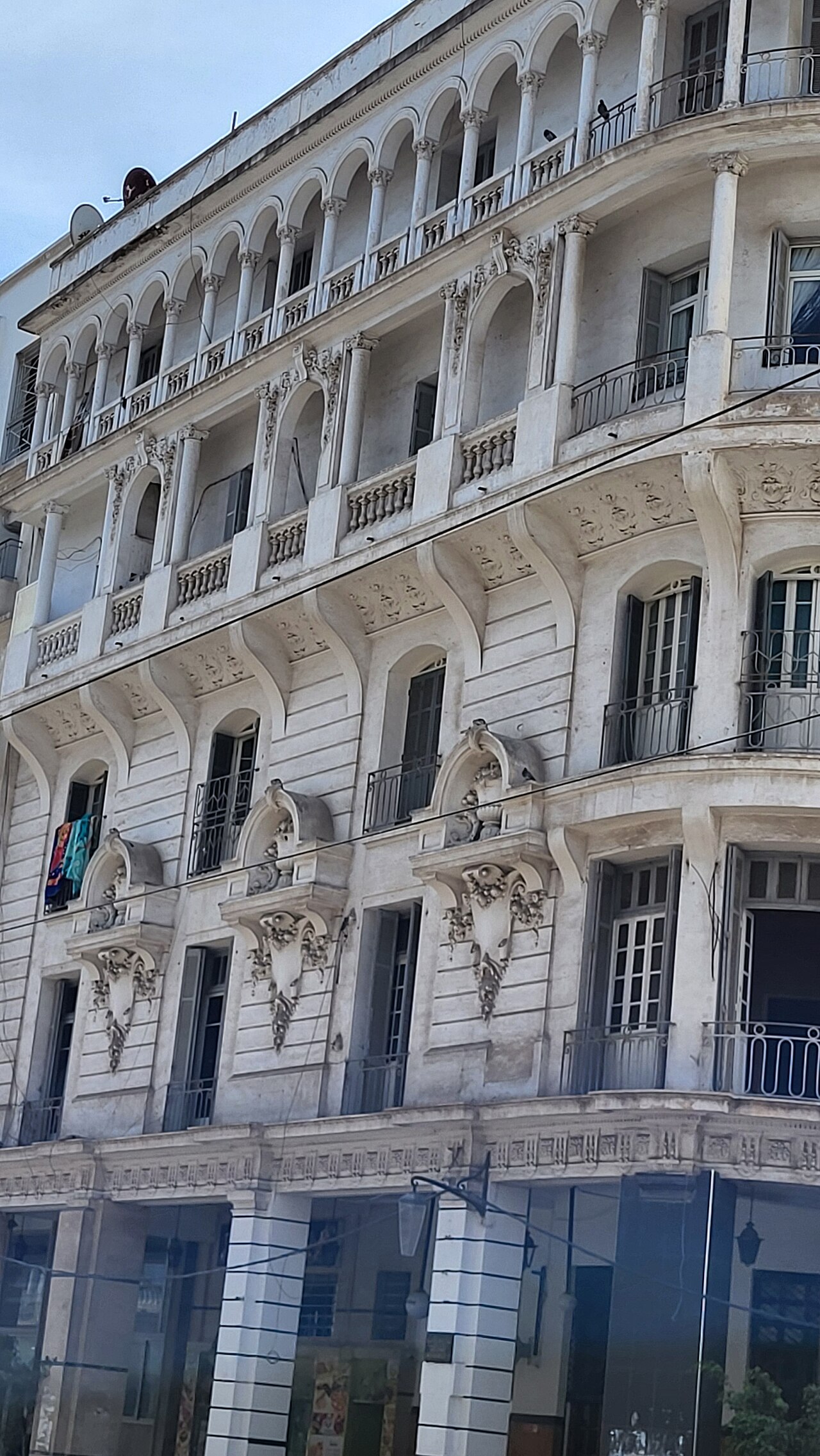
Ask architects what makes Casablanca special and many will say Art Deco. During the French Protectorate, the city boomed and a generation of architects, among them Marius Boyer, was given license to experiment. The result is a downtown of sleek curved corners, geometric balconies, porthole windows and relief sculpture, mixed with Moroccan details such as zellige tile, green-tiled roofs, carved cedar balconies and horseshoe arches. Boulevard Mohammed V is the spine of this district. The tourist board describes a commercial avenue lined with 1930s buildings, with cherubs, fruit baskets and lions heads set against friezes of zellige and stucco, an arcade echoing the Rue de Rivoli, and passages reminiscent of Cairo. Landmarks include the Hotel Lincoln, the Central Market, the former Bourse du Commerce, the Maroc Soir building, the ABC cinema tucked below a residential block, and the Glaoui building with its zellige-covered towers. Nearby, Place Mohammed V gathers the courthouse, the prefecture and the post office in a monumental ensemble. It is a free, self-guided walk that rewards looking up.
The style has a name locally, sometimes called Arab-Deco or Mauresque Art Deco, because Casablanca's architects were asked to combine modern European form with Moroccan identity. That blend is the point. You see it in a cinema like the Rialto or the Lynx, in the cedar balconies that overhang the pavement, and in the Moorish arches of ground-floor arcades. Some buildings are beautifully restored; others are faded, with shop signs hiding the original details, and that patchwork of grandeur and neglect is part of the charm and part of the argument for conservation.
A good route begins at the Central Market, the covered food hall, and heads north up Boulevard Mohammed V past the Hotel Lincoln and the former Bourse to Place Mohammed V and the courthouse. Allow time to detour into side streets and arcades, because the best doorways and stair halls are often off the main avenue. Look up above the shop windows, where the upper floors preserve the original ironwork and reliefs. A short walk takes you to the former Sacred Heart church, now a cultural space, whose tall tower mixes Gothic, Art Deco and Moorish ideas.
Tips for walking it: go in the morning when light is soft and traffic is lighter, wear comfortable shoes, and keep a camera strap around your wrist near busy crossings. A guided tour adds a lot because the history of each building, the architects and the stories of the people who lived in them are not signposted. Coffee at a street cafe is the best way to study a facade at leisure, and Rick's Cafe and the old medina are an easy extension toward the sea.
What to expect
The experience
A self-guided walk along Boulevard Mohammed V and around Place Mohammed V, studying facades, arcades, cinemas and the Central Market.
Best time
Morning for soft light and lighter traffic; early evening for warm light on the facades.
How long
Ninety minutes for the core boulevard, up to three hours with detours and coffee stops.
Tips
Look above the shopfronts, step into arcades and stairwells, and mind the busy traffic at crossings.
Quick picks
- Best for
- Architecture lovers and anyone curious about the 1930s city.
- Families
- Older children who like buildings and cinemas will enjoy it; younger ones may tire of the pavements.
- Couples
- Coffee at a street cafe, then an evening stroll between the lit facades.
- Pair with
- The Central Market, the old medina and Rick's Cafe.
- Time needed
- One and a half to three hours.
Good questions
What is Casablanca Art Deco?+
It is a 1930s style that blends European Art Deco lines with Moroccan details like zellige tile, cedar balconies and arches. It is sometimes called Arab-Deco or Mauresque.
Where can I see it?+
Boulevard Mohammed V is the core, with the Central Market, the Hotel Lincoln, the old Bourse du Commerce and the ABC cinema. Place Mohammed V and nearby streets add more.
Do I need a guide?+
Not strictly, but a guide adds names, dates and stories that are not signposted. You can also walk the boulevard alone in about two hours.
Is it free?+
Yes, the facades and streets are free to walk. Some interiors, such as hotels, restaurants or cultural spaces, may have their own rules.
Can I go inside the old Sacred Heart church?+
The deconsecrated church is run as a cultural space with exhibitions, but opening times and access are not fixed, so check locally before you go.