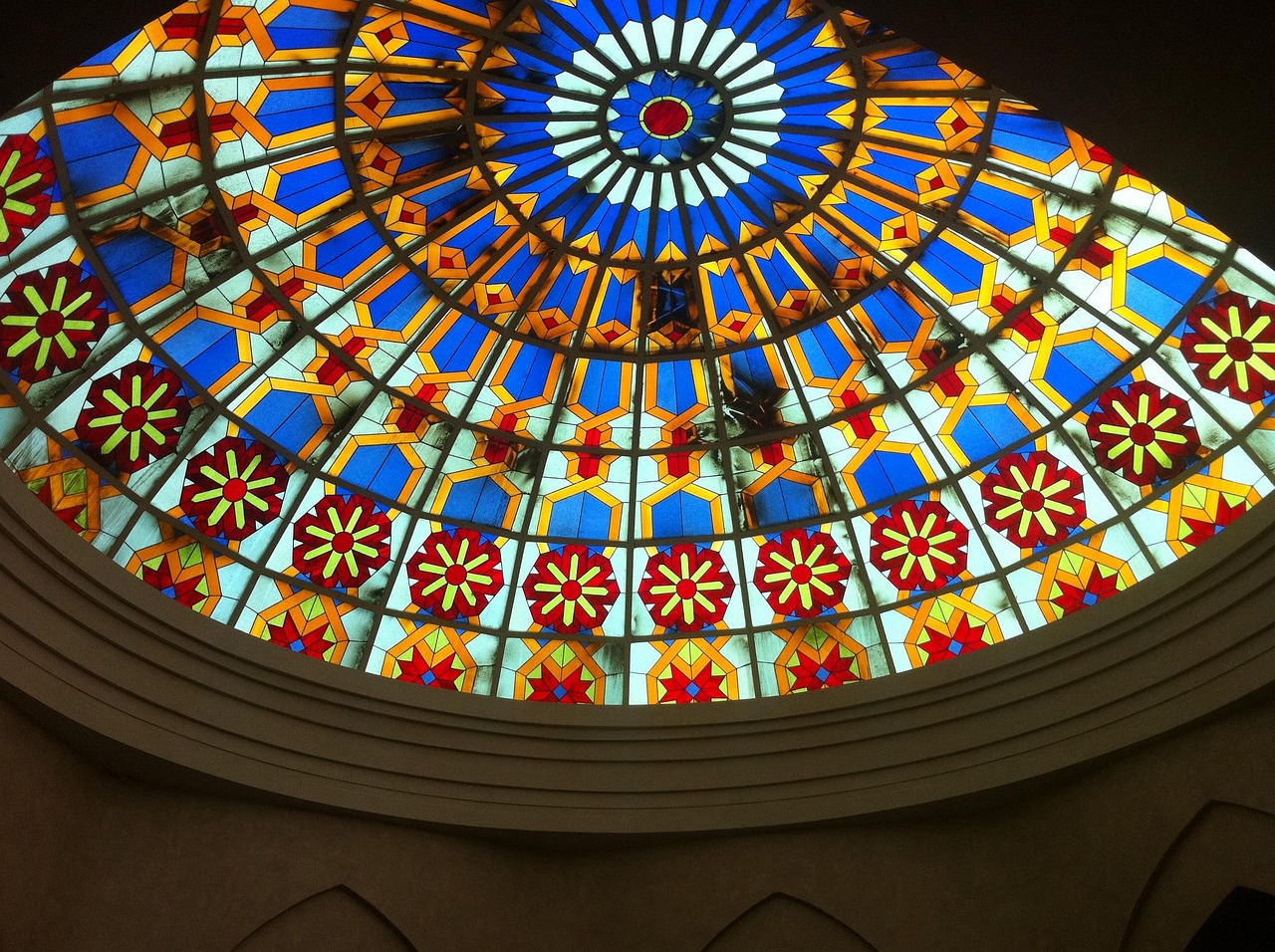
The Chicago Cultural Center is the city's most astonishing free building: the 1897 neoclassical palace on Michigan Avenue (built as the central public library and the GAR's Civil War memorial hall in one) directly across from Millennium Park, whose interiors out-jewel every paid attraction in the Loop — the south wing's climb runs white Carrara marble inlaid with mother-of-pearl mosaic to Preston Bradley Hall and the headliner: the 38-foot Tiffany glass dome, the largest Tiffany dome in the world (30,000 pieces of Favrile glass in fish-scale pattern, restored to full backlit glory in 2008), under which free classical concerts (the long-running lunchtime series) play most weeks; the north wing answers with the Grand Army of the Republic rotunda's Renaissance dome (a second stained-glass ceiling most visitors never find — finding it is the connoisseur move) and its own mosaic stair. Around the architecture the programming runs permanently free: rotating art exhibitions across multiple galleries (the city's Department of Cultural Affairs curates ambitiously — architecture biennial editions anchor here), the concert-and-event calendar, and free building tours (check times at the welcome desk) that unpack the library-era story — the dome's dollar values, the GAR politics, the 1991 conversion that saved it all. The visit scales from the fifteen-minute wow (walk in, climb to the dome, gasp, leave — zero tickets, zero lines) to a toured afternoon, the location could not be more central (Washington Street's Pedway entrance included), and the pairing is automatic: the Bean sits across the street, the Loop's marquee district a block south, and rainy days have no better free answer in America.
The building's double identity explains its riches: Chicago built it in 1897 as two institutions under one roof — the Public Library's palace (the south wing's Tiffany-domed reading room, the mosaic stair's publisher-marks and literary inscriptions) and the Grand Army of the Republic's memorial halls (the north wing's martial rotunda, Tennessee-marble stair, and the veterans' meeting rooms) — with the era's no-expense-spared logic: the Tiffany dome's installation cost ran legendary even then, the mosaics came from the same workshops as the finest Gilded Age interiors, and the whole ensemble survived because the library's 1991 move (to the Harold Washington) converted it into the country's first free municipal cultural center rather than a demolition fight.
Using it well
Enter on Washington for the south stair's full mosaic climb (the dome reveal works best ascending), check the day's free-concert and exhibition slate at the desk (the lunchtime classical series under the dome is the city's best free event; the galleries' rotations run contemporary-ambitious), hunt the GAR rotunda on the north side (the second dome's green-and-gold glass over the martial hall — emptier and arguably moodier than the Tiffany), and take the free building tour if the timing lands. Photography is welcomed and weddings perpetual (the dome hall books ceremonies — weekend visitors photograph around joy). The Pedway connection and Randolph cafe complete the practical layer.
Practicals and fit
78 East Washington at Michigan (every Loop line within three blocks; directly opposite Millennium Park's northwest corner), free always, open daily with event-driven hours, fifteen minutes to two toured hours. Fit: everyone — the first-timer's free wow between Bean and Art Institute, the architecture chip's interior essential (pair the Rookery for the Loop's two great rooms), rainy-day refugees at zero cost, and couples who want the city's most beautiful free quarter hour.
What to expect
The experience
A free 1897 palace — the mosaic stair to the world's largest Tiffany dome, the GAR wing's second glass dome, free galleries, concerts, and building tours — opposite Millennium Park.
Best time
Lunchtime for the free classical series under the dome; any rainy hour; weekdays dodge the wedding photography.
How long
Fifteen minutes of wow to two toured hours.
Tips
Climb the south stair for the dome reveal. Find the north wing's GAR rotunda — the secret second dome most visitors miss. Check the desk for the day's free concert and tour times.
Quick picks
- Best for
- The city's best free fifteen minutes — and the architecture chip's essential interior with the Rookery.
- Families
- A quick gasp-and-go between the Bean and lunch; the mosaic stair counts as the climb.
- Couples
- The dome at concert hour — the Loop's most romantic free room, weddings agree.
- Pair with
- Millennium Park across the street; the Art Institute two blocks; the Rookery for the Loop's other great room.
- Time needed
- One walk-in wow, repeatable.
Good questions
Is it really free?+
Everything — entry, the domes, galleries, concerts, and building tours — the country's first free municipal cultural center, since the library moved out in 1991.
How big is the Tiffany dome?+
Thirty-eight feet across, 30,000 pieces of Favrile glass — the largest Tiffany dome in the world, restored to backlit glory in 2008 over Preston Bradley Hall.
What is the second dome?+
The north wing's GAR rotunda — a green-and-gold Renaissance glass dome over the Civil War memorial hall — emptier, moodier, and the connoisseur's find.
When are the concerts?+
The free classical series plays under the dome most weeks at lunchtime, with the broader event calendar posted at the desk — timing a visit to one costs nothing extra.
How long should we spend?+
The walk-in wow takes fifteen minutes; galleries, both domes, and a free tour fill two — it scales to whatever the day holds.