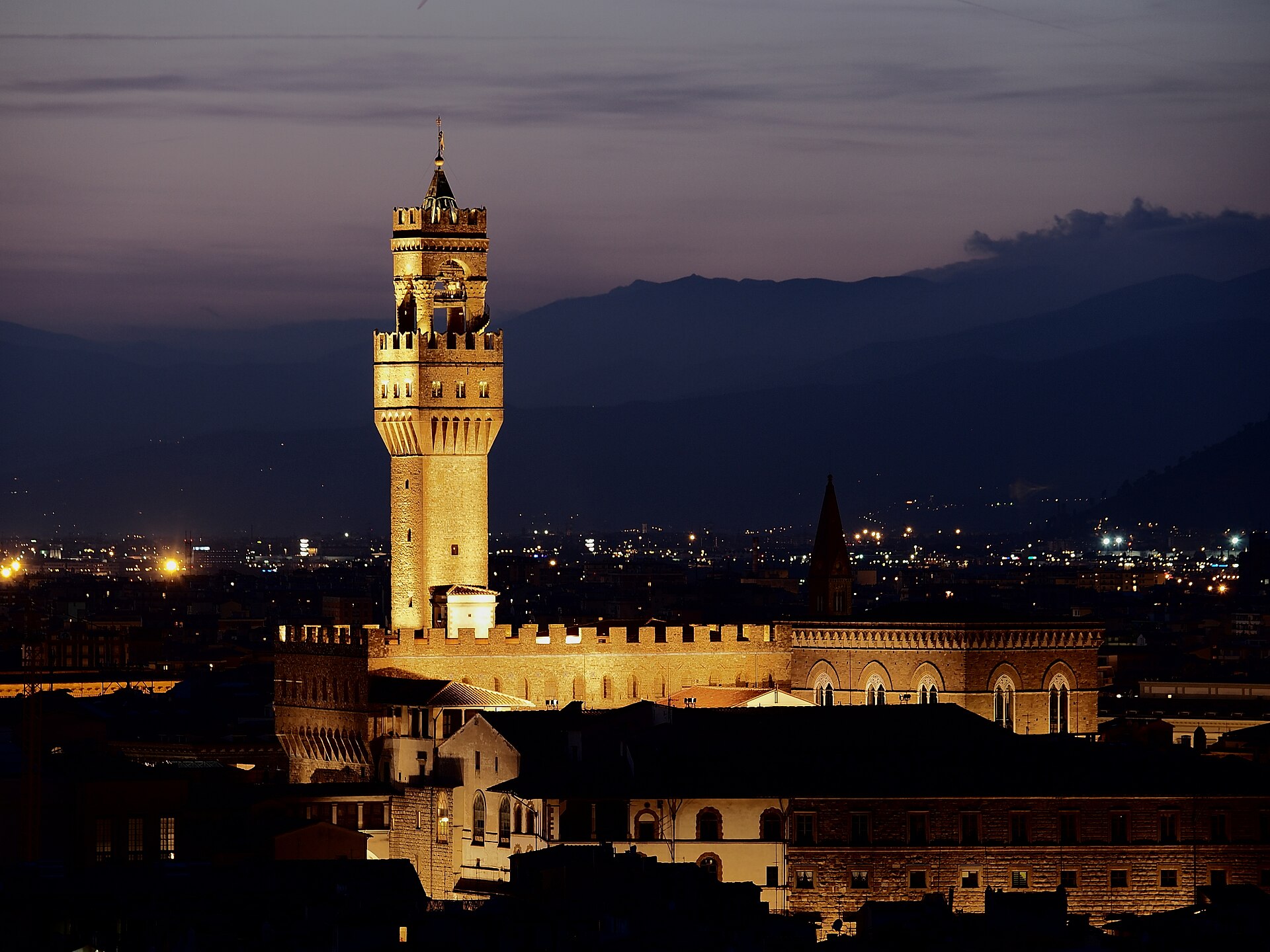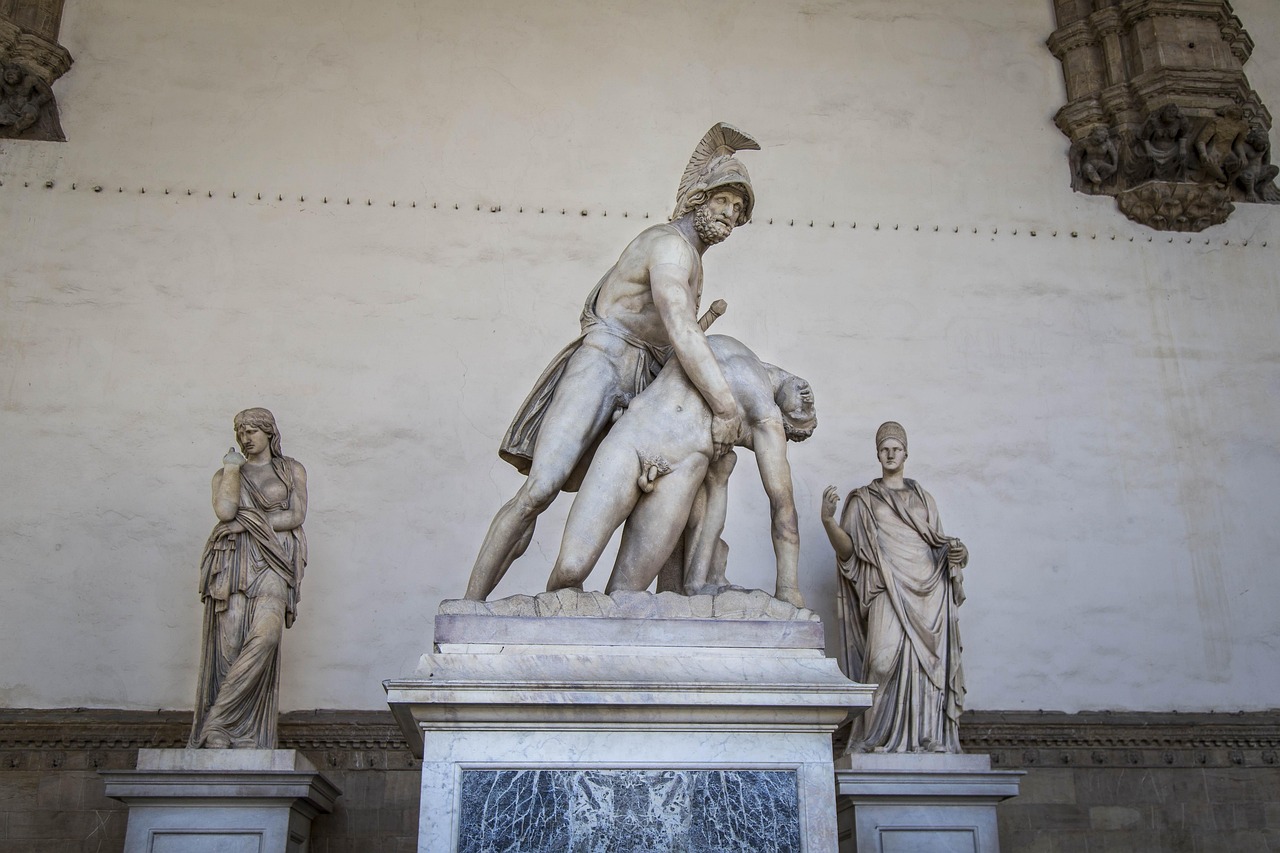
The Piazza della Signoria is the most charged public square in Italy and Florence's best free museum: the civic L where the Republic governed, rioted, executed and triumphed for seven centuries — Palazzo Vecchio's fortress tower presiding — and where the sculpture program amounts to an open-air gallery no ticket matches: the Loggia dei Lanzi (the 14th-century arcade turned sculpture stage, free and open always) holding Cellini's Perseus with the Head of Medusa (the 1554 bronze masterpiece — the gore-dripping triumph cast in one legendary pour; the back of Perseus's head hides Cellini's self-portrait in the helmet's design, the connoisseur's find) and Giambologna's Rape of the Sabine Women (the spiral that invented the serpentine viewpoint — walk its 360), with the Medici lions flanking; the statue line along the palace running the Republic's history in marble — Michelangelo's David's full-size copy on the original site (the 1504 placement was political: the giant-killer facing down tyranny at the government's door; the original moved to the Accademia in 1873), Bandinelli's Hercules (mocked since the day it landed — Cellini called it a sack of melons; the feud is the fun), Donatello's Judith's copy (the tyrant-slayer the Medici looted from their own palace), and the Marzocco lion; Ammannati's Neptune Fountain (il Biancone — the big white one — Florence's teased giant, newly restored to gleaming); and the pavement's darkest marker: the porphyry disc where Savonarola was hanged and burned in 1498 (the plaque sits exactly where the Bonfire-of-the-Vanities preacher met his own fire — the spot every history tour circles). The craft: the square is free and open always, so the timing is the art — before 8am the piazza belongs to you and the statues (the photograph hour), café tables at Rivoire (the 1872 chocolate house) buy the best people-watching seat in Tuscany at a knowing markup, evenings run the passeggiata theater, and the Loggia after dark — lit, empty, free — is the city's most underrated night visit. Fit: first trips (this IS the orientation center — Uffizi, Palazzo Vecchio and Ponte Vecchio radiate from it), the history and art chips at zero cost, couples (the night Loggia), and families (lion-counting and gelato radius).
The square's history is the Republic's biography: cleared in the 1260s on razed Ghibelline houses (the victors salted the ground — the piazza's shape is a grudge), it staged everything after: the priors' processions, the Ciompi revolt, the Pazzi conspirators hung from the palace windows (Botticelli painted the dangling bodies for public record), Savonarola's bonfires and then Savonarola's pyre on the same stones within a year (the 1497 vanities burning and the 1498 execution share the disc's coordinates — the symmetry is the city's grimmest lesson), and the Medici dukes' sculpture program rewriting the republican square into dynastic theater: David answered by Hercules, Judith joined by Perseus (Cellini's bronze deliberately faces David — Medusa's severed head aimed at the Republic's icons; the Loggia as counter-propaganda is the art-history reading worth carrying into the square).
The connoisseur's circuit
The Loggia's second row (Giambologna's Hercules and Nessus, the Roman matrons), Perseus's hidden self-portrait (stand behind; the helmet's curls resolve into a bearded face), the Sabine spiral walked full-round, the palace facade's measured spot where the David stood against the wall-scar history, Neptune's restored gleam and the Ammannati-apology lore, the equestrian Cosimo's Giambologna bronze, and the Tribunale della Mercanzia and Uguccioni facades framing the L. The Rivoire ritual (hot chocolate density as civic monument) and the Gucci-museum corner fill the square's edges; the Vasari corridor's first leg exits the palace overhead toward the Uffizi — the whole power-architecture of the Duchy reads from the pavement's center.
Practicals and fit
Free, always open, dead center (the Uffizi's courtyard opens off it; Ponte Vecchio five minutes); before-8am for empty frames, evening for theater; Rivoire's markup buys the best seats. Fit: every first trip's gravitational center, the history chip at maximum density, art travelers (the Loggia is a museum wing without a door), couples at night, families by day — Florence's one unskippable square.
What to expect
The experience
The Republic's throne-room square, free and open always — the Loggia's Cellini-and-Giambologna gallery, David's sentinel copy on the original site, Neptune's fountain and the Savonarola execution disc.
Best time
Before 8am the piazza is yours; evenings run the passeggiata; the lit Loggia after dark is the city's most underrated free night visit.
How long
An hour's circuit, returned to daily.
Tips
Walk Giambologna's Sabine spiral full-round. Stand behind Perseus — Cellini hid his self-portrait in the helmet's curls. Find the porphyry disc where Savonarola burned; the vanities bonfire shared the spot a year earlier.
Quick picks
- Best for
- First trips — the gravitational center the Uffizi, Palazzo Vecchio and Ponte Vecchio all radiate from.
- Families
- Lion-counting, fountain splash, gelato radius — the square absorbs children endlessly.
- Couples
- The Loggia lit and empty at night — Perseus by lamplight costs nothing.
- Pair with
- Palazzo Vecchio above it, the Uffizi off its courtyard, Ponte Vecchio five minutes — the center in one walk.
- Time needed
- One hour, plus every evening you can give it.
Good questions
Is the David real?+
The square holds the full-size copy on the original 1504 site — the giant-killer placed at the government's door as republican defiance — while the original moved to the Accademia in 1873.
What is the Loggia dei Lanzi?+
A free, always-open sculpture gallery — Cellini's Perseus with Medusa's head (his hidden self-portrait in the helmet's curls) and Giambologna's spiral Sabine among the Medici-era masterpieces.
Where did Savonarola die?+
The porphyry disc in the pavement marks where he was hanged and burned in 1498 — a year after his Bonfire of the Vanities blazed on the same stones.
When is it emptiest?+
Before 8am, when the statues and street-sweepers have it to themselves — the photograph hour — with the lit Loggia after dark as the other secret window.
Is Rivoire worth the prices?+
The 1872 chocolate house's markup buys the best people-watching seat in Tuscany — order the famous dense hot chocolate and treat the table as the ticket.