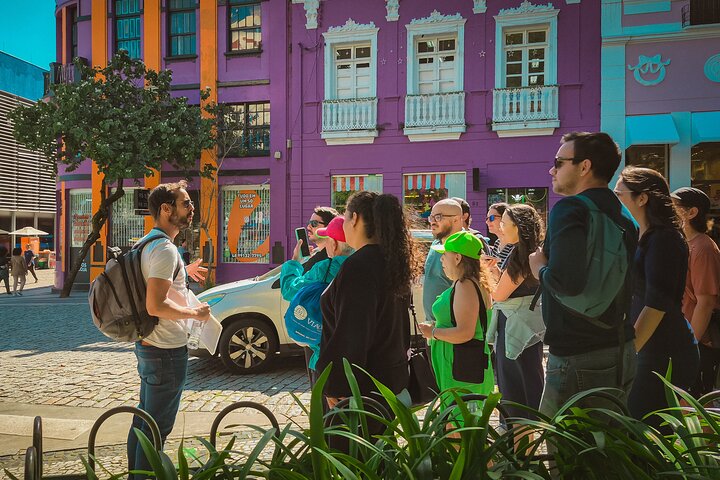
Most visitors head straight for the beaches, but the old centre of Florianópolis rewards a morning on foot. The city grew from a small Azorean settlement in the eighteenth century, and its historic core still holds a main square shaded by a very old fig tree, a neoclassical cathedral, colourful government buildings and a traditional public market. A guided walk strings these together with stories you would not pick up from signs alone. The route usually begins around Praça XV de Novembro, where locals once gathered and where the huge fig tree is the best-known landmark. From there guides lead you past the cathedral and the palace buildings, through narrow side streets with old townhouses, and often down to the public market, where fish stalls, craft counters and casual restaurants have operated for well over a century. Some tours add art, street murals and short tastings to the history. Beyond the dates and buildings, a good guide explains how the city became a capital, how the island's fishing communities shaped Santa Catarina culture, and how the bridges changed everyday life. You see a side of Florianópolis that is gritty and lively rather than resort-like, and that makes the beach days feel better by contrast.
Plan your walk for the morning, when the centre is busiest with workers, shoppers and market stalls, and the sun is gentler. On Sundays the centre is much quieter and some shops and the market counters may be closed or limited, so check the day before. Wear comfortable shoes because pavements are uneven in places, carry water and sunscreen, and keep valuables close as you would in any busy city centre.
The public market is the highlight for many people. Stalls sell local cheeses, cachaça, coffee and seafood, and the restaurant counters inside serve fish, shrimp and the famous local oysters at lunchtime. If your tour ends near the market, stay for a meal and a caipirinha. If it does not, return on your own, because the lunch crowd and the atmosphere are half the reason to go.
Ask about the walking pace and distance when you book. Most routes cover a couple of kilometres over two to three hours with several stops and little climbing, so they suit most ages and fitness levels. Tours in English are not offered on every departure, so check the language if it matters, and consider a private guide if you want a slower pace or a theme such as architecture or food.
Use the walk as a first-day activity if you land in the city, as it is close to many central hotels and gives a quick feel for the place. Then spend the afternoon at a beach, or continue to the bridge area for views at sunset.
History fans can add depth by reading a little before you go. The island was claimed by Portuguese explorers in the sixteenth century, settled in earnest by Azorean families from the 1740s, and renamed from the old town of Desterro to Florianópolis in the 1890s. The name honours a president, and the change followed a turbulent political period. Knowing those few facts makes the street names, statues and old government buildings along the route far more meaningful, and it gives you good questions for the guide.
If you only have one morning for culture, this is the one to choose over a museum visit, because everything is outdoors, flexible and tied to a real place.
What to expect
The experience
A guided walk through the old centre, usually including the main square, the cathedral and the public market.
Best time
Morning on a weekday, when the centre and market are most lively and the heat is lower.
How long
Two to three hours at an easy pace.
Tips
Wear comfortable shoes, carry water and keep valuables out of sight in busy streets.
Quick picks
- Best for
- Visitors who want history and a feel for the city beyond the beaches.
- Families
- Suitable for children who enjoy walking, with plenty of shaded stops.
- Couples
- A good shared activity with a market lunch at the end.
- Pair with
- A beach afternoon or the bus tour on the next day.
- Time needed
- Half a day.
Good questions
How long is the walking tour?+
Most routes take two to three hours with several stops and a little time for photos.
Is the tour suitable for children?+
Yes for children who can walk a couple of kilometres. The route is flat and the market stop is usually popular.
Does it include the public market?+
Many routes finish at or near the public market, but check the stated route to be sure.
Is there much walking uphill?+
No. The centre is largely flat, though some pavements are uneven.
Is English available?+
Not on every departure. Confirm the guide language when you book.