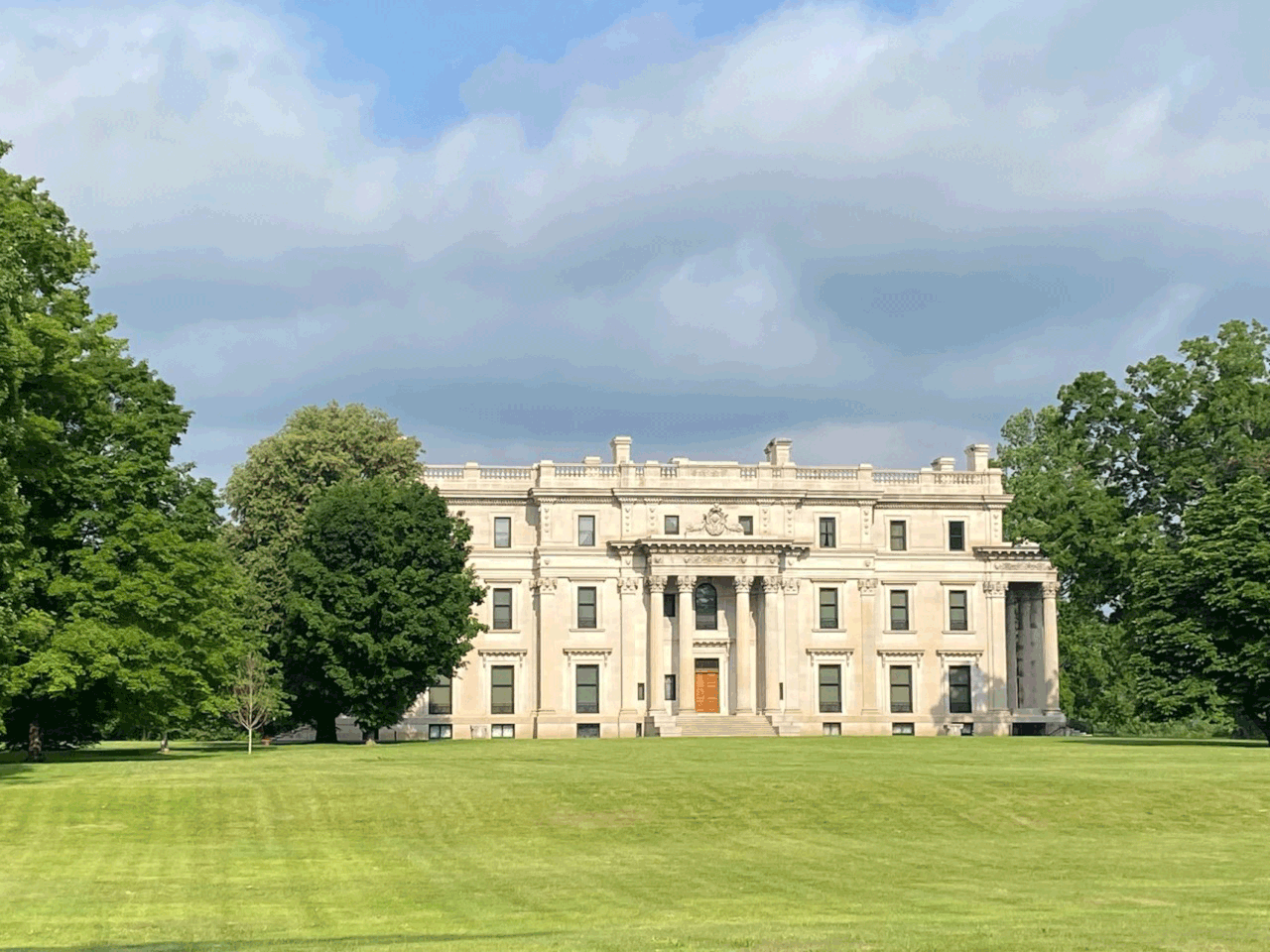
The Vanderbilt Mansion in Hyde Park is the best single introduction to what the Hudson Valley meant to the richest families of the Gilded Age. Frederick W. Vanderbilt, a grandson of the railroad magnate Cornelius Vanderbilt, built the Beaux-Arts house at the end of the 1890s as a spring and fall retreat, and he and his wife Louise lived in it in a style that was modest by the standards of Newport but still grand by anyone else's. The National Park Service looks after it today, and the house survives with much of its original furniture, tapestries and fittings. The setting is half the point: the lawns fall away to the Hudson, the Catskills fill the western horizon, and the walk through the grounds and the Italian gardens is open to anyone who wants it.
The house was designed by McKim, Mead and White, the architects behind much of the best Gilded Age building in New York, and it shows in the proportions: a limestone-faced block with a columned portico facing the river, a tall entrance hall, and a sequence of formal rooms dressed in the European antiques that wealthy Americans of the period collected by the shipload. What makes the tour more than a furniture walk is the way the National Park Service tells the story of the people who ran the place. The estate employed a large staff, and the interpretation of the servants quarters, the service corridors and the working relationship between family and household gives a sense of how a house like this actually functioned, rather than just how it looked on the day of a party.
The grounds are the second reason to come and the one that needs no ticket. A network of paths runs across the lawns and through the trees, with long views over the Hudson toward the Catskills and the opposite bank. The Italian gardens below the house were laid out in a formal pattern and are a lovely place to be in early summer, when the beds are filling in and the light is long.
In autumn the whole property turns into a postcard of the valley in color. Visitors who simply want a walk with river views can park, wander and leave without ever entering the house, which makes this one of the easiest and most generous stops in the region.
The practical advice is to treat the house as a short, high-value tour rather than an all-day commitment. Guided tours of the mansion are offered in season and are run by park rangers, so check the park site for current times and whether any tickets or reservations are required. The mansion and the grounds sit a few minutes from the Home of Franklin D.
Roosevelt and from the Culinary Institute of America campus, and the three together make a natural Hyde Park day. Allow about an hour for the house tour and another hour for the grounds if the weather is kind, and bring a layer, because the bluff catches the wind off the river even when the town below is warm.
Families often ask whether the house is worth the time with children, and the honest answer is that it depends on their age. Younger children will remember the lawns, the river view and the space to run, while older ones tend to be fascinated by the servants' side of the story. Whatever the age, a short pause on the terrace with the Catskills in the distance is a good way to end the visit.
What to expect
The experience
A ranger-led house tour through the formal rooms and service areas, plus free self-guided walks across the lawns, gardens and river overlooks.
Best time
Late spring for the gardens, October for the foliage across the river, and weekday mornings for smaller tour groups. House tours are seasonal, so check ahead in winter.
How long
About an hour for the house, plus an hour for the grounds.
Tips
Walk the grounds first if the weather is clear, because the river light is best earlier in the day. Pair it with the Roosevelt sites a short drive north in Hyde Park.
Quick picks
- Best for
- Anyone curious about the Gilded Age and the people who built the valley's great houses.
- Families
- The grounds suit children well; the house tour is better for ages eight and up.
- Couples
- A river-view stroll through the gardens is one of the valley's quietest romantic hours.
- Pair with
- Home of Franklin D. Roosevelt, Eleanor Roosevelt's Val-Kill, and lunch near the Culinary Institute campus.
- Time needed
- Half a day with the neighboring Hyde Park sites; two hours alone.
Good questions
Do I need a ticket to see the grounds?+
The grounds and gardens are open for walking, and most visitors treat them as a free stop. Mansion tours are the part that is seasonal and may need a fee or timed ticket, so check the park site before you go.
Who built the Vanderbilt Mansion?+
Frederick W. Vanderbilt built the house at the end of the 1890s, and McKim, Mead and White designed it. He was a grandson of Cornelius Vanderbilt, and the house served as a seasonal country retreat.
How long does the tour take?+
Plan on roughly an hour for the guided house tour. With a walk through the Italian gardens and along the river overlooks, a comfortable visit is closer to two hours.
Is it close to the Roosevelt sites?+
Yes. The Home of Franklin D. Roosevelt and the presidential library are a few minutes away in Hyde Park, and Val-Kill is a short drive beyond that. Many visitors combine all three in a single day.
Is the site accessible without a car?+
Hyde Park has no convenient train stop for the mansion, so most visitors drive or take a taxi from Poughkeepsie. If you are traveling by rail, plan a local transfer in advance.