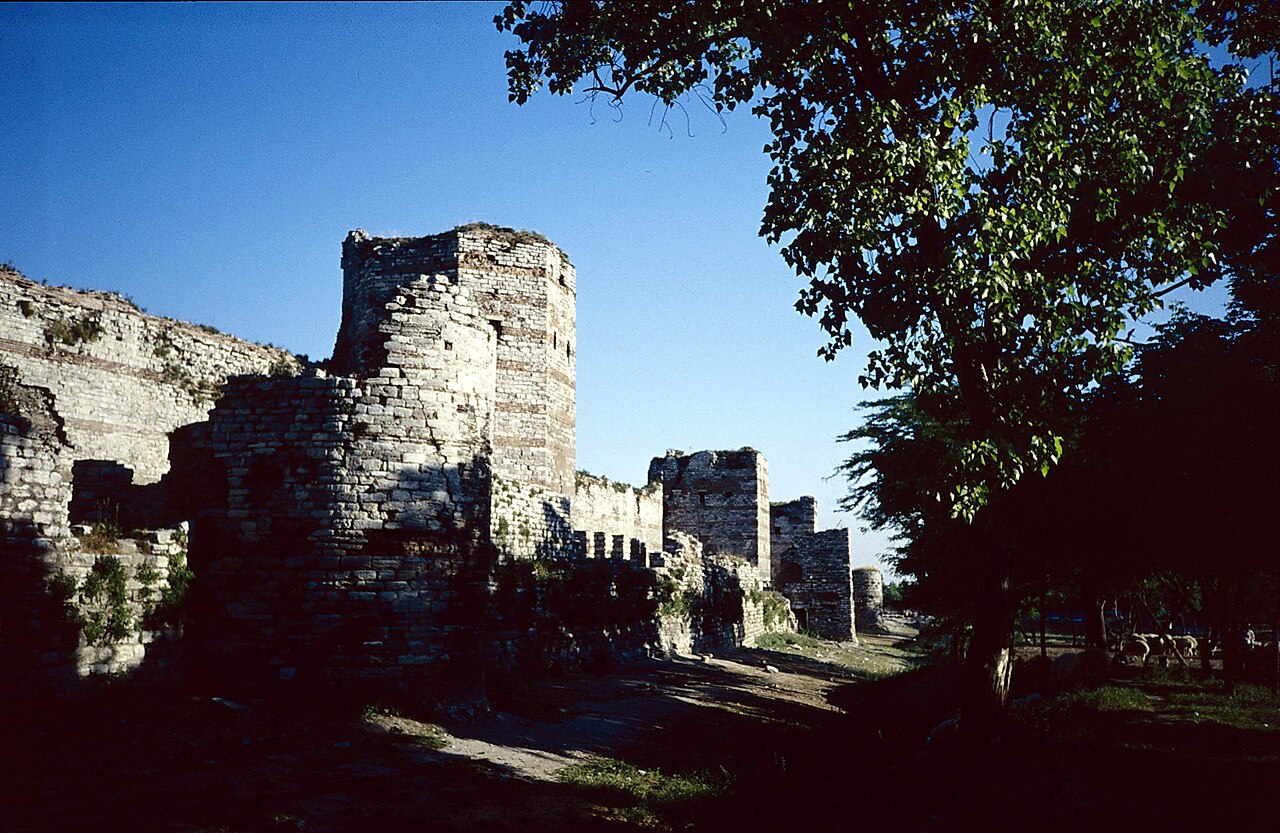
For a thousand years, no army broke through these walls by force, until the Ottoman cannon of Mehmed II in 1453. Built in the early fifth century under the emperor Theodosius II, and rebuilt in a hurry after an earthquake in 447 as Attila's Huns approached, the Land Walls run for about six and a half kilometres from the Sea of Marmara to the Golden Horn and were the most sophisticated defensive system of the ancient world: a broad moat, a lower outer wall and a massive inner wall studded with towers, so that attackers faced three lines of defense in succession. Large sections still stand, some crumbling and overgrown, some heavily restored, punctuated by gates whose names tell the city's history: the Golden Gate, through which emperors entered in triumph; the Gate of Saint Romanus, now Topkapi, near where the Ottoman guns breached the wall and the last emperor, Constantine XI, died in the final assault; and Edirnekapi, through which Mehmed II rode into the conquered city. Near the Golden Horn end stands the Tekfur Palace, a late Byzantine palace facade of patterned brick and stone, now restored as a museum, and at the Marmara end the Yedikule Fortress, the Castle of the Seven Towers, built by Mehmed II around the Golden Gate. Walking the walls takes you through neighborhoods tourists rarely see, past market gardens in the old moat, and gives you a sense of the scale of Byzantine Constantinople that no museum can match.
How to walk them: the full length is a long day's walk, so most visitors choose a section. The most rewarding for a first visit is the northern stretch from Edirnekapi, near Chora, down to the Tekfur Palace and on to the Golden Horn at Ayvansaray, about an hour or so on foot, which combines well with Chora in the morning and Balat in the afternoon. History buffs can start at Topkapi, by the T1 tram, to see the area of the 1453 breach and the Panorama 1453 History Museum, then walk north. The southern end, from Yedikule to the Sea of Marmara, is quieter and more ruinous.
Safety and practicalities: walk the walls in daylight, preferably with a companion, wear sturdy shoes, and stay on the path along the inside or outside of the walls rather than climbing on top, where stretches are unrestored, unfenced and dangerous. Some sections pass through isolated ground and busy roads cut through the walls at several points, so take care crossing. Bring water, as cafes are scattered. The walls themselves are free; the Tekfur Palace museum and the Yedikule Fortress charge modest entry fees and keep their own opening days, so check before you go if they are part of your plan.
Why go: after the crowds of Sultanahmet, the walls show you the edge of the old city, where Byzantine and Ottoman history are written in brick and stone, and daily life goes on around them, with children playing football in the moat gardens and families picnicking under the towers. It is one of the most atmospheric walks in Istanbul and a powerful way to understand the siege of 1453, the moment the Byzantine Empire ended and the Ottoman capital was born. Combine it with Chora and Eyup for a full day in the northwest of the historic peninsula. A good map or offline navigation app helps, since signage along the walls is patchy, and street names change often between neighborhoods.
What to expect
The experience
A self-guided walk along a section of the fifth-century defenses: towers, gates, the moat and restored sites such as the Tekfur Palace, through residential neighborhoods.
Best time
Daylight on a dry day, morning or early afternoon. Spring and autumn are most comfortable.
How long
Two to three hours for a section; a full day for the whole length.
Tips
Walk in daylight with a companion, do not climb on unrestored stretches, wear sturdy shoes and carry water. Combine with Chora at Edirnekapi.
Quick picks
- Best for
- History lovers fascinated by Byzantium and the conquest of 1453, and keen walkers.
- Families
- Older children love the towers and siege stories; keep little ones well away from unfenced edges.
- Couples
- A morning at Chora, then a walk along the walls down to the Golden Horn and lunch in Balat.
- Pair with
- Chora, Eyup and Pierre Loti Hill, or Balat and Fener.
- Time needed
- Two to three hours.
Good questions
How long are the Theodosian Walls?+
About six and a half kilometres, running across the peninsula from the Sea of Marmara to the Golden Horn, with a moat, an outer wall and a towered inner wall.
Is it safe to walk the city walls?+
In daylight and on the paths beside the walls, yes. Avoid climbing unrestored sections, take care crossing roads and prefer to walk with a companion, as some stretches are isolated.
Which section should I walk?+
For a first visit, the northern stretch from Edirnekapi past the Tekfur Palace to the Golden Horn at Ayvansaray, which combines well with Chora and Balat.
Where did the Ottomans break through in 1453?+
Near the Gate of Saint Romanus, today's Topkapi gate in the walls, where Mehmed II's cannon battered the defenses and the last emperor died in the final assault.
Do I need a ticket?+
The walls are free. The Tekfur Palace museum and the Yedikule Fortress charge modest entry fees and have their own opening days.