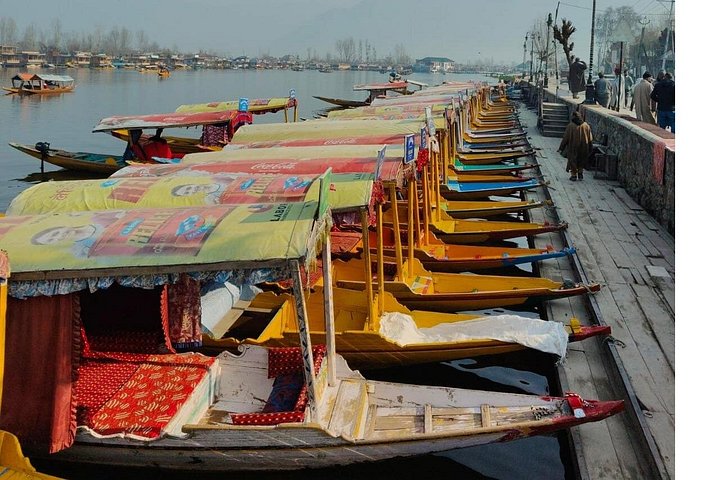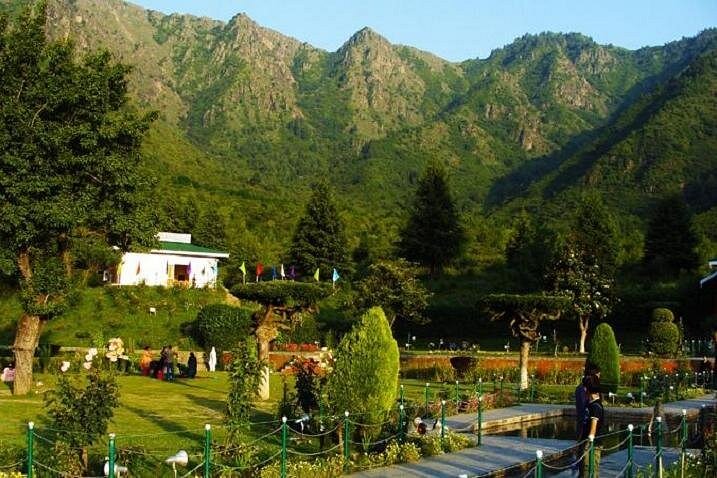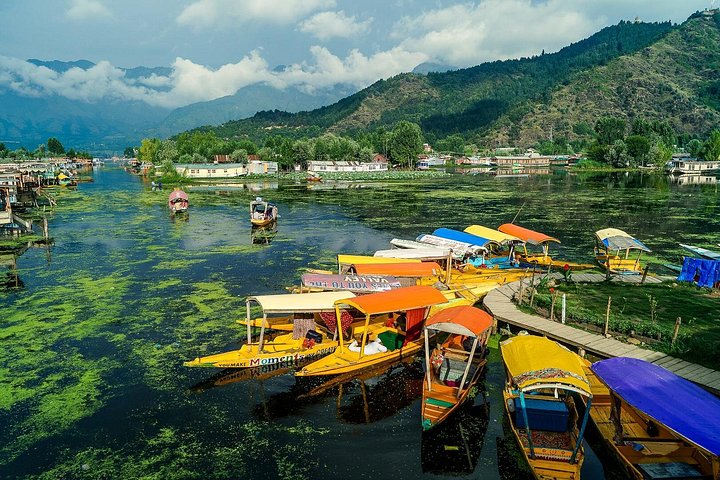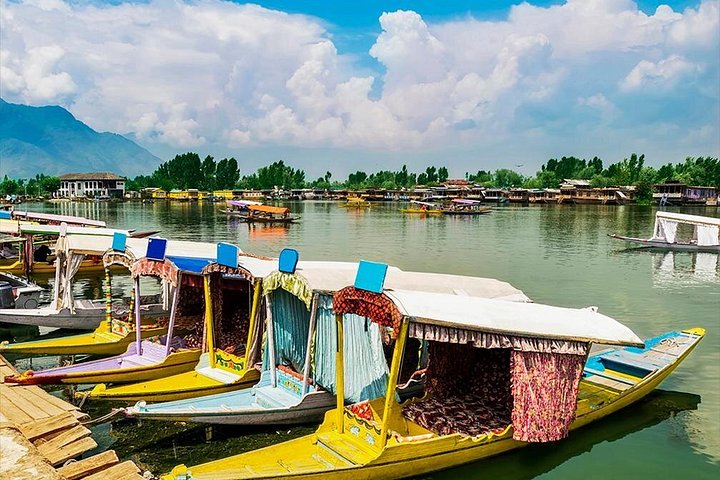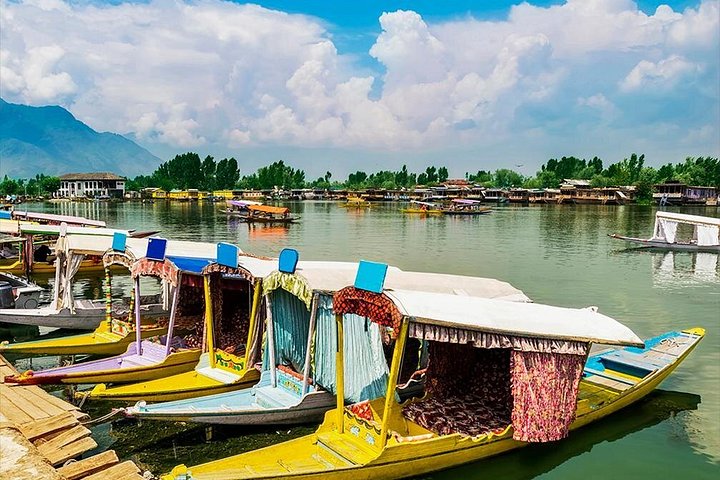
Dal Lake is the heart of Srinagar and the image most travellers carry of Kashmir: a broad, mirror-still lake ringed by mountains, with the Zabarwan range rising behind the Mughal gardens on its eastern shore. The best way to know it is from the water, in a shikara, the long, narrow wooden boat with a canopy, curtains and cushioned seats that has served as the lake's taxi, market stall and ferry for generations. A boatman paddles with a heart-shaped blade, standing or sitting at the stern, and the pace is unhurried enough that the lake becomes a place to look at rather than cross. Along the way you pass houseboats with carved facades and verandas, small islands of willow and poplar, and the floating gardens where families grow tomatoes, cucumbers and gourds on mats of woven weed and soil. Other shikaras act as floating shops, so a canoe loaded with flowers, saffron, dry fruit, shawls or snacks may pull alongside and offer its wares. The mood changes with the hour and the season: soft mist at dawn, hard blue light at noon, and gold on the water in the evening, with lotus blooms covering the shallows in high summer.
Most shikara rides start from one of the numbered ghats along Boulevard Road, and the usual routes run for one to two hours. A common circuit crosses toward the island gardens near Char Chinar, passes through the lanes of the floating gardens and the lotus-filled channels of the inner lake, and returns along the houseboat rows. Early morning rides can include the floating vegetable market, where growers paddle in from the lake villages and trade in boats; it is an authentic working scene and best done at dawn, so ask your boatman or hotel the night before.
Sunset rides are quieter and photogenic, and many couples choose them for the light on the water and the mountains. The ride in the city tour product linked here is combined with a guided look at other Srinagar sights, which suits first-time visitors who want context as well as scenery.
A few practical points make the experience smoother. Agree the price, duration and route with the boatman before you step in, because rates are negotiable at the ghat and hawkers on the water can add up if you buy from every passing canoe. Boats are not motorised for tourists in the same way as on other lakes, so the quiet is part of the appeal.
Carry a hat and sunscreen in summer, because the sun at this altitude is strong, and an extra layer in spring and autumn, when the breeze off the water is cool.
In winter the lake can be cold, misty and occasionally partly frozen, which makes for a very different, stark and beautiful ride. The lake also has real environmental pressures, from weeds and settlement to waste, so take rubbish back with you and avoid buying plastic. Pair the shikara with a visit to a Mughal garden, Hazratbal shrine or a houseboat stay to see how the lake, the city and its culture fit together.
Dal Lake is also a working landscape, home to families who farm the floating gardens, fish, gather lotus stems and cut weed for fodder, so treat the ride as a visit to a neighbourhood as well as a scenic spot.
What to expect
The experience
A paddled wooden shikara ride on Dal Lake with cushioned seats and a canopy, usually combined with a guided look at other sights in a city tour.
Best time
Dawn for the floating market and mist, or late afternoon and sunset for soft light; spring to autumn is most comfortable.
How long
One to two hours on the water, longer if combined with a city tour.
Tips
Agree price, route and time before boarding, bring sun protection and a layer, and avoid buying plastic-wrapped goods from passing boats.
Quick picks
- Best for
- First-time visitors, couples and photographers.
- Families
- Children enjoy the boat and the floating shops, and shikaras have seats and canopies; keep young children seated.
- Couples
- A sunset ride with cushions and curtains is the classic romantic moment in Srinagar.
- Pair with
- A Mughal garden visit and a night on a houseboat.
- Time needed
- Two hours for the ride; half a day with a city tour.
Good questions
What is a shikara?+
A shikara is a long, narrow wooden boat with a canopy and cushioned seats, paddled by a boatman, used on Dal Lake as a taxi, tour boat and floating shop.
When is the best time to ride?+
Dawn suits the floating vegetable market and mist, while late afternoon gives the best light; spring to autumn is the most comfortable season.
How long does a ride last?+
Most rides run for one to two hours, and longer routes reach the inner lake, the floating gardens and the island near Char Chinar.
Can I negotiate the price?+
Rates at the ghats are negotiable, so agree the price, route and duration before you board, or choose a guided tour where the ride is already included.
Is the lake open in winter?+
Yes, though it is cold and misty, and parts can freeze in hard winters; rides are quieter and atmospheric but dress warmly.