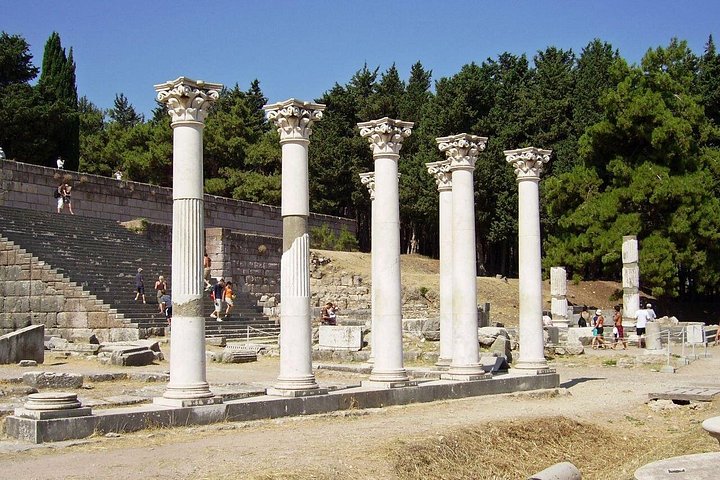
The Asklepieion is the reason many people come to Kos at all. It is an ancient sanctuary of Asklepios, the god of healing, built on a pine-covered hillside a few kilometres from Kos Town, and it is closely tied to Hippocrates, the physician born on the island in the fifth century BC and later called the father of medicine. The site was a place of worship and a place of treatment at the same time. Pilgrims came to pray, to sleep in the sanctuary hoping for a healing dream, and to consult priest-physicians who used diet, baths, herbs and rest as well as ritual. Later the Hellenistic and Roman worlds expanded the complex into a large terraced sanctuary with temples, altars, a fountain house and bathing facilities, and it remained in use for centuries until earthquakes and changing religion ended its life. The ruins were rediscovered and excavated in the early twentieth century, and what stands today is a set of stone terraces, stairways, columns and foundations that still reads clearly as a designed landscape. The layout is the easiest part to appreciate. Three main terraces rise one above the other, joined by a broad stairway. The lowest level held the baths and service rooms, the middle level carried the altar and an earlier temple, and the highest terrace was crowned by the largest temple of Asklepios, whose columns can still be seen in part. From the top you look down over pines and fields to Kos Town and the sea, and on a clear day you can make out the Turkish coast across the strait. Walking up the stairs in the order the ancient visitors did gives you a sense of why the site was chosen: it is quiet, airy, well watered and high enough to feel apart from ordinary life.
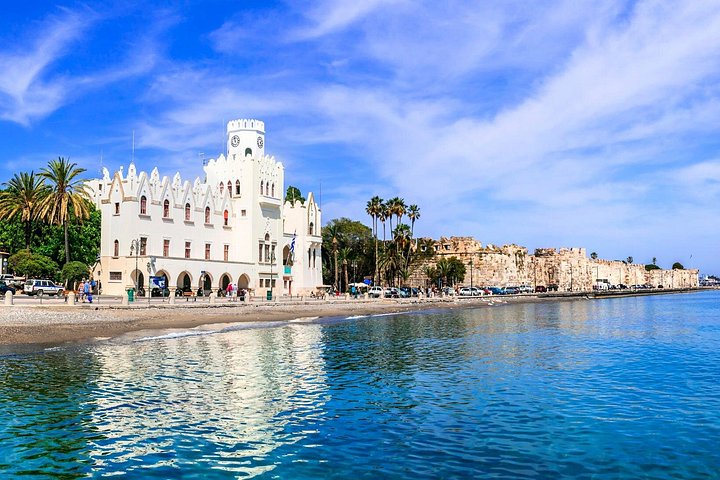
The product linked here is a private half-day tour of Kos history and landmarks, so the exact stops are chosen with the guide and the title does not promise a specific route. Ask for the Asklepieion to be included, along with the old harbour area and anything else you care about, and confirm the pickup and the hours before you go.
A private format is useful here because the site rewards explanation. Without context the terraces look like scattered stones; with a guide who can describe the rituals, the medical ideas and the building phases, the site becomes much easier to read.
If you prefer to go on your own, the sanctuary sits on the road out of Kos Town and is reachable by taxi, by hired bike for fit riders, or by a seasonal tourist train from the town, depending on the year. Check opening days and hours locally, because archaeological sites in Greece often close one day a week and shorten their hours outside summer.
Wear shoes with grip, because the stone steps are worn and uneven, and bring a hat and water, since shade is limited on the upper terraces. Late afternoon is pleasant and softer for photographs, while early morning is quieter and cooler in July and August.
Allow around ninety minutes to two hours on site, a little longer if you read every sign. The visit pairs naturally with Kos Town, where you can see the plane tree associated with Hippocrates near the castle and the Ancient Agora, and with a late lunch in a village on the way back. Families with older children usually enjoy it more than expected, especially if you turn the climb into a small quest to find each terrace in order.
Very young children and anyone with limited mobility should note that the site involves many steps and little handrail, so plan the visit around what you can manage rather than trying to cover everything.
What to expect
The experience
A private half-day history and landmarks tour; confirm that the Asklepieion is on the route, and allow time to climb the three terraces on foot.
Best time
Late afternoon for soft light and cooler stone, or early morning in high summer.
How long
Two to four hours including transfers.
Tips
Wear shoes with grip, bring water and a hat, and check the site opening days before you go as most Greek archaeological sites close one day a week.
Quick picks
- Best for
- History lovers and first-time visitors who want to understand why Kos is famous.
- Families
- Good for school-age children who enjoy ruins; the stairs are steep and uneven for toddlers.
- Couples
- Quiet, scenic and atmospheric, especially late in the day.
- Pair with
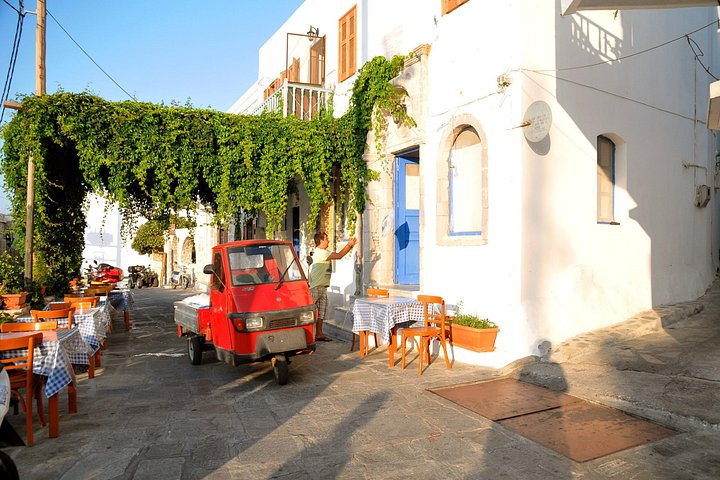
- Kos Old Town and a village lunch on the way back.
- Time needed
- Half a day.
Good questions
Who was Hippocrates?+
A physician born on Kos in the fifth century BC whose methods of observation and diet shaped later medicine. Kos treats him as a local hero.
How many terraces does the Asklepieion have?+
Three main terraces joined by a broad stairway, with baths below, an altar and temple in the middle, and the largest temple on top.
Is the Asklepieion suitable for children?+
Yes for school-age children who like ruins, but there are many steps and little shade, so bring water and take it slowly.
How long should I allow?+
About ninety minutes to two hours on site, plus travel time from Kos Town.
Do I need a guide?+
Not required, but explanation makes the ruins far more meaningful. A private tour lets you choose the pace and the extra stops.