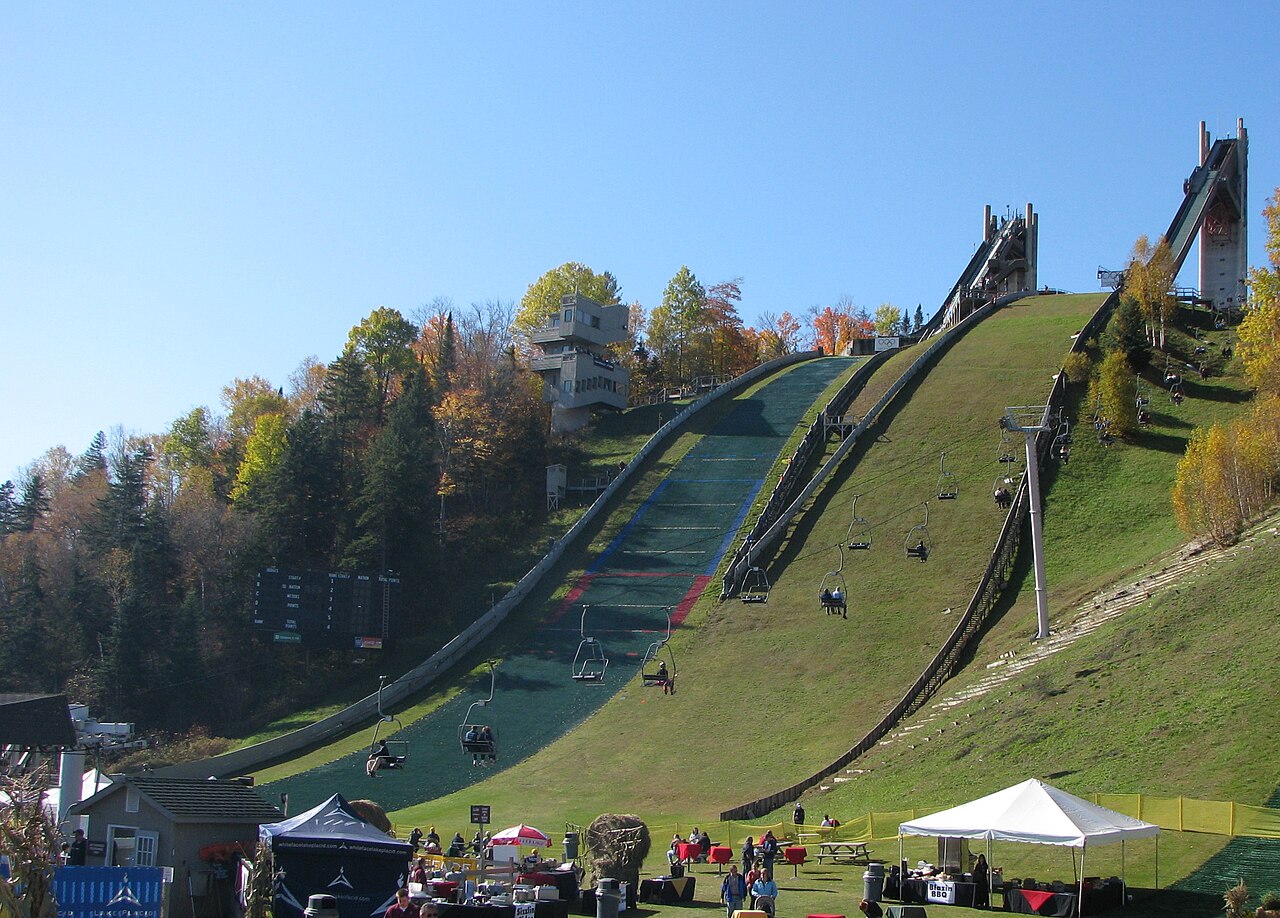
The Olympic Jumping Complex is one of the few places in North America where a visitor can ride to the top of a competition ski jump. Two towers dominate the skyline south of the village: the 90-meter normal hill and the 120-meter large hill, both built for the 1980 Winter Olympics and still used for national and international competition. Visitors ride a chairlift partway and then a glass-sided elevator the rest of the way to the top of the taller jump, where an observation deck looks out over Lake Placid, Mirror Lake, Whiteface Mountain and the ridgeline of the High Peaks. The view alone justifies the visit, and the context adds to it. Standing on the platform and looking down the in-run, you begin to grasp what athletes do here, accelerating down a steep ramp and launching from the edge into a long flight over the outrun below. In summer the ramps are covered with a plastic surface and water, so jumpers train year-round and visitors can often watch.
The experience is simple and compact. A ticket covers the lifts and the observation deck, and the visit typically takes an hour or so including the ride up, the time at the top and a walk around the base to look at the landing hills. Signage and displays along the way explain how ski jumping works, how the hills are measured and how the judging system rewards both distance and style.
A small museum area at the base focuses on the sport's history here. If a training session or competition is underway, the experience becomes much richer, since you can watch real athletes launch from the lip and glide to the landing, and the scale of the jumps becomes obvious in a way a static view cannot convey.
Seasonal patterns shape the visit. Summer and early fall bring plastic-surface training and sometimes competitions, along with the clearest views. Fall foliage turns the surrounding hillsides brilliant, and the observation deck becomes one of the best foliage viewpoints in the region. Winter jumping on snow happens in a limited window and depends on conditions, and cold, wind and ice can close the lifts on short notice, so a winter visit should always be confirmed on the day.
The complex is operated by the regional authority that runs the Olympic venues, which sells combination passes for several sights, so check whether a bundle with the bobsled, the Whiteface gondola or the museum fits your plans.
Practical notes
The lifts are enclosed or open depending on the segment, so dress for wind at the top, which is always cooler than the village. Anyone nervous about heights should know that the final elevator is glass-walled, though the platform feels solid. Strollers and mobility devices need a quick check with staff since the lifts have specific loading procedures.
The complex is a short drive from the village center and can also be reached on a pleasant walk or bike ride for those with energy. Pair it with the Olympic Center and Mirror Lake for a compact day of Olympic history, or add the bobsled track at Mt. Van Hoevenberg for a full Olympic circuit that covers the major venues in a single day.
What to expect
The experience
A chairlift and glass elevator to the top of the 120-meter jump, an observation deck over the village and High Peaks, and a base area with ski-jumping history.
Best time
Clear mornings and fall foliage weeks give the best views. Summer training sessions add action. Winter operation depends on wind and ice.
How long
About one to one and a half hours with time at the top.
Tips
Bring a layer for the top, check the lift status before you drive over, and look for a training session to watch.
Quick picks
- Best for
- Views and Olympic history in a single stop.
- Families
- Children enjoy the elevator and watching jumpers; there are height and loading rules to confirm with staff.
- Couples
- Sunset or a clear fall morning on the deck is a good romantic stop.
- Pair with
- Olympic Center, Mt. Van Hoevenberg and Mirror Lake round out an Olympic day.
- Time needed
- One to one and a half hours.
Good questions
How high is the ride?+
The larger tower is a 120-meter jump, and the elevator and chairlift take visitors to the top of the structure, where an observation deck looks over the village and mountains.
Can you watch ski jumpers?+
Often in summer and fall, when athletes train on plastic-surface ramps. Winter snow jumping and competitions depend on conditions, so check the schedule.
Is it open in winter?+
Operations vary with wind, ice and event schedules, so confirm the same day. Visitors should dress warmly since the top is exposed.
Is it suitable for children?+
Most children enjoy it. Ask staff about age, height and mobility rules for the lifts before you buy tickets.
Can you combine it with other Olympic sites?+
Yes. The regional authority sells bundled passes for several venues, so compare options if you plan to see the bobsled, the gondola or the museum.