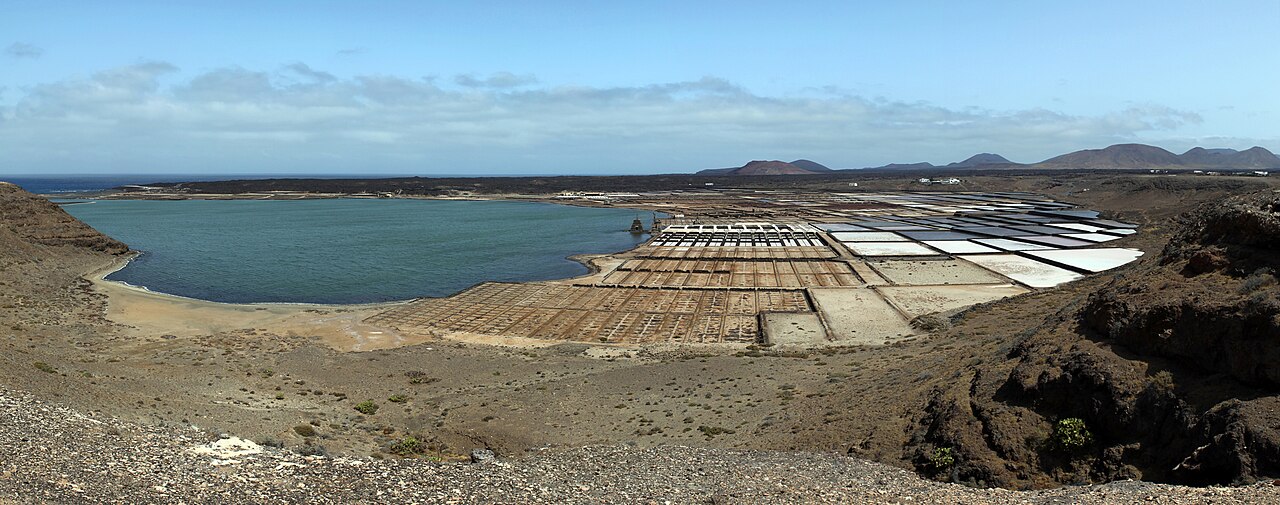
The Salinas de Janubio are a chequerboard of shallow pans in front of a lagoon on the south-west coast, just beyond the lava cliffs of Los Hervideros and a short drive from Playa Blanca. They are the largest salt pan in the Canary Islands and the largest remaining salt works in the archipelago, with thirty-three pans of increasing salinity. Construction began in 1895, and the work is still carried by a family company, now in its fourth generation. Seawater filters through the volcanic rock into the lagoon and is moved by pump into the pans, where the sun does the work, and a batch of salt takes about thirty days. The water can turn shades of pink, caused by brine shrimp, and flamingos sometimes feed here. A guided visit explains the whole process, the wildlife and the history, and ends with a look at the salt and the old windmill pump. The pans are also easy to see from the road as you drive between Yaiza and Playa Blanca.
How it works
The guided visit linked here is run in English and Spanish by a live guide, with groups of up to fifteen people. Tickets are sold in advance, and you choose a date and time at checkout. The salt works lies at the end of the road towards Los Hervideros, near Yaiza, and you can drive to the entrance and park. Without a tour you can still look around the car park area and buy local salt, but the guide is the way to understand what you are seeing.
What to expect
A relaxed walk beside the pans, with explanations of how seawater becomes salt, why the colours change and how the tides and the volcanic rock feed the lagoon. It is an open site with little shade, so bring a hat and sunscreen even in winter. Salt is sold at the shop, and it is a good small souvenir. The pans are a working business, so follow your guide’s instructions about where to walk.
Making the most of it
The salt flats are a short drive from El Golfo and the Green Lagoon, and from the cliffs of Los Hervideros, where waves boom into lava caves, so you can see all three in a half day. Add the Timanfaya National Park and the La Geria vineyards for a full day in the south-west. If you are staying in Playa Blanca, it is a short drive away, and the late afternoon, when the light is low and the colours are strong, is the best time for photographs.
What to expect
The experience
A guided walk beside working salt pans, with explanations of how the salt is made and a look at the old windmill pump.
Best time
Late afternoon, when the low light brings out the colours of the pans and the lagoon.
How long
Allow an hour to an hour and a half for the guided visit.
Tips
Bring a hat and sunscreen, wear flat shoes and follow your guide’s instructions about where to walk.
Quick picks
- Best for
- Curious travellers and photographers who want to see a working salt works on a volcanic coast.
- Families
- Children can enjoy the colours and the story of the salt, but the site has little shade.
- Couples
- Visit in late afternoon and continue to the cliffs of Los Hervideros for sunset.
- Pair with
- Los Hervideros, El Golfo and the Timanfaya National Park.
- Time needed
- About an hour for the visit, or half a day with the nearby coast.
Good questions
Is the guided visit in English?+
Yes, the live guide speaks English and Spanish, with groups of up to fifteen people. Choose your date and time when you buy.
Why are the pans different colours?+
The colours change with the salinity of each pan, and pink tones come from brine shrimp in the water. Flamingos sometimes feed on them.
Can I visit without a tour?+
You can drive to the entrance and look around the car park area, and buy salt at the shop. A guided visit explains the pans and the process.
Is it still a working salt works?+
Yes, it is a working salt producer, and part of the original area is still in use. A batch of salt takes about thirty days.
What else is nearby?+
The cliffs of Los Hervideros and the Green Lagoon at El Golfo are close by, and so is the Timanfaya National Park. It is easy to combine them in a half day.