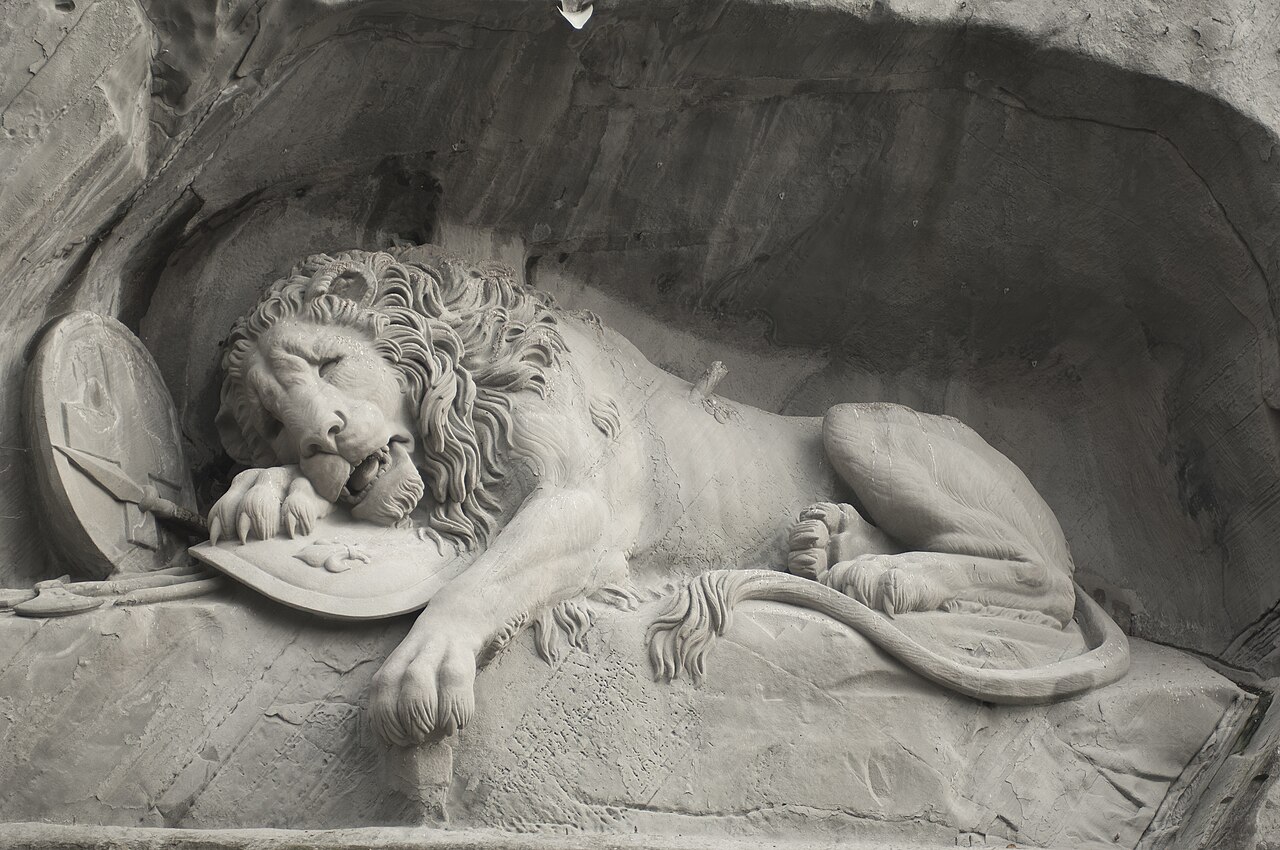
The Bourbaki Panorama is a monumental circular painting housed in a purpose-built rotunda near the Lion Monument. It was painted in 1881 by the Geneva artist Edouard Castres, who had served with the Red Cross during the events it shows. In the bitter cold of February 1871, at the end of the Franco-Prussian War, the exhausted French army of the East, some eighty thousand men under General Bourbaki, crossed the border into Switzerland near the Jura village of Les Verrières. The Swiss accepted them, disarmed them and quartered them in towns and villages across the country, a moment that is remembered as an early act of Swiss humanitarian tradition. Castres painted the scene on a canvas about one hundred and ten metres long and ten metres high, and stood visitors on a central platform so that the whole horizon became the story. The painting came to Lucerne in 1889 and has been here ever since, restored and displayed in a rotunda that also holds a cultural programme of exhibitions and events.
Standing on the platform is the point. The painted snow runs all the way round you, with horses collapsing in the road, soldiers with bandaged feet, women handing out bread and soup, and the border post at the heart of the picture. The foreground is built with real objects, such as sleighs, rifles and bits of fence, which merge with the canvas so that it is hard to say where the three-dimensional part ends and the painting begins.
That illusion was the entertainment of its day, in the age before cinema, and it still works. Take your time, because the details reward a slow walk round: faces, gestures, the blue shadows on the snow and the dull, wintry light.
A short introduction in the museum and a presentation of the painting help you read it. They explain who Bourbaki's men were, why they were fleeing, how Swiss families took them in and how the panorama was painted, restored and rescued. A visit usually takes under an hour, so it pairs naturally with the Lion Monument and the Glacier Garden, which are both within a few minutes' walk. The three together make an excellent half day on the Löwenplatz side of town.
Why see it? Because it shows a side of Switzerland that postcards miss. The story is about neutrality, about practical kindness at a border, and about the weight of a nineteenth-century war that many visitors have never heard of. It is also a rare chance to see a panorama of this scale in near original condition, and the rotunda itself is a handsome piece of architecture. History lovers, art lovers and parents of curious children will all get something from it.
Practical points
The museum has regular opening days and hours that change by season, and some days may be shorter or closed, so check the schedule before you go. The rotunda also hosts events, so the programme can change. The platform is reached by a gentle route, and the museum works well on a wet day. Tickets are sold at the entrance and on the museum's own site, and it is a small enough place that you will not feel rushed, even if you stop to read every panel.
What to expect
The experience
A guided-by-panel visit to a rotunda where a 360-degree painting wraps around a central viewing platform.
Best time
Any time, but a wet afternoon is ideal, and weekday mornings are quietest.
How long
About an hour, including the introduction and a slow walk round the painting.
Tips
Read the introduction first, look for the real objects in the foreground and check the opening days for the season.
Quick picks
- Best for
- History and art lovers, and anyone who wants something different from the lake and mountains.
- Families
- Good for children of reading age who like detail; younger ones may tire sooner.
- Couples
- A quiet, absorbing hour followed by a walk to the lake.
- Pair with
- The Lion Monument and the Glacier Garden, both a few minutes away.
- Time needed
- An hour is plenty, ninety minutes with the introduction.
Good questions
What does the Bourbaki Panorama show?+
It shows the French army of the East crossing into Switzerland in February 1871 at the end of the Franco-Prussian War, and being taken in by the Swiss.
How big is the painting?+
It is about one hundred and ten metres long and ten metres high, painted in 1881 by Edouard Castres, and it is displayed in a round building so that it surrounds you.
How long does a visit take?+
About an hour, which makes it easy to combine with the Lion Monument and the Glacier Garden.
Is it a good rainy-day choice?+
Yes. The whole visit is indoors, and the circular painting is just as dramatic on a grey day.
Where is it?+
It is in a rotunda on the Löwenplatz side of town, a short walk from the Lion Monument and the Glacier Garden.