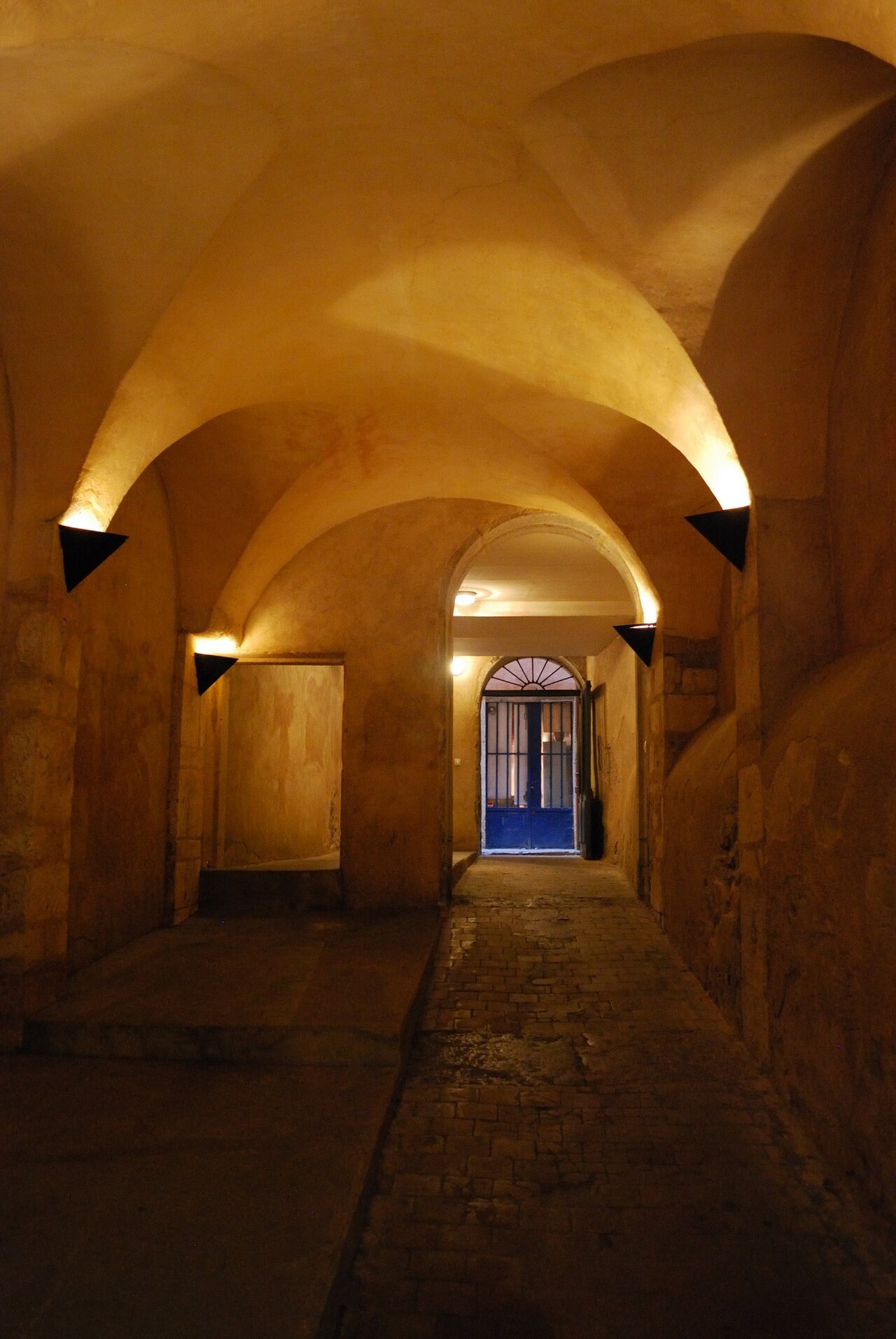
Vieux Lyon is one of the largest Renaissance quarters in Europe, a long strip of tall pastel houses between the Saône and the foot of Fourvière hill, built when Lyon grew rich on banking, printing and trade fairs. It divides into three parishes, Saint-Paul, Saint-Jean and Saint-Georges, threaded together by the Rue Saint-Jean and the Rue du Bœuf. Its great secret is the traboule, from the Latin for passing through: a shortcut that runs through a building, across a courtyard and up or down a staircase to link two streets. Lyon has around 500 of them, about 200 in Vieux Lyon alone, though only around 80 are open to the public. Behind plain doors you find spiral staircases in stone towers, arcaded galleries, wells and quiet courtyards. The quarter also has the Gothic Cathedral of Saint-Jean, with its astronomical clock, many of the city’s traditional bouchons and the puppet Guignol. This page links to the official ONLYLYON tourism page on the traboules.
How to visit: the quarter is free to explore, and the metro line D stop Vieux-Lyon puts you at the cathedral. Under an agreement with the owners, the public traboules are open every day from 7:00 to 19:00; look for the small bronze plaques and lion-head signs by the doors and push the button to open. The tourist office runs guided walks through the old town and its traboules, and the Lyon City Card includes one guided tour. The Croix-Rousse hill has a second network of traboules, linked to the silk workers of the 18th and 19th centuries.
What to expect: these are private homes and working buildings, so keep your voice down, do not shout or run, take your rubbish with you and close doors behind you. The main lanes get very busy at weekends and in the evening, when the bouchon terraces fill. Cobbles are uneven and many passages have steps.
Making the most of it: come early in the morning when the courtyards are quiet and the light falls into the stairwells. Visit the cathedral, then explore the traboules between the Rue Saint-Jean and the Quai Fulchiron, and finish with lunch in a bouchon. The Musée Cinéma et Miniature is on the Rue Saint-Jean, and the funicular to Fourvière leaves from the station nearby.
What to expect
The experience
A self-guided or guided wander through Renaissance lanes, the cathedral and the hidden passageways and courtyards behind the street doors.
Best time
Early morning, when the traboules are quiet, or early evening before dinner in a bouchon.
How long
Two to three hours, longer with a guided tour and a long lunch.
Tips
The public traboules open from 7:00 to 19:00; look for the plaques by the doors and treat the courtyards as the private homes they are.
Quick picks
- Best for
- First-timers who want the atmosphere of Renaissance Lyon and the thrill of discovering its hidden passageways.
- Families
- Children love hunting for the secret doors and spotting the Guignol puppets; strollers struggle with the steps.
- Couples
- Explore the courtyards in the morning and come back for dinner in a candlelit bouchon.
- Pair with
- Fourvière Basilica by funicular, and the Musée Cinéma et Miniature on the Rue Saint-Jean.
- Time needed
- Two to three hours.
Good questions
What is a traboule?+
A traboule is a passageway that runs through a building and its courtyard to link two streets. The name comes from the Latin for passing through.
How many traboules can you visit in Lyon?+
There are around 500 in the city, but only about 80 are open to the public. They are spread across Vieux Lyon, the Croix-Rousse slopes and the Presqu’île.
When are the traboules open?+
The public traboules are open every day from 7:00 to 19:00 under an agreement with the owners. Outside those hours the doors are locked.
Do I need a guided tour to see the traboules?+
No, you can explore on your own by looking for the plaques beside the doors. A guided tour helps you find the best ones and explains their history, and the City Card includes one.
Is Vieux Lyon a UNESCO site?+
Yes, Vieux Lyon is part of the Historic Site of Lyon, inscribed by UNESCO. The listing also covers Fourvière, the Presqu’île and the Croix-Rousse slopes.