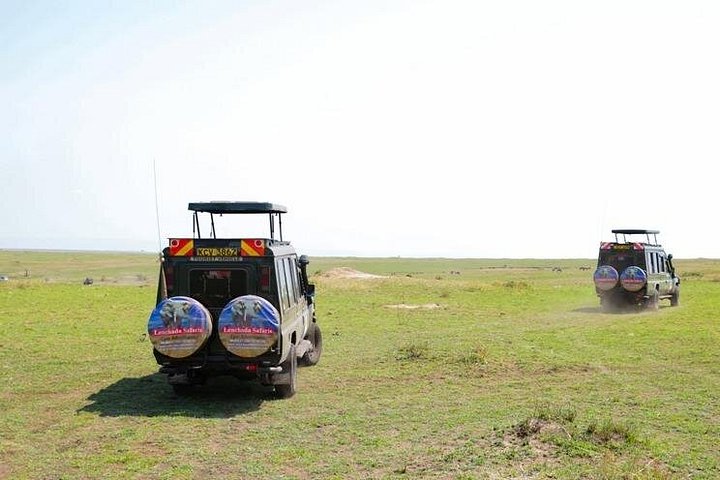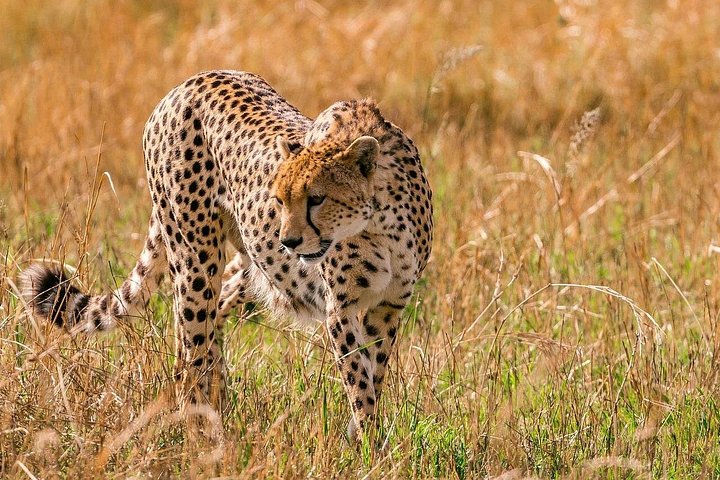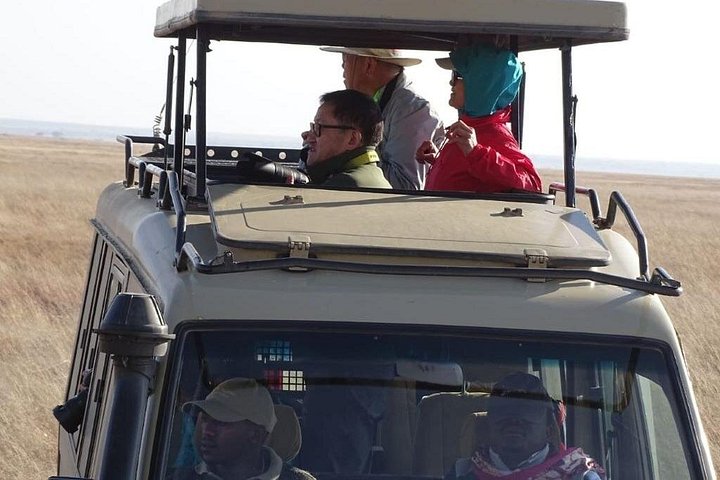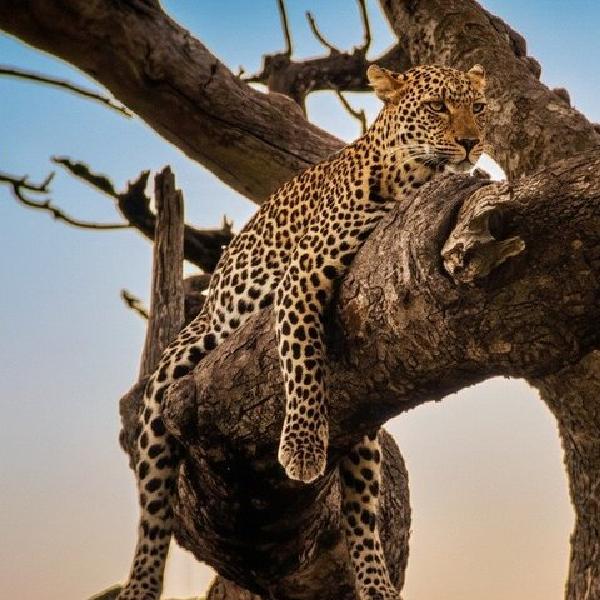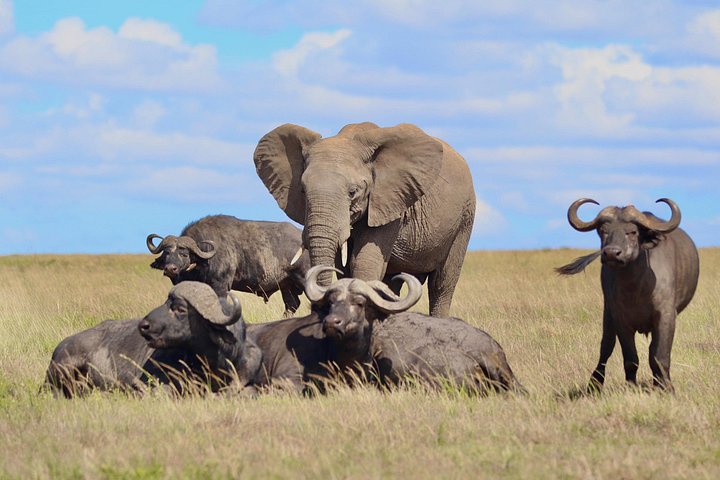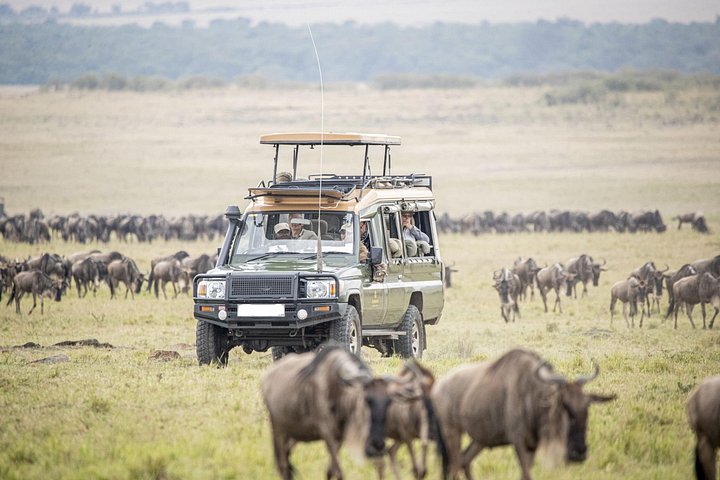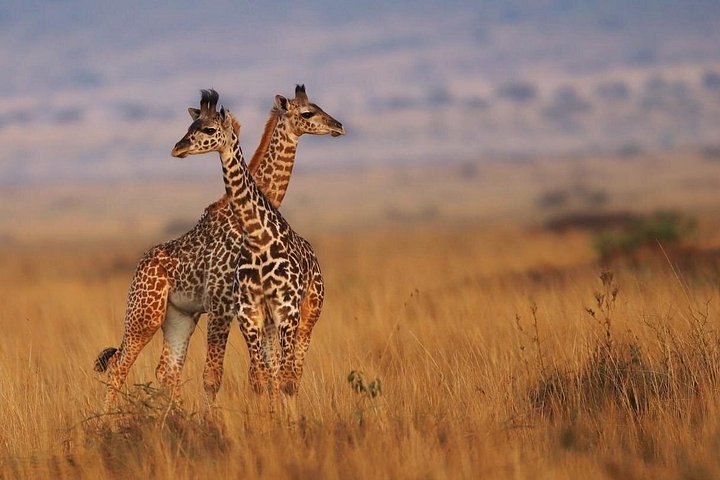
The Maasai Mara National Reserve is the park most people mean when they say they want to go on safari in Kenya. It sits in the south-west of the country, in Narok County, and joins the Serengeti across the Tanzanian border to form one of the great wildlife systems on earth. The reserve covers roughly 1,500 square kilometres of rolling grassland dotted with acacia, croton thickets and riverine forest along the Mara and Talek rivers, and the open terrain is exactly why sightings here feel so easy: lions rest in plain view, cheetahs use termite mounds as lookouts, elephants cross the plains in family groups and giraffes browse against the horizon. The Big Five are all present, and black rhinos, though rare and shy, live in the reserve too. Most visitors see it from a safari vehicle with a pop-up roof, led by a driver-guide who knows where the prides and the leopards have been spotted, and a typical day has a dawn drive, a break at camp in the heat and a late-afternoon drive until the light goes gold.
Our recommended way in is a three-day small-group safari from Nairobi, with a driver-guide, a four-wheel-drive vehicle and two nights near the reserve. It runs on a shared basis, so you travel with a handful of other guests rather than paying for a private vehicle, and the small-group format keeps every passenger at a window seat. The drive from the capital takes most of a day, usually around five to six hours depending on traffic and the condition of the final stretch of road, so day one is often a late-afternoon game drive and day two a full day in the reserve.
Check what your tour includes before you book, especially the daily reserve fee, the style of camp or lodge and whether meals and drinks are covered.
Where to look
The reserve is large and its character changes from one sector to the next. The area around Musiara Marsh and the Talek River in the north is known for big cats, the Mara River and the western Mara Triangle are the classic migration crossing country, the central plains are open and good for cheetahs, and the south-east around Keekorok is quieter with its own herds. The Narok County side is entered through the Sekenani, Talek, Musiara and Oloolaimutiek gates, while the Mara Triangle in the west is managed separately and entered through its own gates, so your camp location shapes which sector you explore most.
Practical points
The daily reserve fee is roughly twice as high in the July to December high season as in the first half of the year, and rates for children are lower, so confirm whether your price includes it. Bring layers for cold dawns, a hat, sunscreen, binoculars and a camera with a zoom lens, and pack in a soft bag because vehicle space is limited.
Roads inside the reserve are dirt tracks that can turn to mud in the rains, so a sturdy 4x4 and an experienced driver matter. Drivers are not allowed to leave the tracks to chase animals in the reserve, which protects the habitat, and quiet, patient viewing is rewarded with longer sightings.
Choosing between operators
Shared small-group safaris vary in quality, so read recent traveller feedback on the guide, the vehicle and the camp, and ask how many guests share a vehicle. A good driver-guide makes the trip, finding animals, explaining behaviour and positioning the vehicle for photographs without crowding the sighting. Ask whether the itinerary includes a full day in the reserve rather than only short drives at the beginning and end, and whether lunch is a picnic in the bush or back at camp.
If you can stretch to a fourth night, you gain a second full day, which is when many travellers see their best predator action.
What to expect
The experience
A shared small-group road safari from Nairobi with game drives in a four-wheel-drive vehicle and two nights near the reserve.
Best time
July to October for the migration, January to March for green, quiet plains and good big-cat viewing.
How long
Three days and two nights, with around five to six hours of driving each way.
Tips
Check what is included, carry cash or a card for the reserve fee if it is not, and pack warm layers for dawn drives.
Quick picks
- Best for
- First-time safari-goers who want the classic Kenyan reserve at a fair price.
- Families
- Good for children old enough to handle long drives and early starts.
- Couples
- Sunrise drives and big-cat sightings make a memorable shared adventure.
- Pair with
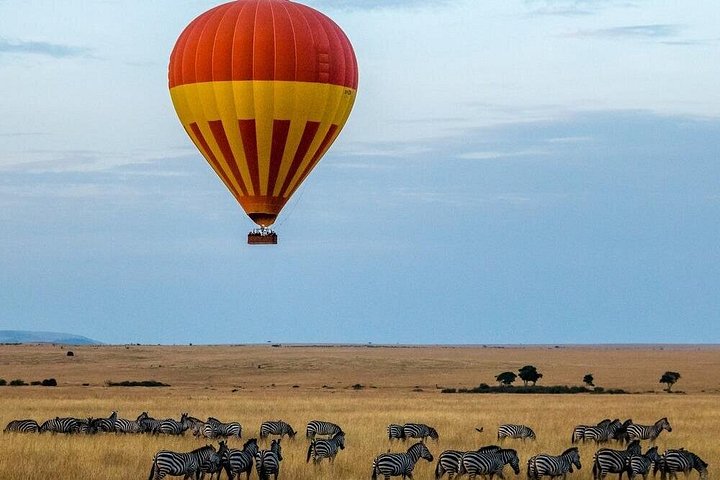
- A balloon flight at dawn or a Maasai cultural visit.
- Time needed
- Three days is the practical minimum; four or five is better.
Good questions
Which animals can I see in the Maasai Mara?+
Lions, leopards, cheetahs, elephants, buffalo, giraffes, zebras, hippos, crocodiles and hundreds of bird species. Black rhinos live here but are rarely seen.
How many days do I need?+
Three days and two nights is the shortest sensible trip by road. Four or five nights give you time for a full day at the river and a visit to a conservancy.
Is the reserve fee included in tour prices?+
Some tours include it and some do not. Confirm before you book, because the fee is charged per person per day and varies by season.
What is the vehicle like?+
Most safaris use a four-wheel-drive Land Cruiser or similar with a pop-up roof, so everyone can stand to see and photograph animals.
Can I do this as a day trip?+
A road day trip from Nairobi is very long. Flying in, or staying overnight, gives you much more time with the wildlife.