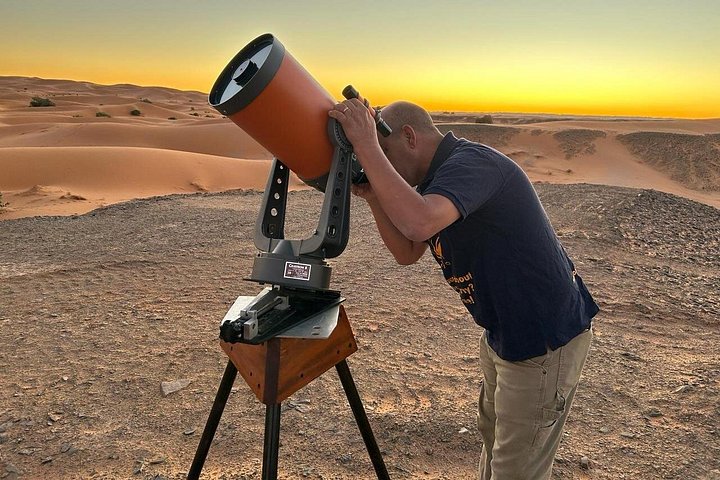
The Sahara night sky is one of the great free shows on earth, and Merzouga is one of the best places in Morocco to see it. This evening programme takes you into the dunes at sunset, serves dinner at a camp or on a carpet under the open sky, and then leaves time for a guided look at the stars once the last glow has faded. With almost no artificial light and clear dry air, you can see the Milky Way arch overhead, spot planets as steady points of light and watch shooting stars cross the dark. Some guides carry a laser pointer or a star chart, and a few operators provide telescopes, so the evening can feel like a casual astronomy lesson.
The best viewing conditions come on moonless nights, so check the lunar calendar before choosing a date. A full moon lights up the dunes with a silvery glow that is beautiful in its own way but washes out fainter stars. Winter nights offer the clearest air, though they are also the coldest, so dress warmly and ask for blankets. Summer nights are milder, but heat haze or dust can sometimes reduce transparency. In any season, give your eyes at least twenty minutes to adjust and avoid looking at phone screens.
Photography takes preparation. A camera with manual controls, a wide-angle lens, a sturdy tripod and a remote shutter will help you capture the Milky Way. Practise your settings before dark, since fumbling in the cold is frustrating. If you prefer to simply look, lie back on a blanket on the sand and let the sky unfold; the constellations of the northern hemisphere sit alongside southern stars that are low on the horizon.
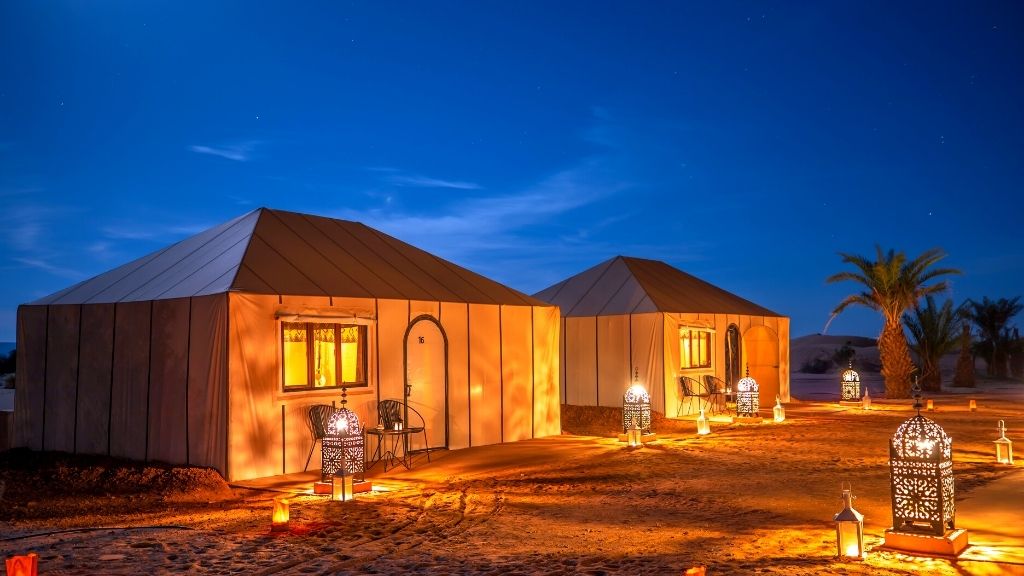
The evening is a good choice for people who do not want to sleep in a tent but still want to experience the dunes at night. Transport back to the village or hotel is normally included, so ask about the return time. If you are already staying in a camp, many camps offer an informal stargazing hour after dinner, though the quality of guidance varies.
Bring a torch with a red light setting, a warm layer and a camera, and be prepared to sit quietly for a while. The reward is a sense of scale that few city dwellers ever experience.
A little preparation makes the sky easier to read. Download a star map or constellation app before you leave, switch it to night mode and use it sparingly. Learn to find the Pole Star, the Big Dipper and Orion, and ask your guide to point out planets that are visible on the night. Bring a reclining mat or blanket, a hot drink in a flask and patience. Do not expect everything to appear at once; eyes need time to adjust, and the Milky Way becomes more detailed after half an hour.
The experience is also an opportunity to learn about the desert sky as a navigation guide. Nomads traditionally used stars to travel and to mark seasons, and a guide may share names and stories. Keep in mind that the ground cools quickly after sunset, so sitting on a thick mat or carpet matters. If you travel with children, bring a small torch with a red filter, hot chocolate or tea and an early bedtime plan, because the cold arrives fast and the excitement fades quickly.
What to expect
The experience
A sunset visit to the dunes, dinner and guided stargazing, with return transport.
Best time
Moonless nights in any season; winter has the clearest air.
How long
About four to five hours.
Tips
Dress warmly, bring a red torch and avoid phone screens while your eyes adjust.
Quick picks
- Best for
- Couples and astronomy fans.
- Families
- Good for older children who enjoy the night sky.
- Couples
- A quiet, romantic evening.
- Pair with
- A sunset camel ride.
- Time needed
- An evening.
Good questions
When is the sky darkest?+
On moonless nights. Check the lunar calendar before choosing a date.
Is it cold?+
From November to March, very. Wear layers and request blankets.
Will I see the Milky Way?+
Usually yes in clear conditions, especially away from camp lights.
Are telescopes provided?+
Sometimes. Ask the operator in advance.
Is dinner included?+
This programme normally includes dinner. Check the menu and any dietary options.