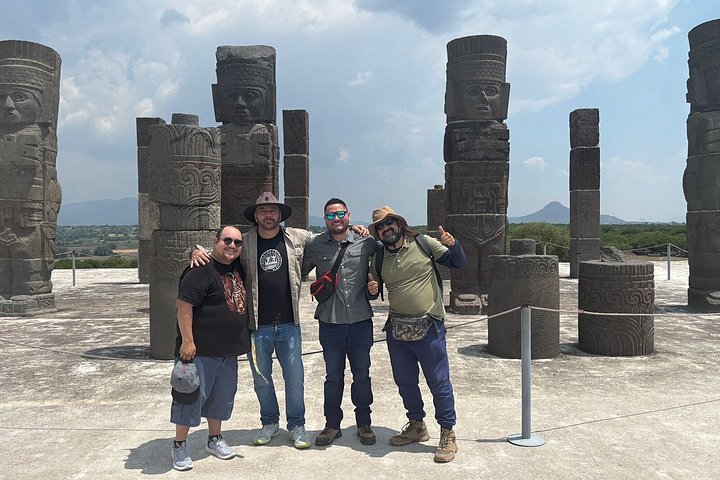
Tula, about an hour and a half north of Mexico City, was the capital of the Toltecs, the culture that rose in central Mexico after Teotihuacan collapsed. Its best-known image is the row of four-meter basalt warriors, the Atlantes, that crown Pyramid B, but the site also has a ball court, a colonnaded hall, carved friezes of jaguars, eagles and skulls, and wide views over the Hidalgo plain. It is far quieter than Teotihuacan, and a good guide ties together the Toltec legends, the myth of Quetzalcoatl and the later Aztec reverence for this lost city.
The Toltecs were remembered by the Aztecs as master builders and artists, and Tula as a kind of golden age. Archaeology paints a more complicated picture, but the site still delivers. The pyramid known as Temple of Tlahuizcalpantecuhtli, or Pyramid B, is topped by four stone warriors, once pillars holding up a temple roof, whose angular bodies and stern faces have become an icon of ancient Mexico. Reliefs on the pyramid's lower tiers show predators devouring human hearts, a theme that returns on the Coatepantli, or Wall of Serpents, nearby.
Two ball courts speak to the importance of the sacred game, and the Burnt Palace, an assembly of columns and benches, hints at the political life of the city. A small site museum displays sculptures and ceramics, including some of the original sculptural fragments that were too fragile to leave outside. Walking the compact zone takes around two hours and is easy for most visitors, though the sun can be strong, so a hat and water are important.
Most visitors reach Tula on a guided day trip, sometimes combined with Teotihuacan or the town of Tepotzotlan, and the journey takes about ninety minutes each way. The site is usually open daily except Monday, and mornings are the best time, with softer light for photography and cooler air. If you have already seen Teotihuacan, Tula adds a different chapter to the story and a chance to see ancient Mexico without crowds.
What to expect
The experience
A guided excursion from Mexico City to the Toltec capital, with the Atlantes warriors, ball courts, friezes and a site museum.
Best time
Mornings, for cool air and soft light. Closed Mondays.
How long
About two hours at the site and 6-8 hours with transport.
Tips
Bring a hat, sunscreen and water because there is little shade. Do the museum first to understand the sculptures. Combine with Teotihuacan only if you enjoy long days.
Quick picks
- Best for
- Ruins enthusiasts who have seen Teotihuacan and want a quieter second site.
- Families
- Older children enjoy the giant warriors and the open spaces.
- Couples
- A calm, scenic outing for couples who prefer history to crowds.
- Pair with
- A traditional lunch in a nearby town, then a rest day in Condesa.
- Time needed
- Half to full day.
Good questions
Who were the Toltecs?+
A culture that dominated central Mexico after Teotihuacan declined, remembered by the Aztecs as brilliant builders and warriors.
What are the Atlantes?+
Four giant basalt warrior figures that once supported a temple roof on top of Pyramid B. They are Tula's signature image.
How far is Tula?+
Roughly 90 minutes by road north of Mexico City, depending on traffic.
Is it crowded?+
No. Tula is much quieter than Teotihuacan, which is a big part of its charm.
Is there shade?+
Very little. Use a hat, sunscreen and plenty of water.