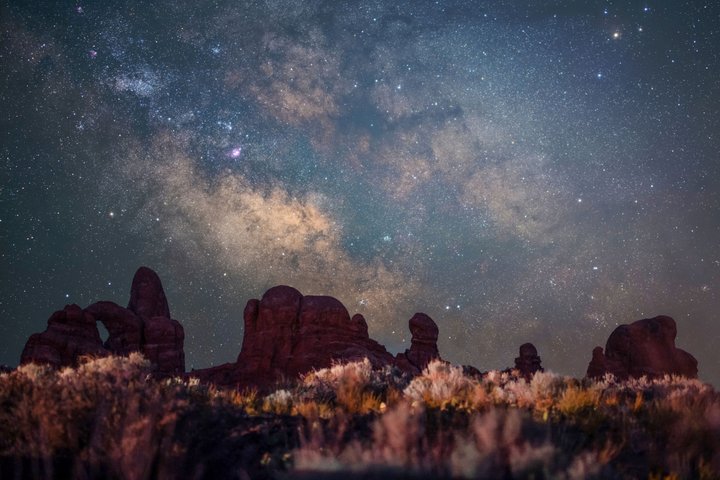
Southeast Utah has some of the darkest skies in the lower forty-eight, and the national and state parks around Moab are recognized as International Dark Sky Parks. Without city light, the Milky Way is clearly visible on moonless nights, and planets and meteor showers stand out against black desert sky. A guided astrophotography and stargazing tour in Arches adds telescopes or camera guidance, a guide who knows where the arches line up with the sky and a chance to photograph the formations under starlight. The tour linked here has a high rating and over a hundred reviews. Moab also offers other stargazing tours and a self-guided audio option, so you can choose the style that suits you.
November is a good month for it. Nights are long, the air is cold and dry, and darkness falls early, which means you can stay out and still reach bed at a sensible hour. The trade-off is the cold, so dress as if for a winter hike, with a hat, gloves, insulated boots and a warm layer you can add as the temperature falls. A red-light headlamp preserves night vision, and a folding chair or a blanket makes a long session comfortable.
Check the moon phase before you plan. A new moon or a thin crescent gives the darkest sky, while a full moon washes out the stars but lights the rock beautifully for night photography. If the weather is cloudy, ask your operator about rescheduling, and keep a flexible evening in your schedule.
If you want to go independently, remember that Dead Horse Point State Park closes to day users at 10 pm and allows stargazing after that only for campers, ranger programs and permitted tour companies. Arches is open year-round, but roads and trails are unlit, so go with a plan, a headlamp and a companion, and take care on icy ground. A stargazing night pairs naturally with a day in Arches or a sunset at Dead Horse Point.
What to expect
The experience
A guided evening tour in Arches with stargazing and astrophotography help, led by a local guide.
Best time
Moonless nights for the darkest sky; in November, early evening is already dark.
How long
Two to three hours after sunset.
Tips
Dress very warmly, bring a red-light headlamp and check the moon phase and weather before you book.
Quick picks
- Best for
- Photographers and couples who want the Milky Way over the red rock.
- Families
- Older children enjoy it; bring warm layers and snacks.
- Couples
- A romantic way to end a day in the parks, with hot drinks in the car.
- Pair with
- A day in Arches or a sunset at Dead Horse Point.
- Time needed
- An evening of two to three hours.
Good questions
Are the parks near Moab dark-sky parks?+
Yes, the national and state parks around Moab, including Dead Horse Point, are recognized as International Dark Sky Parks. Dead Horse Point notes that its late-night stargazing is limited to campers, ranger programs and permitted companies.
What is the best time of year?+
Any clear moonless night is good. Winter offers long, cold nights and early darkness, but dress for freezing temperatures.
Can I photograph the stars with my phone?+
Modern phones with night modes can capture bright stars, but a guide with camera tips will help you get the arches and Milky Way in the same frame.
What if it is cloudy?+
Operators typically reschedule or refund for poor weather. Check the booking terms and keep a spare evening.
Can I stargaze on my own in Arches?+
Yes, the park is open year-round. Roads and trails are unlit and icy in winter, so go with a plan, headlamps and extra layers.