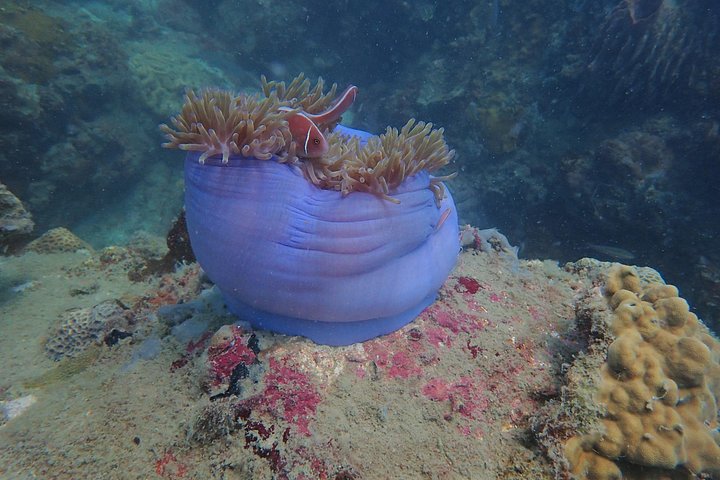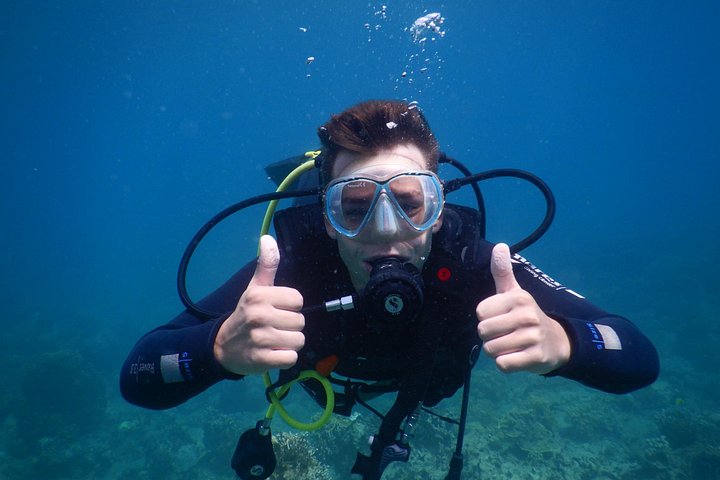
Nha Trang is Vietnam's best-known dive base, and Hon Mun is the heart of it. A discovery dive is the entry point: no certification needed, a briefing on land, equipment fitted for you and a shallow, supervised dive with an instructor holding your hand, often literally. The trip we link runs for around six and a half hours door to door, covers boat transfers to Hon Mun and is reasonably priced for a guided dive, with a rating of about 4.9 from more than 120 reviews. That price includes the dive guide, gear and the time needed to get there and back, so it is good value compared with dive operators in much of Southeast Asia. Divers who are already certified can book fun dives with local dive centres instead. The key caveat for this guide is the season: October to December is rainy, with rougher seas, reduced visibility and operators scaling back.
The dive itself
Introductory dives are one-to-one with an instructor and stay shallow, typically no deeper than six to ten metres, so you spend the time looking at coral, fish and the rock formations around Hon Mun. You will learn simple skills such as clearing your mask and equalising your ears before you go down. Anyone with asthma, ear problems, heart conditions or who is pregnant should check medical suitability before booking, and you must not fly within the period your operator specifies after a dive, so do not schedule a dive on your departure day.
Season and conditions
Local dive guides describe January to August as the main season, with the clearest and warmest water in the middle of the year. September is a transition, and October to December is the rainy season, with rough seas, lower visibility, port closures and many operators scaling back. Because of that, a discovery dive in the wet months is a gamble: it can be fine on a calm morning, but cancellations are likely.
If you are set on diving, build in a spare day, confirm with the operator that boats are going, and ask what the refund policy is if the sea closes the port.
Practical points
Bring swimwear, a towel and sun protection, eat lightly before you go, and tell the instructor if you feel any discomfort. Marine park fees are usually included in dive packages but confirm what your price covers. If the weather rules out the dive, a snorkelling trip or a mud bath makes a good substitute once conditions improve.
What to expect
The experience
A guided introductory scuba trip to Hon Mun with a briefing, equipment and a one-to-one dive with an instructor.
Best time
Calm mornings in the drier months, roughly January to August.
How long
About six and a half hours including transfers and boat time.
Tips
Disclose medical conditions, avoid flying soon after diving, confirm what the price includes and keep a spare day in case the sea closes the port.
Quick picks
- Best for
- Adventurous first-timers who want to try breathing underwater.
- Families
- Suitable for older children subject to the operator's age and health rules, but check carefully.
- Couples
- A memorable shared activity, followed by dinner on the seafront.
- Pair with
- A rest day on the beach or a mud bath at I-Resort afterwards.
- Time needed
- Most of a day including transfers.
Good questions
Do I need to be certified to dive?+
No. An introductory dive needs no certification, and the instructor stays with you throughout the dive.
How deep is a discovery dive?+
Introductory dives are shallow, usually between about six and ten metres, so the focus is on the reef and the experience.
Is diving good in November?+
November falls in the rainy season, when seas are rougher, visibility is lower and many operators scale back. Check conditions and keep a spare day.
How long is the trip?+
The operator lists about six and a half hours including transport, briefing and the dive.
Can certified divers go too?+
Yes. Certified divers can book fun dives with local dive centres. The tour we link is for the discovery experience.