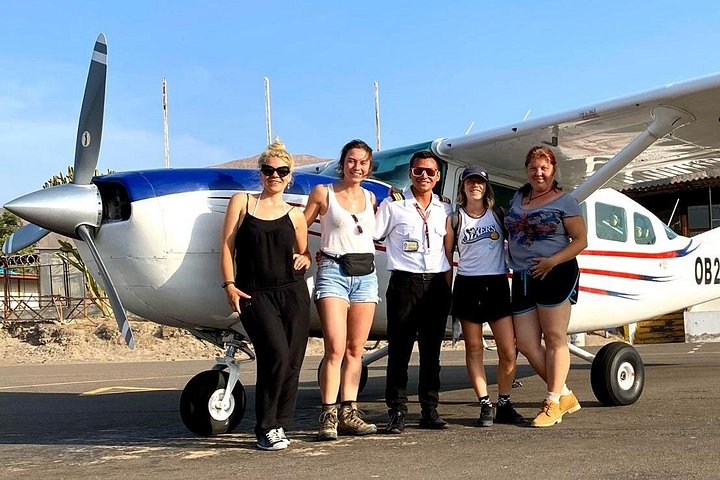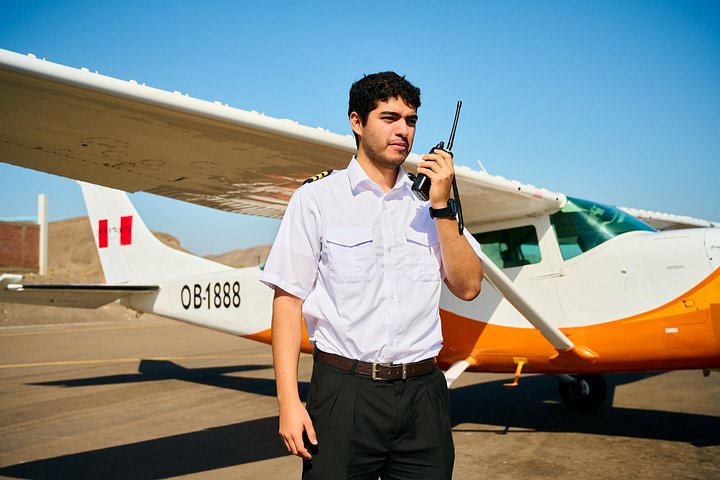
For travellers who are already in the town of Nazca, the direct flight is the quickest way to see the lines. A short transfer takes you to the airfield, where you board a light aircraft and fly for around thirty-five minutes over the main figures. The pilot guides you through the best-known shapes, including the hummingbird, the condor, the monkey and the spider, and tilts the wing to let each side view them. After landing, you can return to your hotel or continue your journey.
Seeing the lines from the ground is impossible, because the figures are too large and the lines too shallow. From above, though, they emerge as clear shapes against the pale plain. Straight lines run for kilometres, trapezoids and spirals stretch across the desert, and the animals are drawn in a single continuous line. The effect is humbling.
If you are prone to motion sickness, prepare in advance, and arrive early because flights depend on wind and visibility. Morning tends to be best. Fees at the airfield may be separate, and you may be asked to show your passport. The flight pairs well with a visit to the Maria Reiche museum or the lookout tower, and with a trip to Chauchilla Cemetery or the Cantalloc aqueducts. Nazca has hotels for an overnight stay, which saves the long drive from other regions.
The advantage of flying from Nazca is time. Without long ground transfers, you can combine the flight with other sights in the same day, or even take an early flight and move on to your next destination by midday. Many hotels in town arrange the airfield transfer and even early breakfast boxes. The flight itself follows a set route over the main figures, and pilots generally name each one as they come into view. The turns are tighter than a commercial plane, so be ready for the sensation.
What you see depends on the light and the weather. Clear mornings give sharp outlines, while haze can soften the shapes. The flat plain makes the lines easy to see once you know where to look, and the pilot will often point the wing toward each figure. After you land, consider visiting the María Reiche museum, which tells the story of the scholar who devoted her life to studying and protecting the lines.
The lookout tower beside the highway offers a ground-level view of a few figures. Fees at the airfield and the lookout may be charged separately. Carry small notes for tips and snacks. Sunglasses help with glare, and a hat is useful on the ground.
Compare it with a flight from Ica. The Nazca departure is shorter overall and often cheaper, but you must get to Nazca first, which may involve a bus journey or an overnight stay. Many travellers on the bus route between Lima and Arequipa stop in Nazca for a morning flight and continue in the afternoon.
Hotels in Nazca keep luggage for guests, so you can fly with only a small bag. Choose an operator with a good safety record and modern aircraft, and avoid touts who approach you at the bus station. Ask whether the price includes airfield taxes and what happens in case of delay.
What to expect
The experience
A light aircraft flight of about 35 minutes over the Nazca geoglyphs, starting from the town airfield.
Best time
Morning for calm air and clear visibility.
How long
About 35 minutes in the air.
Tips
Passport, cash for any airfield fees and light food beforehand.
Quick picks
- Best for
- Visitors already in Nazca.
- Families
- Older children comfortable in small planes.
- Couples
- Couples seeking a highlight.
- Pair with
- Chauchilla Cemetery, aqueducts or a museum.
- Time needed
- Allow half a morning.
Good questions
How long is the flight?+
About 35 minutes.
Do I need my passport?+
Usually yes for the flight manifest.
Are fees extra?+
Sometimes. Check at booking.
When is it clearest?+
Morning.
Can I see everything?+
You will see the main figures. The pilot picks the route.