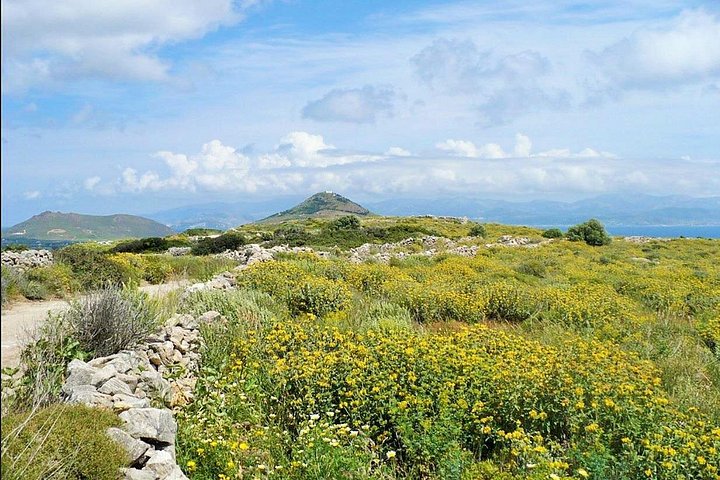
Paros was famous in antiquity for its marble, and the place to see where it came from is Marathi, on the slopes of a hill a few kilometres inland from Parikia. The stone quarried here, known as Parian marble, is translucent and fine-grained, and sculptors prized it for the way it let light penetrate the surface and give skin and drapery a soft glow. According to the national tourism organisation, the marble was used for celebrated works such as the Venus de Milo and the Hermes of Praxiteles, and Paros became known across the Greek world as a centre of sculpture. Quarrying continued through Roman and Venetian times, and stone from here helped build monuments across the Mediterranean. At Marathi you can see the historic galleries, which were worked underground by miners following the best seams. The sunken entrances, tunnels and chambers show how the stone was cut and carried out, and remains of ramps and carved inscriptions hint at the lives of the workers. The setting is quiet and rural, among scrub and olive trees, with the sea visible in the distance. It is a short and unusual stop that connects the island's landscape with its art.
Visiting requires some care. The galleries are old and uneven, light is limited inside, and access arrangements and opening hours have varied over the years, so check locally before you go and expect to need a torch if you plan to enter any tunnel. Wear sturdy shoes, because the ground is rocky and can be slippery. Do not enter unstable areas or climb over barriers, and keep children close. In summer the site is hot and shadeless, so go in the morning.
The quarries make the most sense as part of a wider story about marble on Paros. You can see the same stone in the paved lanes of Lefkes, the columns of the church in Parikia, the walls of the kastro and the windows of village houses. The Archaeological Museum of Paros, a short drive away, displays sculpture carved from Parian marble and provides background on ancient workshops. Pair the quarries with a visit to the museum and a walk through the old town for a morning that links source, craft and monument.
It is also possible to reach Marathi on a guided island tour or by car. Roads are narrow and signs can be sparse, so use a map and allow extra time. Photographers will enjoy the textures of the quarry faces and the light on the stone, especially early or late in the day. Expect to spend an hour or so on site, plus travel. The site suits curious adults, older children and anyone interested in geology or art history, and is less suitable for people with limited mobility.
What to expect
The experience
A self-guided visit to the old quarry area with sunken galleries and spoil heaps; check access and bring a torch.
Best time
Morning, when it is cooler and the light is good.
How long
About an hour plus travel.
Tips
Wear sturdy shoes, bring a torch and water, and check access before you go.
Quick picks
- Best for
- Art lovers, geology fans and curious travellers.
- Families
- Possible with older children who can follow safety rules; keep them close.
- Couples
- An unusual, quiet stop away from the crowds.
- Pair with
- The Archaeological Museum and Parikia old town.
- Time needed
- About an hour.
Good questions
What is Parian marble?+
A fine, translucent white marble prized by ancient sculptors, quarried on Paros for centuries.
Is Marathi open to visitors?+
Access has varied, so check locally for current arrangements.
Do I need a torch?+
Yes, if you plan to look inside any gallery, though caution is essential.
How far is it from Parikia?+
A few kilometres inland, reachable by car, taxi or on a tour.
What else can I see nearby?+
The Archaeological Museum, Lefkes and the old town of Parikia.