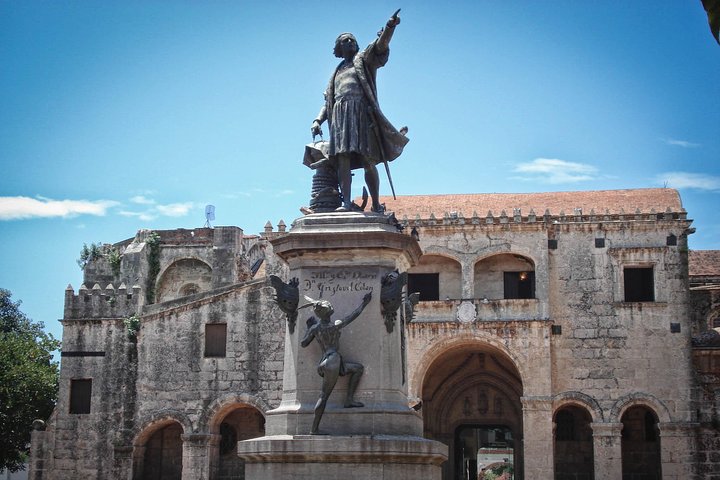
Altos de Chavón looks like a medieval village that has stood above the river for five hundred years, but it was built in the 1970s as an artists’ colony and cultural center on the grounds of the Casa de Campo resort near La Romana. Its designers copied the look of a 16th-century Mediterranean hill town, and the result is surprisingly convincing: cobblestone streets, coral-stone walls, arched doorways, wrought-iron lanterns, bougainvillea and a plaza with a small stone church. Behind it, the ground falls away to a deep green gorge and the winding Chavón River, with a view that is as good as any in the east of the country. For visitors who have spent a few days on the beach, it is a pleasant change of scene and an easy cultural outing. The village has several sights to fill a visit. The Church of Saint Stanislaus is the centerpiece of the plaza and is a popular spot for weddings. A short walk leads to the Greco-Roman style amphitheater, which seats thousands and has hosted international concerts since the early 1980s. There is a small archaeological museum with pre-Columbian pottery and objects from the Taíno people, plus galleries, craft workshops and an art school that gives the village its creative character. Shops sell local art, jewelry, cigars, rum and coffee, and a handful of restaurants serve lunch with a river view.
How to visit
Altos de Chavón is in the La Romana area, roughly an hour and a quarter to an hour and a half by road from Bávaro depending on traffic, so a half-day tour from the resorts generally means a morning or early afternoon departure and a return before dinner. The tour is usually a guided visit with transport, which saves arranging a driver, and some itineraries add a nearby stop such as a cave or a rum or cigar workshop. Check the inclusions when you book.
What to expect
The village is compact and mostly flat, so you can see the main sights in about two hours at an easy pace, but the cobblestones are uneven and the walk to the amphitheater has a few steps, so wear comfortable shoes. It gets hot in the middle of the day, and there is limited shade in the open plaza. Some galleries and the museum keep their own opening hours, which can vary, so ask your guide what is open on the day.
Making the most of it
Go in the morning when the light is soft and the plaza is quiet, and take time at the viewpoint above the river. Bring a hat, water and a little cash for small purchases. If you are building a week, this makes a good companion to a Catalina Island day: one outing is about the sea and the other about the Dominican Republic’s creative side. Dress modestly if you plan to step inside the church, and keep voices low during any service.
Good to know
Because the village sits within a private resort estate, access arrangements and any entrance charges can differ by visit, which is another reason to take a tour that handles them for you. Shops tend to close in the late afternoon, so a morning or early afternoon visit gives you the most to see. Photography is welcome in the open spaces, though staff may ask you to put cameras away in some galleries.
What to expect
The experience
A guided half-day outing by road to a hilltop artists’ village near La Romana, with time in the plaza, church, amphitheater and viewpoints.
Best time
Mornings, when the light is soft and the plaza is quiet, in any season.
How long
About two hours in the village, with the rest of the half day spent on the road.
Tips
Wear comfortable shoes for the cobblestones, bring a hat and water, and ask the guide which galleries and the museum are open that day.
Quick picks
- Best for
- Travelers who want a taste of culture and views between beach days.
- Families
- Easy for most ages, though the cobblestones and midday heat can tire small children and strollers struggle.
- Couples
- Romantic stone lanes, a river view and a good setting for photos.
- Pair with
- Catalina Island on another day, or a long lunch back at the resort.
- Time needed
- Half a day.
Good questions
Is Altos de Chavón a real medieval village?+
No. It was built in the 1970s to look like a 16th-century Mediterranean village, and it works today as an artists’ colony, school and cultural center.
How far is Altos de Chavón from Punta Cana?+
It is in the La Romana area, roughly an hour and a quarter to an hour and a half by road from Bávaro, depending on traffic.
How long do I need at Altos de Chavón?+
About two hours covers the plaza, church, amphitheater, museum and viewpoint at a relaxed pace. A half-day tour adds the transfers.
Can I go into the church and the amphitheater?+
The church is open to visitors outside services, so dress modestly and keep quiet. The amphitheater is usually viewable from the grounds, though access can change on concert days.
What is there to buy at Altos de Chavón?+
The shops and galleries sell local art, crafts, jewelry, rum, coffee and cigars. Carry a little cash for small purchases.