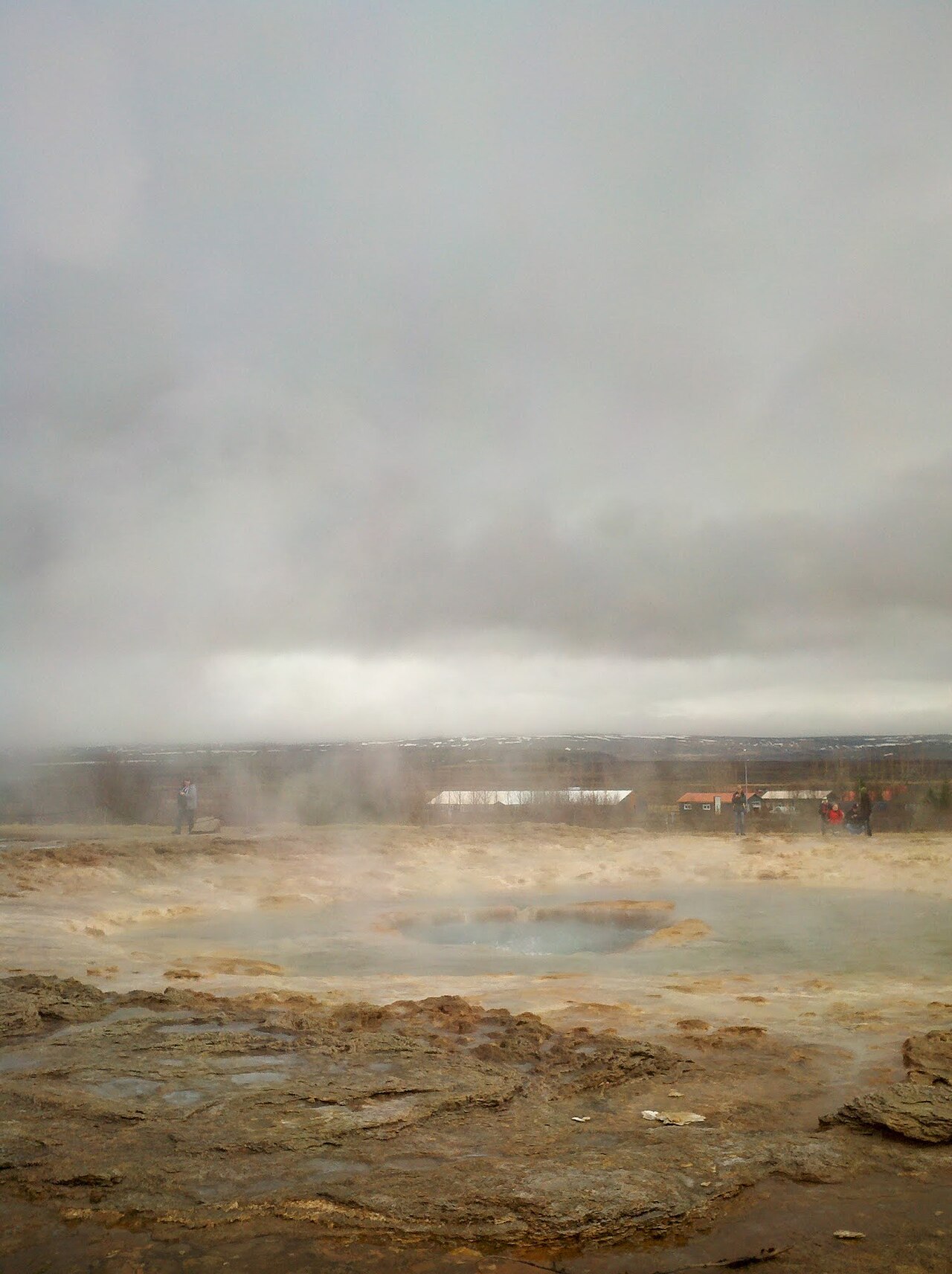
Every geyser on earth is named after this field's sleeping giant: Geysir ("the gusher"), which once threw water 500 feet and now rests between rare awakenings. Its understudy stole the show generations ago — Strokkur ("the churn") erupts every five to ten minutes, all day, every day: the pool's surface swells into the famous turquoise dome, holds a heartbeat, and launches 60-100 feet while a hundred cameras fire. The surrounding Haukadalur field steams with hot springs and fumaroles (Blesi's twin pools, Litli Geysir's burble) along a short gravel loop; the whole site is free (paid parking), open always, and sits mid-Golden Circle between Thingvellir and Gullfoss. Stand downwind of the rope line at your own laundering risk — the wind decides where Strokkur's column lands, and it's warm, not scalding, by the time it finds you. Mostly.
Haukadalur's geothermal field has boiled since at least 1294's earthquakes, and its great vent entered world literature early enough to become the generic: "geyser" is Icelandic's most successful export after "saga." The Great Geysir itself performed for centuries — 1845 measurements recorded 170-meter columns — before dormancy settled in; earthquakes occasionally rouse it (2000's shook loose a few seasons of eruptions), and the pool still steams expectantly, a celebrity in retirement whose name does the working.
Strokkur carries the franchise with industrial reliability: its plumbing recharges in five-to-ten-minute cycles, and the eruption sequence is the field's genius — the pool drains subtly, surges, then domes into the glassy turquoise bubble (the photograph that fills Iceland's marketing) a half-second before the column tears through, 20-30 meters typically, occasionally double in mood. The etiquette of the rope line is self-teaching: watch two eruptions before raising the camera (the dome is learnable), note the wind, and accept that the downwind crowd's shrieks are part of the soundtrack — the fallout lands warm. The wider loop (30-40 minutes, gravel, gentle) strings Blesi's paired springs — one boiling-clear, one silica-blue and cooler — Konungshver, Litli Geysir's mud-chuckle, and the hillside viewpoint that frames the whole steaming shelf against Langjökull's distant white.
Practicals
Free entry, paid parking at the large lot, open around the clock and year (winter's steam-on-snow is the field at its most theatrical; summer's evening light empties the coaches); the visitor complex across the road runs the cafeteria-and-wool-shop layer (the Geysir Center's lamb soup is Circle tradition); and the site anchors the loop's middle — 40 minutes from Thingvellir, 10 from Gullfoss, which is why every itinerary threads it. Boardwalk discipline is the usual Icelandic covenant: the crusts are thin, the water is boiling, and the ropes are the entire safety system — Iceland trusts you, memorably.
What to expect
The experience
The original geyser's steaming field — Strokkur erupting every 5-10 minutes through its turquoise dome, hot-spring loop past Blesi and the dormant Great Geysir, free and open always, with the Geysir Center's services across the road.
Best time
Any hour (Strokkur doesn't rest) — early morning and evening dodge the coach wave; winter steam-on-snow is the theatrical maximum.
How long
Forty-five minutes for several eruptions and the loop; linger for the dome shot you'll inevitably retry.
Tips
Watch two eruptions before photographing — the pre-launch dome is learnable and it's the picture. Check the wind before choosing your rope-line spot; downwind gets rinsed warm. Walk the full upper loop; most coaches don't. Lamb soup across the road is Circle tradition.
Quick picks
- Best for
- The Circle's crowd-pleaser — a guaranteed-eruption spectacle on a five-minute metronome.
- Families
- Kids get an eruption before boredom exists; the countdown game runs itself.
- Couples
- Evening light, thinned crowds, and the dome in silhouette — stay for ten eruptions; they're free.
- Pair with
- Gullfoss ten minutes on — the Circle's crescendo pairing.
- Time needed
- An hour.
Good questions
Does the original Geysir still erupt?+
Rarely — the namesake rests between earthquake-roused seasons, steaming quietly. Strokkur, fifty meters away, covers the franchise every five to ten minutes.
How often and how high is Strokkur?+
Every 5-10 minutes, typically 20-30 meters (60-100 feet), with occasional double-pumps. The turquoise dome a half-second before launch is the famous frame.
Is it free?+
The site, yes — around the clock, all year. Parking is paid, and the Geysir Center across the road handles food, facilities, and wool-sweater commerce.
Will we get wet?+
Downwind of the rope line during a big launch, possibly — the fallout arrives warm, not scalding. Check the steam's drift and choose your side accordingly.
How long should we stay?+
Three eruptions minimum (ten minutes buys them), plus the 30-minute spring loop most coaches skip — Blesi's twin pools and the hillside viewpoint reward it.