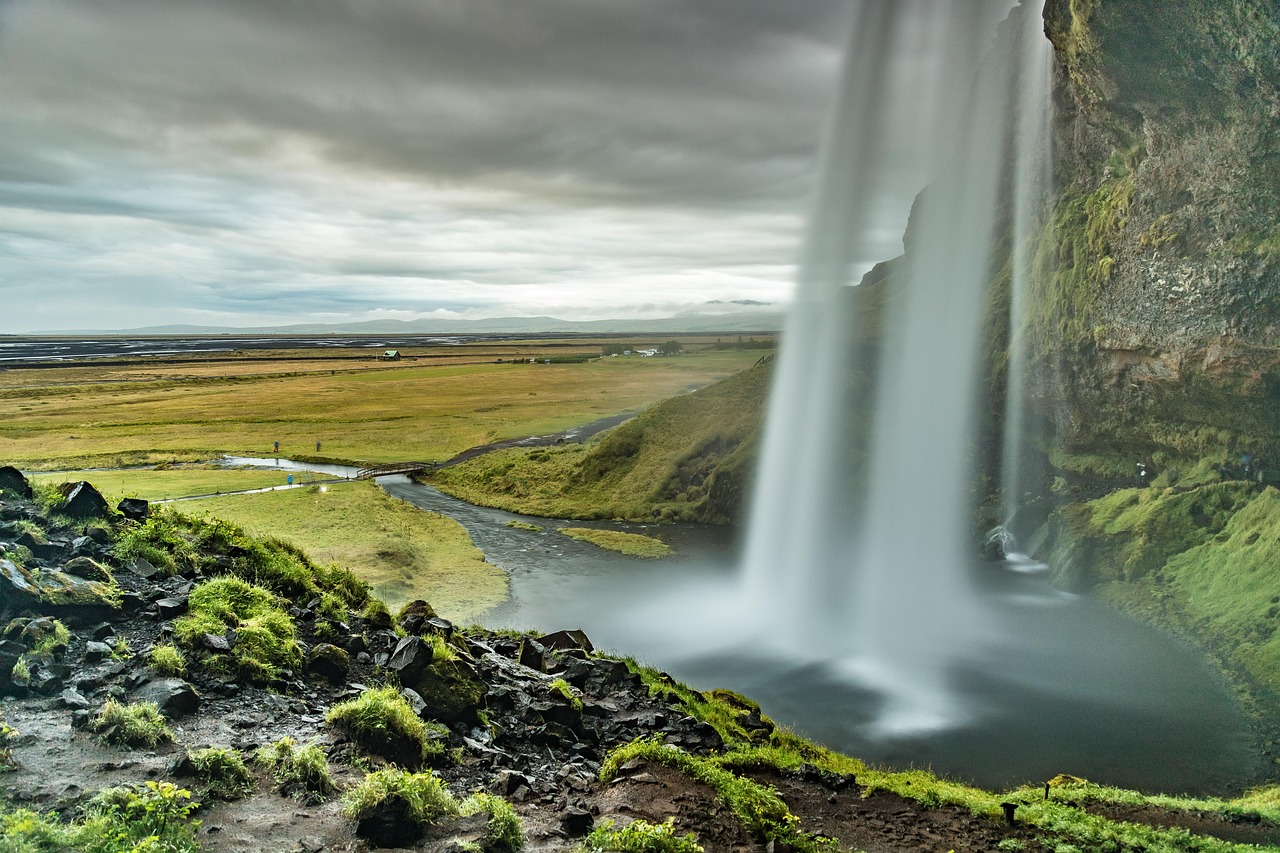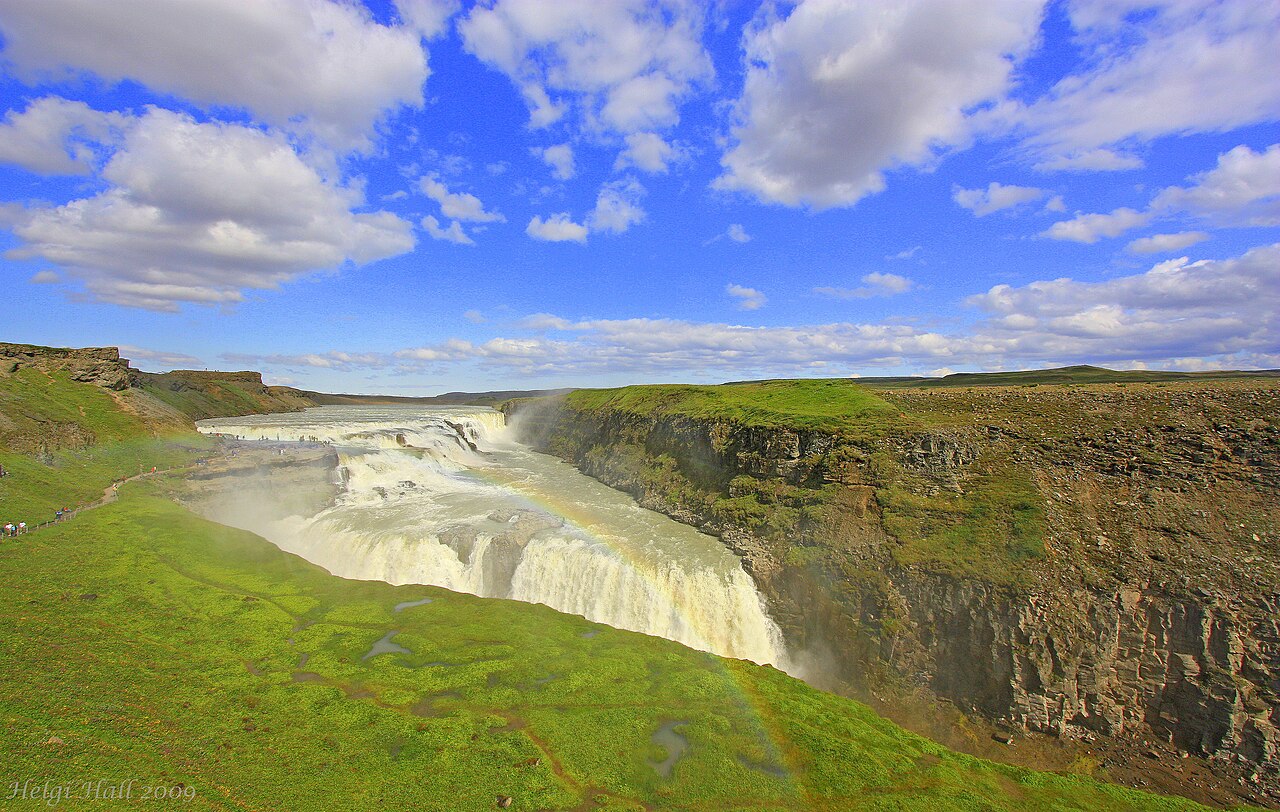
Gullfoss closes the Golden Circle with raw wattage: the glacial Hvítá river, wide and brown-gold with Langjökull's sediment, drops 105 feet in two offset stairsteps and vanishes into a slot canyon so abrupt the river seems to fall into the earth. Paths serve both registers — the upper rim's full-panorama overlooks and the lower trail onto the spray-soaked promontory between the tiers, where the falls' power becomes weather (waterproofs earn their packing). Sunny days hang rainbows in the mist; winter armors the cliffs in blue ice around the still-roaring water. Free, open always, cafe and facilities above (the lamb soup rivalry with Geysir is real); the memorial on the rim honors Sigríður Tómasdóttir, the farmer's daughter whose 1920s crusade against damming the falls made her Iceland's first environmentalist hero.
The falls work in two movements
The Hvítá — glacier-fed, carrying Langjökull's gold-brown rock flour that names the "Golden Falls" — first spreads across a broad 36-foot cascade angled one way, then pivots and plunges 69 feet the other, into a crevice barely 60 feet wide running perpendicular to the river's line. From the upper overlooks the geometry reads as sleight of hand — a river swallowed mid-plain — and the canyon below runs a mile and a half of churned white. Flow swells to triple in summer melt; winter strangles it in ice without silencing it.
The paths grade the encounter. The upper circuit (paved, step-free to the main overlooks) delivers the postcard panoramas and the winter-safe vantage; the lower stair-and-trail descends to the rock promontory alongside the first tier — inside the spray plume, where the falls stop being scenery and become force (waterproof layers transform this from endurance to joy; the path closes in icy conditions). Rainbow physics favor sunny mid-days; the crowds favor midday too — early morning and evening return the falls to something like privacy, and the midnight-sun hours gild the mist.
The human story earns its rim memorial: early-1900s investors schemed the falls into a hydroelectric concession, and Sigríður Tómasdóttir — daughter of the farmer at Brattholt who held the land — fought it for years, walking repeatedly the 75 miles to Reykjavik's courts, threatening (legend insists) to throw herself into the falls if the dam rose. The concession lapsed, the falls passed eventually to the nation, and Sigríður became the patron saint of Icelandic conservation; her stone profile watches the gorge she kept. Practicals: free, open always, big paid-free parking (upper and lower lots), the Gullfoss Kaffi's soup-and-sweaters above, ten minutes from Geysir — the Circle's natural crescendo, 90 minutes' drive back to the city or onward via Kerið crater's red bowl (small fee, worth the stop) on the southern return.
What to expect
The experience
A two-tier glacial waterfall vanishing into a slot canyon — upper panorama paths (step-free to the mains) and the lower spray-zone promontory trail, free and open always, with cafe and facilities above.
Best time
Sunny middays hang the rainbows; early morning and evening thin the coaches; winter's ice-armored version is its own spectacle (lower path closes when icy).
How long
An hour covers both levels and the mist recovery.
Tips
Pack the waterproof shell for the lower promontory — inside the plume is the real encounter. Mind path closures in winter; the upper overlooks carry the day regardless. Find Sigríður's memorial on the rim and take the story home. The soup upstairs closes the Circle properly.
Quick picks
- Best for
- The Circle's crescendo — power after Thingvellir's poise and Strokkur's theater.
- Families
- The upper paths are safe and dramatic; the spray zone delights exactly the kids you'd predict.
- Couples
- Evening gold on the mist after the coaches leave — the Circle's quietest hour.
- Pair with
- Geysir ten minutes back, or Kerið crater's red bowl on the southern return route.
- Time needed
- One hour.
Good questions
Why "Golden Falls"?+
The Hvítá runs gold-brown with glacial sediment, and sunlit mist gilds the gorge — plus the folk tale of a farmer's gold thrown into the falls rather than inherited. The name predates the tourism.
Can we get close?+
The lower trail's promontory stands beside the first tier inside the spray — viscerally close, soaking, and the reason waterproofs made the packing list. The upper overlooks give the full geometry dry.
Is it open in winter?+
Always — ice-armored and roaring, with the upper paths maintained; the lower trail closes in icy spells. Crampon-grade days are real; the cafe thaws all comers.
Who was Sigríður?+
Sigríður Tómasdóttir, the Brattholt farmer's daughter who fought the falls' damming in the 1920s — walking to Reykjavik's courts repeatedly and, legend holds, threatening to join the falls if they rose. Her memorial watches from the rim she saved.
What does it cost?+
Nothing — falls, paths, and parking run free; the cafe and wool shop above handle the voluntary spending.