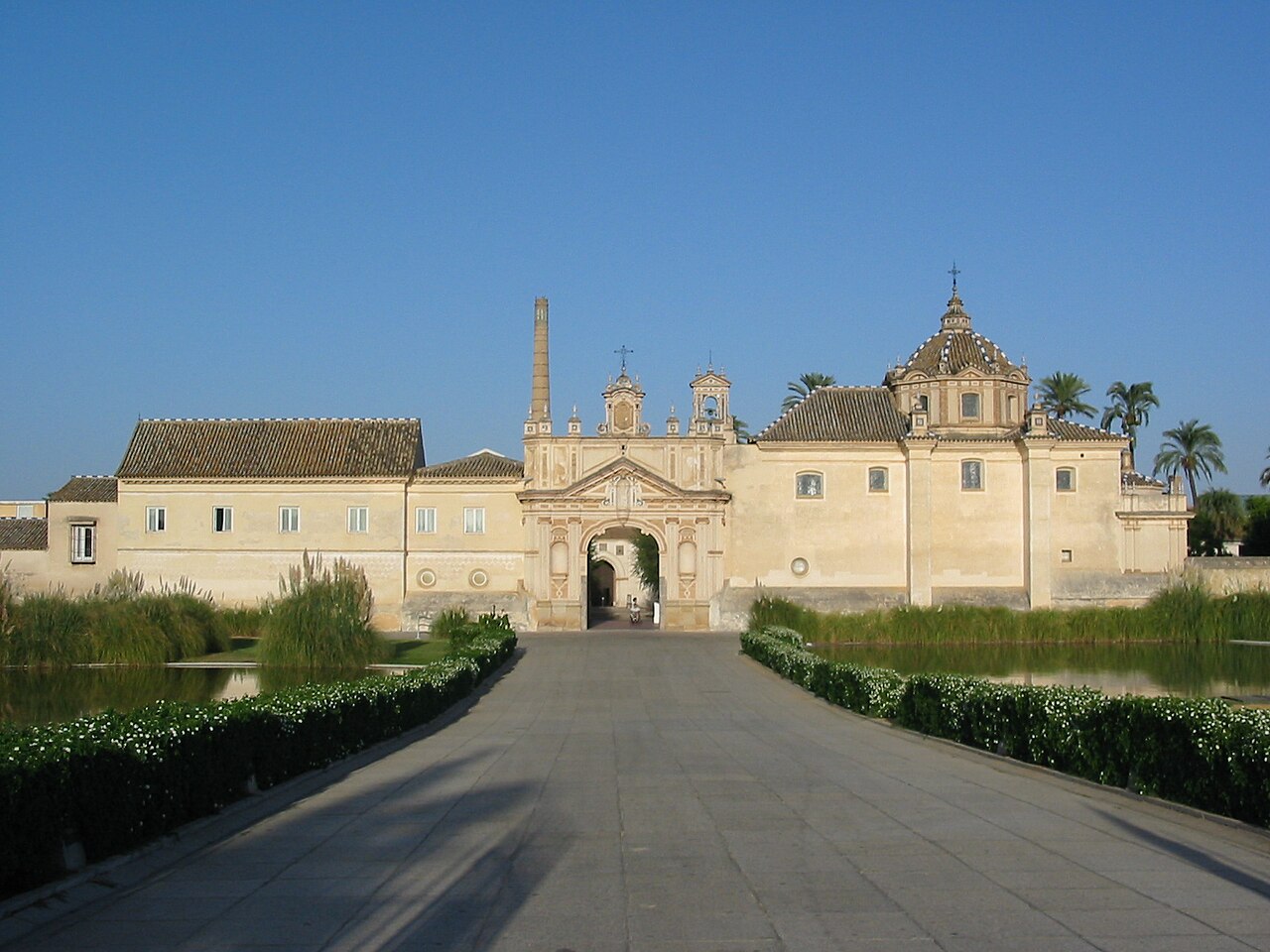
The Monasterio de Santa María de las Cuevas, better known as La Cartuja, has had one of the strangest histories of any building in Seville. It was founded at the end of the fourteenth century on the island across the river from the old town, where, legend said, an image of the Virgin had been found in a cave used by potters, and it grew into a rich and powerful Carthusian monastery. Christopher Columbus had close ties with its monks, prepared his later voyages here, and after his death his remains rested in the monastery's chapel for some thirty years before their long journey to the Caribbean and, eventually, back to Seville's Cathedral. During the Napoleonic invasion the monastery was occupied by French troops, and after the monks were expelled in the 1830s an English merchant, Charles Pickman, bought it and turned it into a ceramics factory, the famous La Cartuja de Sevilla, which produced fine tableware for well over a century. He built tall brick bottle kilns and chimneys among the cloisters and chapels, and the result is an extraordinary landscape in which Gothic and Mudéjar monastery buildings stand side by side with industrial kilns. The factory moved out in the twentieth century, the buildings were restored for the 1992 Expo, and since then the complex has housed the Centro Andaluz de Arte Contemporáneo, the CAAC, Andalusia's museum of contemporary art. Its collection covers art from the mid-twentieth century to the present, with special attention to Andalusian artists, and includes works by figures such as Luis Gordillo, Pablo Palazuelo, Candida Höfer, Rebecca Horn, Joseph Kosuth and Louise Bourgeois, shown in thematic exhibitions alongside temporary shows. Many visitors come as much for the buildings as for the art: the church, the chapter house, the refectory with its tiles, the cloisters and the orchards, with the kilns rising above.
Visiting: the CAAC is run by the Junta de Andalucía and is open from Tuesday to Sunday, closed on Mondays, with shorter hours on Sundays. The entry fee is very low, and there are free-entry times each week; check the official website for current hours and exhibitions. Allow one and a half to two hours to see the monastery buildings, the kilns and a selection of the exhibitions. The grounds include gardens and an orchard, and in summer the centre often hosts open-air concerts and cinema in the evenings, a pleasant way to spend a warm night. There is a café on site.
Why go: the Cartuja is the best antidote in Seville to monument fatigue. It is spacious, calm and almost never crowded, and the combination of medieval monastery, Columbus history, industrial heritage and contemporary art is unlike anything else in the city. Contemporary art lovers will enjoy the collection and exhibitions, but even visitors with no special interest in modern art usually find the setting memorable, and the bottle kilns make wonderful photographs.
Getting there: the monastery is on the island of La Cartuja, on the west bank of the river, about twenty-five to thirty minutes on foot from the Alameda de Hércules or the Plaza de Armas, across the Cachorro or Barqueta bridges, or a short bus or taxi ride from the centre. On the same island are Isla Mágica, the futuristic pavilions and bridges of the 1992 Expo and the Torre Sevilla. Combine it with a walk along the river and lunch in Triana, at the southern end of the island, or with the Alameda de Hércules for an alternative, local-feeling day in Seville. Bring a hat in summer, as the walk across the island is exposed.
What to expect
The experience
A visit to a Gothic-Mudéjar monastery turned ceramics factory, with bottle kilns among the cloisters and Andalusia's contemporary art museum inside.
Best time
Weekday mornings or a free-entry time; summer evenings for outdoor events. Closed on Mondays.
How long
An hour and a half to two hours.
Tips
Check the free-entry times. Look for the Pickman kilns and the refectory tiles. Combine with Triana or the Alameda de Hércules.
Quick picks
- Best for
- Travellers tired of crowds who enjoy history, architecture and contemporary art.
- Families
- Spacious grounds and odd kilns interest older children; the art is hit or miss for younger ones.
- Couples
- A calm, photogenic visit, with summer evening concerts in the gardens.
- Pair with
- Triana, the Alameda de Hércules and Isla Mágica on the same island.
- Time needed
- Two hours.
Good questions
What is the connection with Columbus?+
Columbus had close ties with the monastery's monks, and after his death his remains rested in its chapel for some thirty years before being moved.
Why are there kilns in a monastery?+
After the monks left in the nineteenth century, Charles Pickman turned the buildings into the La Cartuja de Sevilla ceramics factory, which built bottle kilns and chimneys among the cloisters.
What art is in the CAAC?+
Contemporary art from the mid-twentieth century to the present, with special attention to Andalusian artists and international names such as Louise Bourgeois and Rebecca Horn.
How much does it cost?+
Very little, with free-entry times each week. Check the official website for current hours.
How do I get there?+
Walk about twenty-five minutes from the Alameda de Hércules or the Plaza de Armas across the river, or take a bus or taxi to the island of La Cartuja.