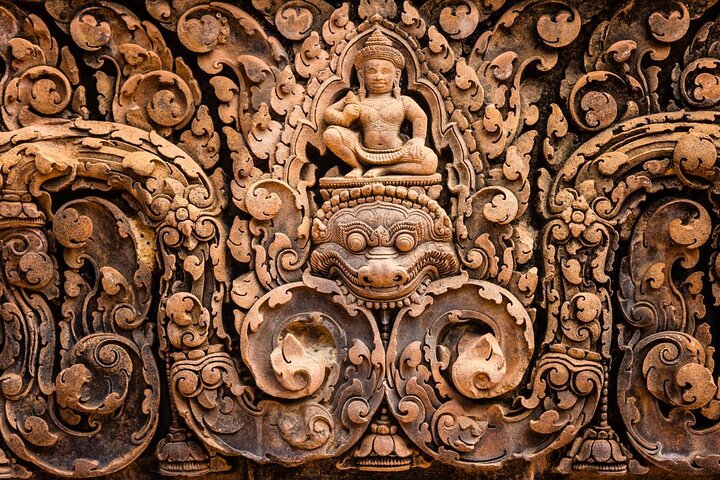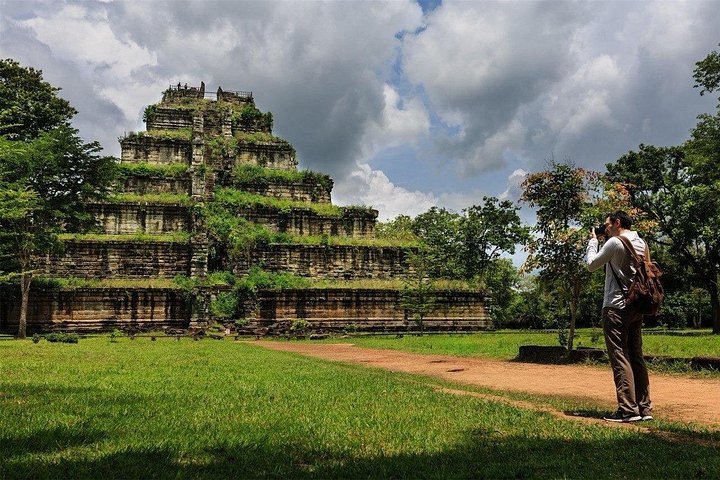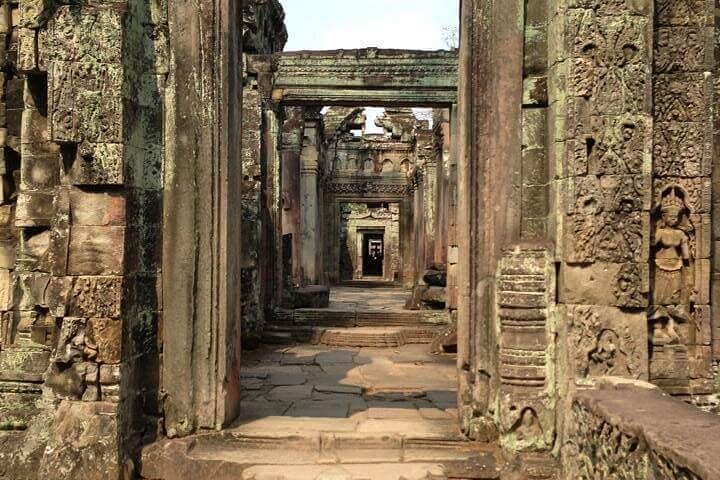
Preah Khan is the temple for visitors who like their Angkor atmospheric, a little tangled and not quite tidied up. King Jayavarman VII founded it in the late twelfth century on the site of a victory over the Chams, and its name means Sacred Sword. It served as a Buddhist monastery, a university and a royal temple all at once, and inscriptions suggest that thousands of people lived and worked in and around it. Unlike Angkor Wat, which climbs towards a single summit, Preah Khan spreads out along an east to west axis in a series of rectangular enclosures, each entered through a gate with a cross-shaped hall, and the walk through them is a long, gently mysterious procession of corridors, courtyards and carved lintels. Trees have claimed several doorways, and fallen blocks lie where they dropped, but the structure is stable enough that you can wander freely and look for apsaras, Buddha niches and the odd two-storey pavilion with round columns that looks almost Greek. A few hundred metres away, Neak Pean sits in the middle of a square artificial pool and is reached by a wooden walkway across a flooded landscape of reeds and lotus. The little shrine, wrapped by the coils of two serpents, was designed as a place of healing and purification, and the four smaller pools around its central basin were once fed through carved stone spouts.
How to visit
Preah Khan lies north of Angkor Thom, on the outer part of the park known as the Grand Circuit, about fifteen minutes by tuk-tuk from the Bayon. Neak Pean is a little further along the same road. Both need an Angkor Pass, which is not included in the tour and is sold only by Angkor Enterprise, online or at the ticket office on Road 60.
Check opening hours with your driver or guide, but expect to enter in the morning or mid-afternoon, when the light slants through the corridors and the heat is easier to bear. Most visitors need around an hour and a half at Preah Khan and thirty to forty minutes at Neak Pean.
The tour
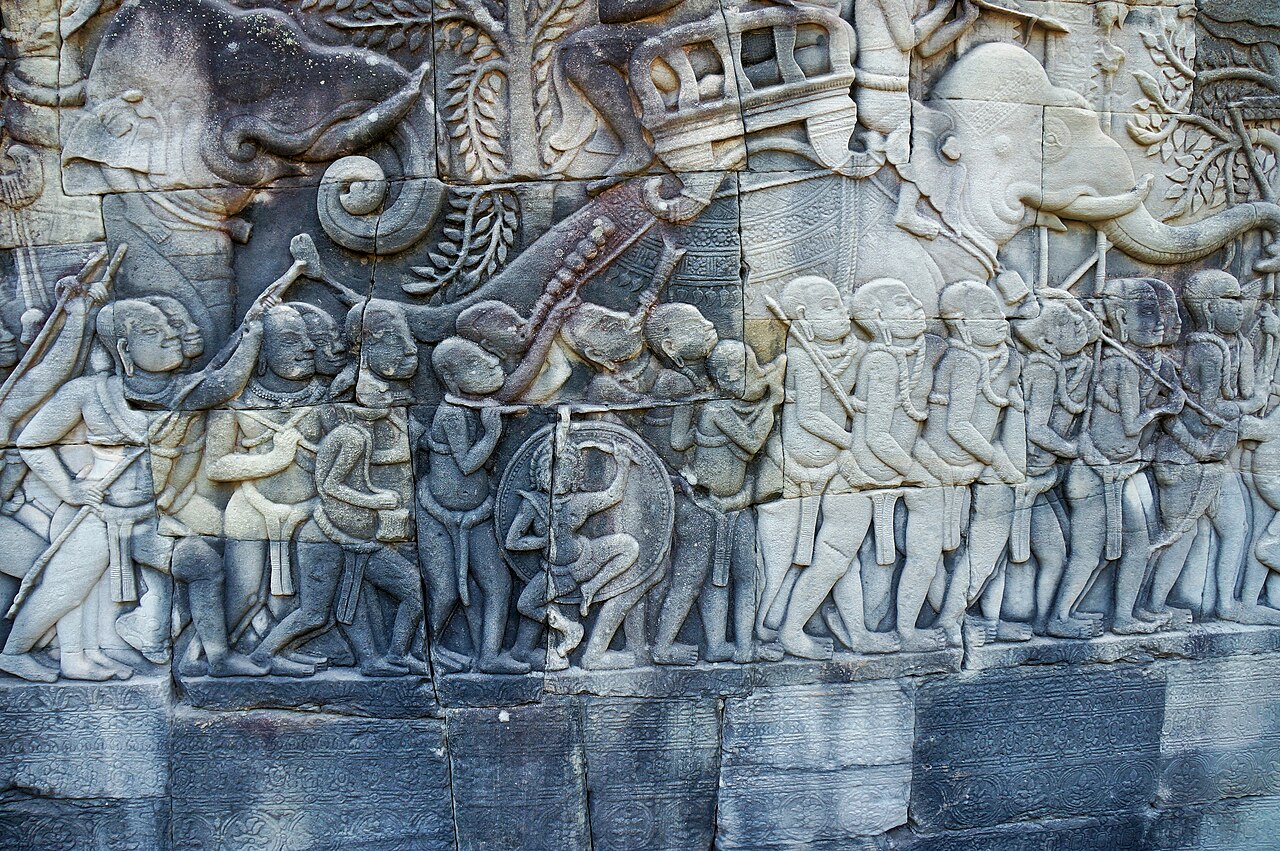
The half-day tour collects you from your hotel, drives the Grand Circuit route and gives you time with a guide at each stop. A guide matters here, because Preah Khan has no single headline monument and its charm lies in details that are easy to walk past: the guardian figures on the causeway, the Hindu and Buddhist carvings that were chiselled over each other as the religion of the court changed, the stone-vaulted Hall of Dancers and the strange Greek-looking pavilion. Confirm pickup times, group size and inclusions when booking, as these vary by operator.
Making the most of it
Walk Preah Khan from east to west, as the original builders intended, then come back by the northern side to avoid the tour groups heading the other way. Carry a small torch for the dark side chambers, wear shoes with grip for the uneven stones and keep to the marked routes where restoration is under way. Bring insect repellent for the damp, wooded sections and water for both sites, since there is little shade on the walkway to Neak Pean.
If your pass covers more than one day, this is a good half-day to pair with Ta Prohm, because the two sites share the same jungle-and-stone mood and make a pleasing contrast with the grand set pieces of Angkor Wat and the Bayon.
What to expect
The experience
A guided half-day drive around the Grand Circuit, walking the long corridors of Preah Khan and crossing the walkway to the island shrine of Neak Pean.
Best time
Early morning or late afternoon, when the light is soft inside the corridors; the dry months from November to February are the most comfortable.
How long
About four hours with transport, including roughly an hour and a half at Preah Khan and half an hour at Neak Pean.
Tips
Carry your Angkor Pass, a small torch, water and insect repellent, and wear shoes with grip for the uneven stones.
Quick picks
- Best for
- Travellers who enjoy atmospheric ruins with fewer crowds, photographers and anyone on their second or third day at Angkor.
- Families
- Children usually enjoy the long corridors and the walkway across the pool at Neak Pean; keep an eye on them on the loose stones.
- Couples
- The late-afternoon light along the corridors is quiet and romantic, with far fewer people than at the headline temples.
- Pair with
- Ta Prohm for another jungle temple, or the Bayon and Angkor Thom on the same day.
- Time needed
- Half a day, or a full day if combined with other Grand Circuit temples.
Good questions
What is Preah Khan known for?+
Preah Khan is a large Buddhist monastery-temple founded by Jayavarman VII in the late twelfth century. It is known for its long vaulted corridors, carved doorways wrapped by tree roots and a relaxed, partly unrestored atmosphere.
What is Neak Pean?+
Neak Pean is a small island shrine in the middle of a restored square pool, reached by a wooden walkway. It was designed as a place of healing, with four smaller pools around a central basin and two serpents coiled around its base.
Do I need an Angkor Pass for Preah Khan and Neak Pean?+
Yes, both sites are inside the Angkor Archaeological Park, and the pass is not included in the tour price. Buy it online or at the Road 60 ticket office before you go.
How long should I spend at Preah Khan?+
Allow around an hour and a half to walk the full east to west axis without rushing. Add thirty to forty minutes for Neak Pean.
Can I visit Preah Khan and Neak Pean on the same day as Angkor Wat?+
Yes, many visitors do Angkor Wat at sunrise and then take the Grand Circuit in the afternoon, but it makes a long day in the heat. Splitting them across two days with a three-day pass is more relaxed.