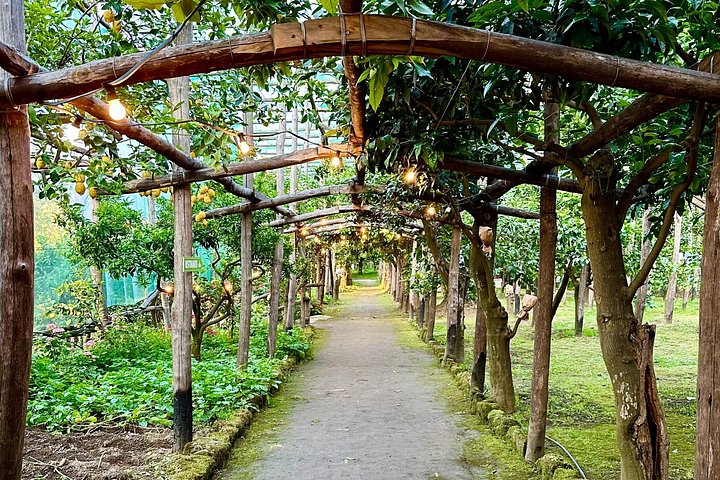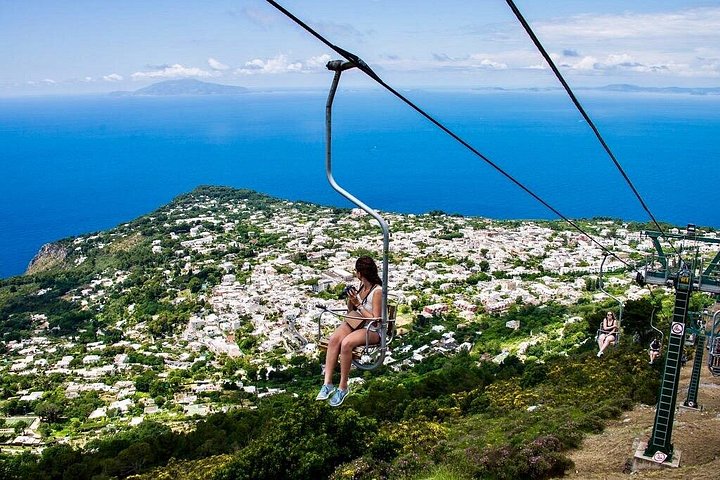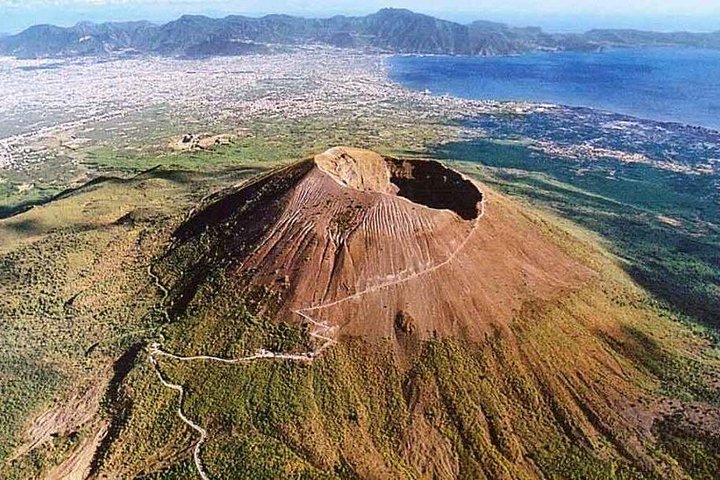
Vesuvius rises to about 1,280 metres above the Bay of Naples and is the only active volcano on the European mainland. Its eruption in AD 79 destroyed Pompeii and Herculaneum, and its most recent eruption was in 1944. Today the summit is part of a national park, and visitors reach it by road to a car park at roughly one thousand metres, followed by a steady uphill walk of about twenty to thirty minutes on a wide gravel path. At the top, a trail runs along part of the crater rim, where you can look down into the bowl, see steam rising from vents and take in a view that stretches across Naples, the islands of Capri and Ischia and the long arm of the Sorrento peninsula. The mountain is a landscape of black lava, pale ash and low, hardy plants, and the contrast with the green lemon terraces below is striking. Rangers and volcano guides explain the geology and the monitoring that keeps an eye on the crater. The experience is short, so Vesuvius is easily combined with another stop, such as Pompeii, a winery or a lunch.
The tour linked here is a Sorrento departure that names Mount Vesuvius in its title and includes the entry ticket and lunch. That is the simplest way to go, because the road up is narrow, parking is limited and public transport to the upper car park is awkward. Pick-ups are normally in the morning, and the return is in the afternoon, which leaves the evening free.
The weather decides almost everything. On a clear, still day the view from the rim is one of the best on the bay. In cloud the crater can be completely hidden, and in strong wind or after heavy rain the path may be closed for safety. Because the mountain is high, it is noticeably colder and windier than Sorrento, so bring layers, a windproof jacket and shoes with real grip, since the gravel is loose and steep in places.
A hat and sunglasses help in bright weather, and water is worth carrying. The path is not technical, but the slope and the altitude can tire children and anyone with limited mobility.
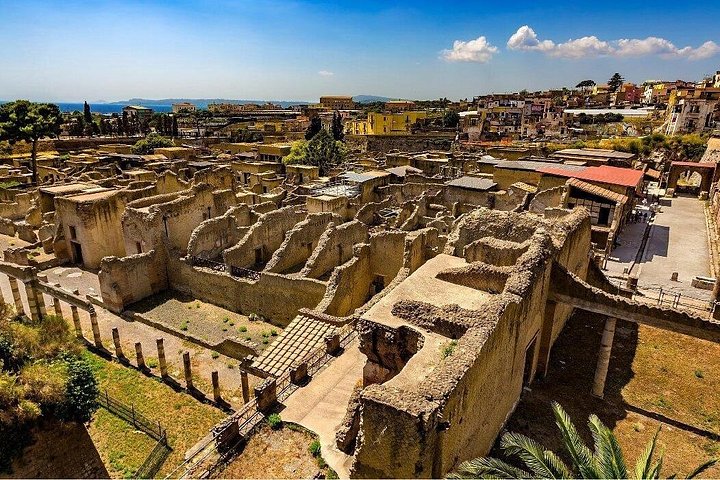
Think of Vesuvius as a view and a story rather than a hike. The walk is short, the rim loop is modest, and the rewards are the scale of the crater and the sight of the plain below. If the forecast is poor, move the visit to another day or swap it for Herculaneum, which is partly covered and works well in rain.
If the day is bright, combine the crater with Pompeii for a full picture of the eruption: the mountain that did it, and the city it buried. Travellers who enjoy photography should aim for the earliest slot, when the air is clearest and the car park is quiet.
Timing within the day also helps. Morning departures tend to catch clearer air, the car park fills up around midday, and the light softens in the afternoon, which suits photographs of the bay. If you are driving yourself, check in advance whether tickets or time slots are required, as access arrangements for the park can change. Take a small snack and a spare layer, and allow a few minutes at the rim simply to stand and look, because that is the moment the visit is really about.
What to expect
The experience
A drive up the mountain to the upper car park, a steady uphill walk on a gravel path to the crater rim, and a short loop along the edge with views over the bay.
Best time
A clear, still morning for the best visibility. Cloud and wind can hide the crater or close the path.
How long
About an hour and a half on the mountain, within a half-day or full-day tour.
Tips
Bring a windproof layer, shoes with grip, water and a hat, and keep the date flexible in case of weather.
Quick picks
- Best for
- Travellers who want the volcano behind the Pompeii story and a big view.
- Families
- Fine for school-age children who can manage a steady uphill walk, but cold and windy for the very young.
- Couples
- A dramatic viewpoint on a clear morning, with a long lunch to follow.
- Pair with
- Pompeii or Herculaneum, to complete the story of the eruption.
- Time needed
- Half a day to a full day depending on the tour.
Good questions
How hard is the walk to the crater?+
The path is wide gravel and not technical, taking about twenty to thirty minutes uphill from the car park. It is steady and can be tiring in cold or wind.
Can I see the crater in any weather?+
No. Cloud can hide it completely and strong wind or heavy rain can close the path. Choose a flexible booking and check the forecast.
Is Vesuvius still active?+
Yes, it is active and closely monitored. Its last eruption was in 1944, and steam still rises from vents on the crater rim.
What should I wear?+
Layers, a windproof jacket and sturdy shoes with grip. It is colder at the summit than in Sorrento.
Can I combine it with Pompeii?+
Yes. Many day tours pair the two, which makes a full day but gives a complete picture of the AD 79 eruption.